August 24th, 2011 by John Mandrola, M.D. in Health Tips
No Comments »

It may seem a little formal to say this, but I would like to start by stating my goals for today’s post:
- Introduce the concept of the athletic heart;
- Touch upon the notion of sudden death of the athlete;
- Explain what an ECG really is, and how it may help diagnose heart disease;
- Review a recent study about the common ECG variant seen in athletes…Early repolarization.
Intro: The adaptations of the human heart never cease to amaze me. Physical training transforms our hearts into high performance engines. Repeated sessions of interval training, combined with longer aerobic efforts, and sprinkled with adequate rest maximize our ability to keep pressure on the pedals, or run the sixth mile of the 10k at the same pace as the first, or for you swimmers, to keep getting back to the wall on the 1:15 mark.
Fitness also brings measurable changes in things we can observe. Read more »
*This blog post was originally published at Dr John M*
August 19th, 2011 by John Mandrola, M.D. in Health Tips
No Comments »
The “normal” number of heartbeats per minute is very much a frequently asked question. People, especially medical people, like well-defined lows and highs. Parameters which can be assigned an ‘L’ or ‘H’ makes life easier.

2009 National Championship Masters (45-49) Road Race
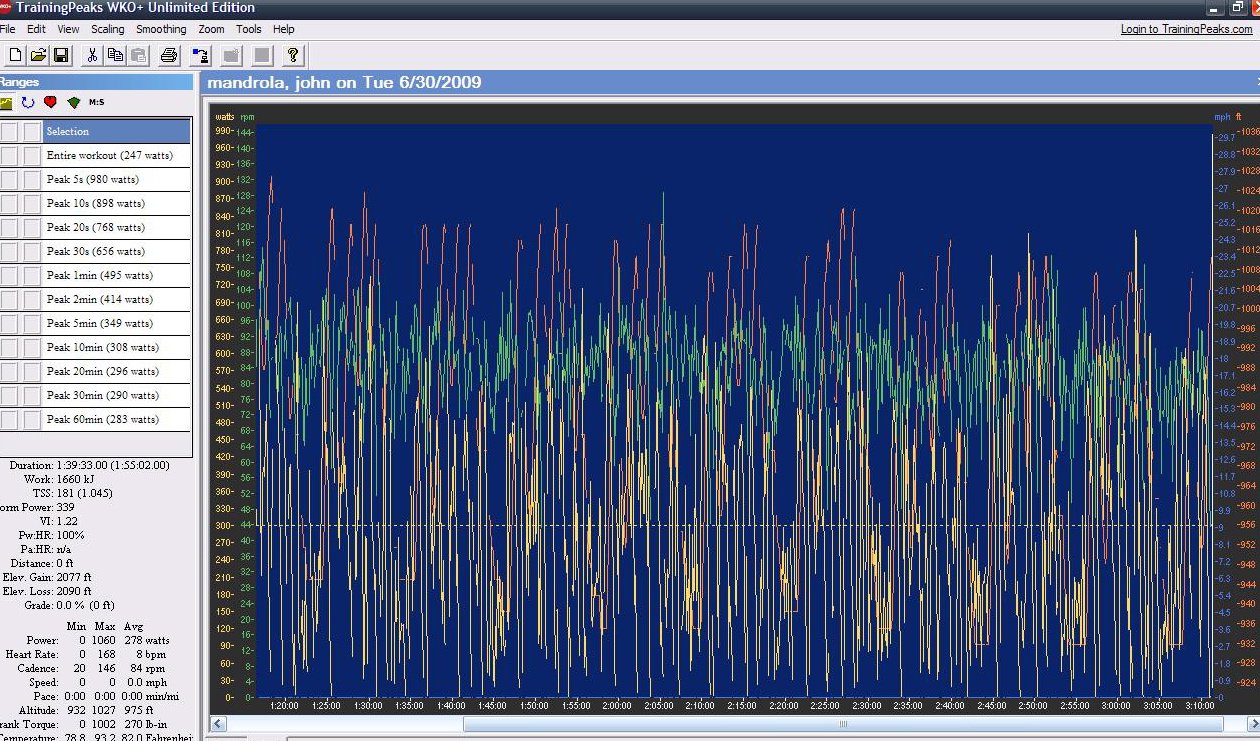
As a modern-day competitive cyclist, I am immersed in a sea of information. In our quest for weekend glory, minutia like speed, wattage outputs, RPMs, torque, elevation gain and of course, heart rates (highs, lows, and averages) get recorded, downloaded, and then studied intensively.
As a heart rhythm specialist, it is a frequent occurrence to see patients referred for low or high heart rates. More often than not, heart doctors are called upon to adjudicate patients who fall outside the “normal” values.
The old school teaching holds that the normal resting heart rate is greater than 55 and less than 100 beats per minute (bpm). Maximal heart rates are estimated by the Read more »
*This blog post was originally published at Dr John M*
August 6th, 2011 by John Mandrola, M.D. in Health Tips, True Stories
No Comments »

Dehydrated, cramped, limping? on a bike. Road nationals 2010.
People who exercise outdoors face a new threat.
It’s unrelenting.
Consistent.
Inescapable.
Perhaps, even more dangerous than distracted or mean motorists.
It’s the heat. Gosh, is it hot. If only I had a dollar for every time I heard someone say, “Doctor M, you aren’t riding in this heat; are you?”
Well…Other than the fortunate souls smart (or lucky) enough to live in cooler climates, most of us are facing an extreme wave of hotness. As a Kentuckian, I live in the epicenter of this summer’s cauldron. Louisville sits in a wind-protected valley alongside the heat sink that is the Ohio River. Think hot and steamy.
The excessive heat smacked me hard last evening. Normally, my highly-veined skin and northern European heritage serves me well in the heat. But last night, while riding in sight of our city’s skyline, it started: My mouth grew dry and my breathing labored. And why was that helmet feeling so tight? Next came the sensation of tingles—not the pleasant kind of tingles, like when your teenager hugs you. And then came the deal-breaker: chills. I stopped, swallowed my pride and called for a ride home. (Here’s an always for you all: When it’s ninety degrees out and you feel cold–stop exercising, immediately.)
After last night’s brush with heat exhaustion, I thought it reasonable to ramble on about the dangers of exercising in the heat. And of course, I will offer some nuggets of wisdom for beating the heat. Read more »
*This blog post was originally published at Dr John M*
July 28th, 2011 by John Mandrola, M.D. in Opinion
No Comments »
Today I would like to say thanks to a group of colleagues that too often go un-thanked.
These would be my hospital-based internal medicine friends: hospitalists are what they are called.
This idea came to me after reading Dr Robert Centor’s post on KevinMD. In his usual concise manner, he laments the lack of respect that many sub-specialists show hospitalists.
I feel differently about my hard-working colleagues.
As a sub, sub-specialist who works primarily in the hospital, I would like to say how grateful I am to have knowledgeable, hospital-based internists available.
I believe, and write frequently about the importance of seeing the forest through the trees. A good doctor must see the big picture: a little atrial fib, for instance, isn’t a major problem if you can’t move, eat or have widespread Cancer.
But for good patient care, the details are important too. Hospitalists are good at details. In fact, Read more »
*This blog post was originally published at Dr John M*
July 24th, 2011 by John Mandrola, M.D. in Opinion, Research
No Comments »
I recently came across a very important blog post on the use of the novel new blood-thinner, dabigatran (Pradaxa).
Fellow Kentucky cardiologist, and frequent TheHeart.org contributor, Dr. Melissa Walton-Shirley wrote this very detailed case presentation involving a cantankerous non-compliant rural patient with AF (atrial fibrillation) that sustained a stroke while “taking” dabigatran.
Dr. Walton-Shirley details the very commonly done procedure of cardioversion (shock) for AF. As she clearly points out, the most important safety feature of shocking AF back to regular rhythm entails adequate blood thinning before and after the procedure. Thin blood prevents the possibility of clots dislodging after restoring normal contraction to the top chambers of the heart (atria).
Herein lies the rub with dabigatran, and the two soon-to-be-approved non-warfarin blood-thinning agents, apixaban and rivaroxaban. In the past, Read more »
*This blog post was originally published at Dr John M*