May 15th, 2011 by Happy Hospitalist in Health Policy
2 Comments »

There is a huge myth being unknowingly perpetrated against the general public when it comes to their rights and responsibilities as a patient. It’s a myth that I can remember hearing as far back as my first few weeks of clinicals during medical school. It was a constant presence during my residency training and even now, as a private practice hospitalist I hear misinformation being handed down day after day, month after month.
This myth is perpetrated by doctors, nurses, and therapists of all kinds. What is this myth? That their health insurance company will not pay for the care provided if they want to leave against the medical advice of their physician.
Will my insurance company pay if I leave against medical advice (AMA)? Yes. They will pay. Medicare and Medicaid pay for services that are medically necessary. For example, if you go to the ER and the doctor recommends a CT scan of your chest and you decline, this does not mean the insurance company will deny payment for your visit to the emergency room. This is what the informed consent process is for. If you have been admitted for a medical condition that requires hospitalization and your care plan meets Medicare medical necessity muster, your care will be paid for whether you leave the hospital when your physician believes it is safe or not. Read more »
*This blog post was originally published at The Happy Hospitalist*
May 7th, 2011 by Happy Hospitalist in Opinion
No Comments »
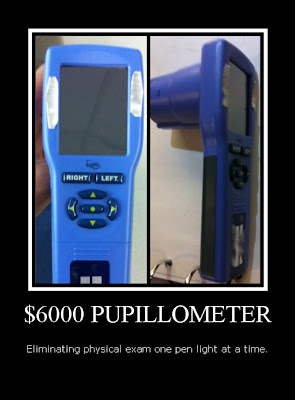 So I’m rounding in the ICU the other day when I came upon this new hospital medical device. It’s called a pupillometer. What does this pupillometer do? It measures subtle changes in the light reflex of the pupil to help take the physical exam to the next level of precision.
Or eliminate it, depending on how you look at it. What used to be a basic physical exam skill is now being replaced by a $6000 piece of medical technology that can distinguish tiny changes in pupil size. Now the real questions remain. Has this pupillometer device gone through the rigors of randomized trials in the ICU to define whether a $6000 flashlight changes outcomes or mortality? And if not, how do we allow medications to require such testing but not the technology that often changes nothing and simply makes health care more expensive.
The way I see things, if I’m trying to decide whether someone’s pupils constrict 1% vs 3% vs 10%, I’m getting a palliative care consult instead and putting the pupillometer back in my holster.
First the vein light. Now the pupillomter. And I thought the super bright LED pen light was all the rage.
*This blog post was originally published at The Happy Hospitalist*
May 3rd, 2011 by Happy Hospitalist in Opinion, True Stories
No Comments »
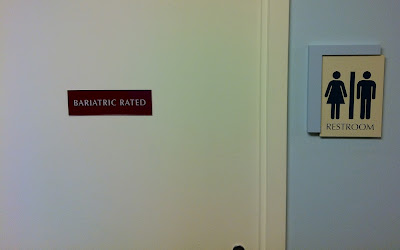 America’s handicap bathroom definition has officially left the train depot for the next station. In America, we are entitled to life, liberty and the pursuit of happiness.
Oh yeah, and bariatric rated bathrooms. I snapped this picture of a bariatric rated “handicap bathroom” at the hospital Mrs Happy delivered Zachary
A part of me feels for folks who struggle through life outside their home in search of a toilet adequate enough to do their thing. Bathrooms and toilets simply aren’t made to hold the weight or size of 300, 400 or 500 pound people and neither are the hospital toilets.
Part of me wants to believe these bariatric rated bathrooms are for the oversized pregnant women on the floor. But the rational side in me knows otherwise. America is fat. And we have the bariatric rated handicap bathrooms to prove it.
*This blog post was originally published at The Happy Hospitalist*
April 21st, 2011 by Happy Hospitalist in Humor, Opinion
No Comments »
I’m not sure if this is true or not, or if it’s a local phenomenon, but I heard a discussion the other day from a previous Walgreens employee describing the most shoplifted item in their store. Are you ready for this…..
Hemorrhoid creams and suppositories.
There are apparently a lot of a**holes in this world that get rubbed the wrong way.
*This blog post was originally published at The Happy Hospitalist*
April 14th, 2011 by Happy Hospitalist in Health Policy, Humor, True Stories
No Comments »
This was a classic moment of comical clarity that only comes along once a week. As you may or may not know, starting in 2013, The Medicare National Bank has promised to take back 1% of all of a hospital’s total Medicare revenue (to increase in future years) if the hospital has a higher 30 day readmission rate for congestive heart failure, acute myocardial infarction or pneumonia than an as yet undefined acceptable 30 day rate of readmission.
What does this mean? It means if the government decides that 20% is an acceptable rate for congestive heart failure 30 day readmission, and the hospital has a readmission rate of 25%, the hospital will be told to return 1% of all Medicare revenue for the year, not just their heart failure revenue.
Let’s use some hypothetical numbers, shall we? If a hospital generates $250 million dollars in a year on 25,000 Medicare discharge diagnosis related groups (DRGs) but only 100 of those discharge DRGs (or $1,000,000) were heart failure in 2013, what would happen if 21 CHF patients returned for readmission (a 21% thirty day readmission rate) within 30 days for heart failure instead of allowable 20%? The hospital would have to return 2.5 million dollars (1% of their total revenue on all Medicare admissions).
That one patient that took them from 20% to 21% will cost them 2.5 million dollars. The hospital would generate one million dollars in CHF revenue for the year and pay back 2.5 million dollars in penalty. That’s a pretty hefty price to pay considering that hospital profit margins from Medicare have been negative, on average, for most of the last decade. Read more »
*This blog post was originally published at The Happy Hospitalist*