February 6th, 2011 by RyanDuBosar in Better Health Network, Research
No Comments »

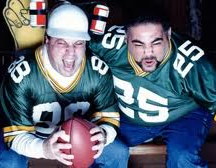 Sports fans may literally live and die on their team’s victories, according to researchers who examined cardiac mortality rates after the home team won and lost the Super Bowl.
Total and cardiac mortality rates in Los Angeles County increased after the football team’s 1980 Super Bowl loss but overall mortality fell after the 1984 the team’s Super Bowl win, researchers concluded from a review of death certificates reported in Clinical Cardiology.
First, authors gave a clinical review. Stress causes a cardiac cascade. The sympathetic nervous system increases and releases catecholamines. This triggers a rise in heart rate and blood pressure, and ventricular contractility increases oxygen demand, causing blood the sheer against and fracture atherosclerotic plaque, the authors explained. Stimulation of alpha receptors in the vasculature further constrict coronary vessels, increasing oxygen demand while limiting oxygen supply to the heart.
Next, they gave a sporting review. Los Angeles has played twice in the Super Bowl, the first time losing to the Pittsburgh Steelers (who play in this Sunday’s Super Bowl, incidentally) in 1980. The Los Angeles Rams, as they were known then, were a long-time hometown team and played the game in nearby Pasadena, Calif. “This game was high intensity,” wrote the authors, “with seven lead changes before Los Angeles lost a fourth-quarter lead and the game.”
Later, a new football franchise arrived in town, the Los Angeles Raiders. In 1984 the Los Angeles Raiders traveled to Tampa, Fla. to beat the Washington Redskins in a more mundane affair.
Now, the review of findings. Researchers combed death certificates based on age, race and sex to compare mortality rates for Super Bowl-related days with non-Super Bowl days and created regression models predicting daily death rates per 100,000. Read more »
*This blog post was originally published at ACP Internist*
January 18th, 2011 by PJSkerrett in Better Health Network, Health Tips
No Comments »

 After shoveling the heavy, 18-inch layer of snow that fell overnight on my sidewalk and driveway, my back hurt, my left shoulder ached, and I was tired. Was my body warning me I was having a heart attack, or were these just the aftermath of a morning spent toiling with a shovel? Now that I’m of an AARP age, it’s a question I shouldn’t ignore.
Snow shoveling is a known trigger for heart attacks. Emergency rooms in the snowbelt gear up for extra cases when enough of the white stuff has fallen to force folks out of their homes armed with shovels or snow blowers.
What’s the connection? Many people who shovel snow rarely exercise. Picking up a shovel and moving hundreds of pounds of snow, particularly after doing nothing physical for several months, can put a big strain on the heart. Pushing a heavy snowblower can do the same thing. Cold weather is another contributor because it can boost blood pressure, interrupt blood flow to part of the heart, and make blood more likely to form clots.
When a clot forms inside a coronary artery (a vessel that nourishes the heart), it can completely block blood flow to part of the heart. Cut off from their supply of life-sustaining oxygen and nutrients, heart muscle cells begin to shut down, and then die. This is what doctors call a myocardial infarction or acute coronary syndrome. The rest of us call it a heart attack.
The so-called classic signs of a heart attack are a squeezing pain in the chest, shortness of breath, pain that radiates up to the left shoulder and down the left arm, or a cold sweat. Other signs that are equally common include jaw pain, lower back pain, unexplained fatigue or nausea, and anxiety. Read more »
*This blog post was originally published at Harvard Health Blog*
December 21st, 2010 by PJSkerrett in Better Health Network, Health Tips, News, Research
1 Comment »
 Like swallows returning to San Juan Capistrano in the spring, Chia Pets begin appearing every December on late-night television and in the gift aisles of many stores. (Full disclaimer: I bought one for the Yankee Swap at Harvard Health Publication’s annual Christmas party.) Water these ceramic figures and they sprout a green “fur” from seeds embedded on the surface. Silly? Sure, that’s why they are such a hit. What you might not know is that the seeds may someday be a real gift for people with diabetes.
Chia seeds come from a plant formally known as Salvia hispanica, which is a member of the mint family. It gets its common name from the Aztec word “chian,” meaning oily, because the herb’s small, black seeds are rich in oils. It was a staple food for the Aztecs, and legend has it that their runners relied on chia seeds for fuel as they carried messages one hundred or more miles in a day. Chia seeds contain more healthy omega-3 fats and fiber than flax or other grain seeds. They are also a good source of protein and antioxidants. Read more »
*This blog post was originally published at Harvard Health Blog*
June 11th, 2010 by DrWes in Better Health Network, Humor, News, Research
No Comments »

You just can’t make this stuff up:
The underwear project, spearheaded by the nanoengineering professor, was funded by the U.S. military and its effectiveness will likely be tested on the battlefield.
“This specific project involves monitoring the injury of soldiers during battlefield surgery,” Wang told Reuters. “The goal is to develop minimally invasive sensors that can locate, in the field, and identify the type of injury.”
Ultimately, the waistband sensors will be able to direct the release of drugs to treat the wounded soldier.
I wonder what other creative uses our men in uniform will find for this? I can hear it now: “It’s not the size of the device, honey, it’s the metronome that’s in it!” (Heh.)
-WesMusings of a cardiologist and cardiac electrophysiologist.
*This blog post was originally published at Dr. Wes*
May 1st, 2010 by DaveMunger in Better Health Network, Health Tips, Research, True Stories
1 Comment »


This week I’ve been trying to eat according to the DASH guidelines for lowering blood pressure. It actually hasn’t been too difficult — partly because I’m not following their strictest guidelines, which call for just 1,300 milligrams of sodium and 16 grams of saturated fat a day. I’ve been shooting for 2,300 milligrams of sodium and 22 grams of saturated fat.
In 2003, I tried a somewhat different “diet,” which in some ways was more difficult to follow, even though it only lasted one day. My son Jim (then age 11) and I ate every meal at McDonald’s for an entire day (yes, this was before Super Size Me). We recorded the experience on the Web. I thought it would be interesting to compare my day at McDonald’s to a typical day on DASH. Read more »
*This blog post was originally published at The Daily Monthly*