January 27th, 2011 by AnnMacDonald in Better Health Network, Health Tips
No Comments »

 This picture shows the view from my office window in Boston: Dull, dreary, and depressing — at least on overcast days like today. Lack of light is one of the reasons that people feel mentally foggy.
One of the bloggers I follow, Rachel Zimmerman of WBUR’s CommonHealth blog, recently wrote that she’s been drinking three times as much coffee as usual. In addition to imbibing more caffeine, I’ve been trying to boost my spirits and alertness with mid-day runs to the snack machine (not the best strategy, in case you’re wondering).
At this time of year, many people aren’t just foggy and sad — they’ve got SAD, or seasonal affective disorder. About half a million Americans — women more often than men — are diagnosed with seasonal affective disorder each year. Many others experience at least some of the symptoms, which include loss of pleasure and energy, inability to concentrate, feelings of worthlessness, and an uncontrollable urge to eat sugar and high-carbohydrate foods (in my case, chocolate chip cookies).
Bright white light therapy remains a mainstay of treatment for seasonal affective disorder. That’s because the light acts on cells in the retina, the tissue located at the back of the eye that sends visual information to the brain. The hypothalamus, which helps control the sleep-wake cycle, is one part of the brain that receives this information. During the winter months, when people tend to stay indoors more, days are shorter, and the weather becomes overcast, our exposure to natural light diminishes. That disrupts the sleep-wake cycle, as well as other circadian rhythms. The result can be symptoms of seasonal affective disorder. Read more »
*This blog post was originally published at Harvard Health Blog*
January 8th, 2011 by admin in Better Health Network, Health Tips
No Comments »

This is a guest post from Dr. Jennifer Wider.
**********
Winterize Your Mind And Body
During the winter months, certain health issues may arise that women should have on their radar. From mental health issues like stress, depression and seasonal affective disorder (SAD), to physical concerns like skin care, the winter can certainly pack an extra punch.
Depression peaks during the holiday season, affecting more than 17 million Americans, according to the National Mental Health Association. On average, women are more vulnerable to stress-related illnesses like depression and anxiety than men. One study, conducted by Pacific Health Laboratories, revealed that 44 percent of American women report feeling sad through the holidays compared to 34 percent of American men.
“Depression of any kind is more common in females than males,” explains Greg Murray, M.D., lecturer and clinical psychologist at Swinburne University of Technology in Australia. “A pattern of elevated depression in the winter months is more marked in women than in men.”
There are a host of different reasons why women may be more susceptible to stress during the winter than men. Women tend to be the primary caretakers of the family and often take on the extra burden of the holidays with gift buying, entertaining, and coordinating visits with extended family. For working women, the added responsibilities can be difficult to balance, especially if they are already balancing a family, job, childcare and eldercare duties. Read more »
December 17th, 2010 by RyanDuBosar in Better Health Network, Research
No Comments »

Six of the nation’s leading healthcare systems will collaborate on outcomes, quality, and costs across eight common conditions or procedures in an effort to share best practices and reduce costs with the entire healthcare system.
Cleveland Clinic, Dartmouth-Hitchcock, Denver Health, Geisinger Health System, Intermountain Healthcare, and Mayo Clinic will to share data among their 10 million patients with The Dartmouth Institute, which will analyze the data and report back to the collaborative and the rest of the country, according to a press release.
The collaborative will focus on eight conditions and treatments for which costs have been increasing rapidly and for which there are wide variations in quality and outcomes across the country. The first three conditions to be studies are knee replacement, diabetes, and heart failure. They will be followed by asthma, weight loss surgery, labor and delivery, spine surgery, and depression.
*This blog post was originally published at ACP Internist*
December 12th, 2010 by John Mandrola, M.D. in Better Health Network, Opinion, True Stories
No Comments »

 The human heart resides in a lighltless 98.6-degree chest cavity. Its contracting muscles are further cushioned by the well-lubricated glistening smooth pericardial sac. One wouldn’t think that the heart could sense the time of year. The heart’s rhythm should remain independent of the holiday season. But then there is December in the EP lab. They are as busy as the malls.
Is it the depressing weather? Or the short days? Or a post-Thanksgiving hangover? It’s hard to say, but every year for as many as I can remember, the EP lab rocks in November and December. And with the advent of deductible health plans, this holiday phenomenon has only intensified.
The I-90 of the heart, the AV node, seems to give out more in the holidays. I’ll never forget the Saturday in December many years ago when I did five “urgent” pacemakers — and neither will the pacemaker rep. Read more »
*This blog post was originally published at Dr John M*
November 14th, 2010 by DrCharles in Better Health Network, Health Policy, News, Opinion
3 Comments »

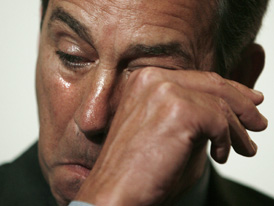 When the Republicans took back the House of Representatives [recently], John Boehner, the presumptive new Speaker and current Senator from Ohio, unleashed a “sob heard round the world.” As The New York Times quotes:
“I’ve spent my whole life chasing the American dream,” (Boehner) said, beginning to cry. He swallowed and tried again. But describing all the bad jobs he had once led to near sobbing when he got to the line, “I poured my heart and soul into running a small business.”
Boehner has cried in public many other times, the recent election night being only the largest stage to date. The tears also flow at his annual golf tournament, or while watching a child pledge allegiance to the flag, listening to a Republican colleague speak about his Vietnam War experiences, the unveiling of a statue of Ronald Reagan, while accepting various awards, during a rendition of “America the Beautiful,” etc. Could these tears be signs of major depression? Should melancholy be a disqualification for leadership? Were Clinton’s tears any better? Read more »
*This blog post was originally published at The Examining Room of Dr. Charles*














