Better Health: Smart Health Commentary Better Health (TM): smart health commentary

Latest Posts

Audio: ACP President: Not Enough Americans Have Been Vaccinated Against H1N1 Flu

stubbsOver 10,000 Americans (mostly young) have already died of H1N1 flu, and yet we’ve only vaccinated 10-20% of those who need protection. January 10-16 is National Influenza Awareness Week, and the American College of Physicians is doing its part to raise awareness of the ongoing need to protect Americans from the next wave of influenza.

I interviewed ACP President, Dr. Joseph Stubbs, about the current influenza season and Americans’ vulnerabilities to the virus. Please enjoy the audio of our conversation or read the transcript below.

Audio clip: Adobe Flash Player (version 9 or above) is required to play this audio clip. Download the latest version here. You also need to have JavaScript enabled in your browser.

Read more »

Tragic H1N1 Flu Death Of University of North Carolina Freshman

lillian-400x300.jpgIf you think that the H1N1 pandemic is slowing down and have grown complacent with vaccination now that vaccines are more widely available, please learn something from last night’s tragic loss of local college student from Rhode Island, Lillian Chason:

A University of North Carolina at Chapel Hill student, who friends said was battling complications from the H1N1 virus, died Wednesday evening, according to UNC Hospitals and a Facebook post made by her father.

Freshman Lillian Chason had been in critical condition at UNC Hospitals for weeks. Friends told WRAL News on Tuesday that she started feeling bad before Thanksgiving and went into the hospital on Nov. 20. Read more »

*This blog post was originally published at Terra Sigillata*

Ask Kathleen Sebelius & Anne Schuchat Your H1N1 Flu Questions

kathleen-sebelius-anne-schuchat-2009-9-15-15-10-37Do you have any nagging questions about the H1N1 flu? Then please join me at a special blogger briefing at HHS on Monday at 3:30pm ET. In a Better Health/MedPage Today exclusive, I’ll be live-blogging the event from inside the HHS studio in DC, and the conversation will be available via live webcast. Please send in your questions in advance (press release and instructions are below) or feel free to forward developing questions to me via Twitter: @drval during the event. Hope to chat with you soon!

***

Please join the Department of Health and Human Services (HHS) for a special briefing on H1N1 flu.  As your readers turn to you for accurate and timely information about the ongoing H1N1 pandemic, we want to arm you with the most current information and take your questions on H1N1 and seasonal flu.  Send us the questions that you or your readers want to know and our communication experts will answer them during the webcast. Send questions to hhsstudio@hhs.gov by Sunday, November 22th at 3 pm (EST). Read more »

H1N1 Flu Vaccine: The Bottom Line

If you’re a bit confused about the H1N1 vaccine recommendations, you are in good company! They are a bit confusing because this year’s flu season is a bit confusing. To add insult to injury, the recommendations for H1N1 are just similar and dissimilar enough from “seasonal flu”, Influenza A&B, that sorting it out can make your head spin and your tongue get tied.

Kim Carrigan and I attempted to clear the air about this challenging topic recently on Fox News Boston…as you’ll see, I even got tripped up once, so don’t feel badly if you’re a bit confused!

Read more »

*This blog post was originally published at DrGwenn Is In*

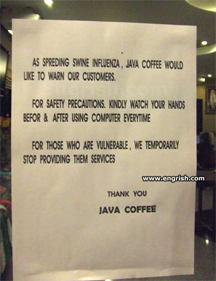
Lost In Translation: H1N1 Flu Warnings In Foreign Lands

I’m grateful to Engrish.com for bringing us this H1N1 warning sign from Thailand:
thaih1n11

H1N1 Flu: Where Germs Are Hiding


With news reports about the H1N1 flu all over the place, you may not think about the old “stomach flu” right now. Did you know that there really is no such thing as the stomach flu? If you have diarrhea or vomiting, it is usually not from influenza virus, but rather from another bug that got you. Often these bugs get us from not properly handling our food or from unsanitary conditions in our kitchens. Don’t go blaming the restaurant so quickly because studies show our homes are a breeding ground for bacteria that make us sick, too!

Top places germs reside

  1. The kitchen sponge and/or dishcloth is the number one place for nasty bugs to hang out. Replace your sponge every few weeks, or put it through the dishwasher so the heat can kill off some of the bacteria.
  2. The bottom of the sink is also very high in bacterial count. Just think about the conditions that germs love: Warm, moist environments. Your sink, sponges, and dishtowels are often wet and bacteria love it!
  3. Keyboards, computer mouse, remote controls, doorknobs, etc. I am guilty of this too: You are working on your computer and then you reach for a snack. There is a ton of bacteria on surfaces all over your office and home. Wash your hands every time you go to eat something. The toilet actually has less bacteria than many commonly touched surfaces around your office and home.

Tips to prevent getting sick

  • WASH HANDS. I can’t emphasize this enough. Wash your hands before you go to prepare food or eat food. Wash your hands after you go to the bathroom. A good rule of thumb is to wash for at least 20 seconds using hot water and lots of soap. Use a hand sanitizer if you cannot always wash in a sink.
  • Wash all surfaces food will touch before and after you prepare food. Wipe the counter clean before you get the food out, and wash it off after as well.
  • Wash all produce well. Even if you don’t eat the outside of it (think watermelon, cantaloupe, oranges, etc) you still want to wash it. Once you cut into it or peel it, the outside is getting on the inside with the trail of the knife or your hands.
  • Always cook meats to an internal temperature of 165 degrees. Use a food thermometer to be sure.
  • Do not keep perishable food out for more than 2 hours at room temperature. Get all food back into the fridge in 2 hours or less to minimize bacteria multiplying.
  • Keep your fridge at 40 degrees or less.

Check out this research from the USDA:

Best Ways To Clean Your Kitchen Sponge

Your microwave or dishwasher can make sponges safer to reuse in today’s kitchens.

Heating your used kitchen sponges in your microwave for one minute, or washing them in your dishwasher and leaving them there through a drying cycle, are the most effective household ways to inactivate harmful bacteria, yeasts and molds.

ARS food safety experts who specialize in research on foodborne pathogens, like E. coli O157:H7, looked at several simple, convenient and often-recommended ways of cleaning reusable kitchen sponges. Techniques included soaking sponges for three minutes in a 10-percent chlorine bleach solution, soaking in lemon juice or sterile water for one minute, heating in a microwave at full power for one minute, or washing in a dishwasher—including through a drying cycle.

At the outset of the experiment, they soaked all the sponges for 48 hours at room temperature in a slurry of ground beef and laboratory compounds which allow bacteria, yeasts and molds naturally present in the beef to grow on the sponges.

Microwaving and dishwashing each killed nearly 100 percent of the bacteria, with dishwashing being only slightly (0.0001 percent) less effective.

And, microwaving and dishwashing each killed nearly all yeasts and molds; less than 1 percent (only 0.00001 percent) survived.

This post, H1N1 Flu: Where Germs Are Hiding, was originally published on Healthine.com by Brian Westphal.

Physicians And The H1N1 Flu

Yesterday I visited the Centers for Disease Control in Atlanta and was taken inside the command center, where almost 100 staffers have been working around the clock to monitor and stem the current outbreak of flu.

I first spoke to Toby Crafton, the manager of the command center, who oversees the day-to-day operations. He and his team have been preparing for a possible pandemic of flu or another infectious illness for years. I also spoke to Michael Shaw, PhD, who heads up the virology labs that are studying the H1N1 virus causing the current outbreak. He’s spent a career learning the laboratory techniques that are so urgently needed right now. The third person I spoke to was Dr. Richard Besser, Acting Director of the CDC, who has been working at the agency for 13 years and is an extensively published expert in infectious diseases.

I mentioned that last week I had received an email notification from the New York City Department of Health (NYCDOH) about how I should be managing my patients with flu-like symptoms. The advice was actually not intuitively obvious to me. For example, the Department of Health said that for patients with mild illness, treatment with anti-viral meds like Tamiflu and Relenza was only recommended for patients who also had underlying conditions that increased their risk for complications due to influenza. Dr. Besser pointed out that it was especially important right now for physicians to stay up to date with the recommendations being made by public health officials. Doctors can contact their local department of health and sign up for the same type of email notification that I received.

This brings us to the main point of today’s blog post. Many of us - patients and physicians alike - have been thinking about the influenza virus for about a week. Public health officials like the teams at the CDC and the NYCDOH have been thinking about it for years. Physicians, me included, are used to practicing medicine based on “clinical judgment.” We understand that medicine is an art and not a science, that there are many different ways to approach a problem, that there’s often no clear “right” or “wrong.” We are also used to doing things “our way”, whatever that way is. But this is not a time for doing things “our way” if it’s at significant odds with strong recommendations being made by public health officials. There are recommendations that may seem logical - like prescribing medication for somebody with mild flu symptoms “just in case” that nevertheless go against the judgment of people who have trained for years to think about how to deal with an epidemic.

What if you’re a physician who strongly disagrees with a suggestion of public officials? Then challenge that recommendation publicly. Bring the discussion to light; maybe you’re right. While this is no time to go rogue, doctors have an obligation to think carefully and independently and to challenge recommendations that seem illogical. But don’t silently do things your own way.


Watch CBS Videos Online

Latest Interviews

Health Tips For Back-To-School

I was lucky enough to be asked by one of the local TV stations to talk about some back-to-school issues when it comes to health. I don t know about where you re at but most of the local schools around here started yesterday August rd Keeping up-to-date on immunizations…

Read more »

“Medical Self-Care” And The Doc Tom Interview

Next in our series of posts about our founder Doc Tom. Previous time capsules and Come ye economics buffs and algebra fans Get out your pencils and solve for x n and XX Whatever else the year XX is remembered for it will without a doubt go down in history…

Read more »

See all interviews »

Latest Cartoon

cardiaccath

Here’s a cartoon I created a few years back. Enjoy!

- Dr. Val

*This blog post was originally published at Science-Based Medicine*

See all cartoons »

Latest Book Reviews

A Biomedical Look At Spaceflight

Book review by Dan Buckland Dan Buckland is an editor at Medgadget and an MD PhD student at Harvard Med MIT whose thesis deals with diagnosing back injury in spaceflight using ultrasound. Mary Roach author of previous entertaining books Bonk a history of sex research and Stiff a history of…

Read more »

UTI and “Eat, Pray, Love”

I really didn t expect to like Eat Pray Love. In fact since its publication in I’d been avoiding it like the plague. Typical new-agey Oprah-y girly-book I thought. Nothing in it to speak to me. Then I saw the trailer for the movie and I was hooked probably because…

Read more »

Will Science Succeed With An Anti-Aging Revolution?

Wouldn’t it be great if we could find a way to prolong our lives and to keep us healthy right up to the end Ponce de León never found that Fountain of Youth but science is still looking. What are the chances science will succeed How’s it doing so far…

Read more »

See all book reviews »