Listening to NPR on Saturday morning I caught part of Scott Simon’s interview with brothers Stephen Amidon and Thomas Amidon, M.D. discussing their book “The Sublime Engine: A Biography of the Human Heart.” The interview touched on the story of the human heart in science and medicine, history, and culture:
It turns out that the classic red heart symbol we see almost everywhere around Valentine’s Day doesn’t look much like a real human heart at all.
“Of all the theories about where that symbol comes from, my favorite is that it is a representation of a sixth century B.C. aphrodisiac from northern Africa,” says Stephen Amidon…”And I kind of like that history because it sort of suggests that early on, people sort of understood the connection between love and the heart.”
Words and how we use them were the focus of Dr. Pauline Chen’s interview by WIHI host Madge Kaplan this past Thursday, February 10th, “A Legible Prescription for Health“:
On this edition of WIHI, Dr. Chen wants to spend some time talking about language, especially the words doctors use with one another when describing patients; the unintended barriers created the more doctors and nurses don protective, infection-protecting garb; the mounting weight of patient satisfaction surveys; and more.
Back to the NPR interview on the human heart as a “sublime engine,” the authors don’t feel that as our advances in surgical techniques become commonplace that the heart will lose any of its cultural and metaphorical significance. Read more »
The puppeteer skit features the interaction between a young man with a rash and his older physician. The patient is an informed kind of guy: He’s checked his own medical record on the doctor’s website, read up on rashes in the Boston Globe, checked pix on WebMD, seen an episode of “Gray’s Anatomy” about a rash and, most inventively, checked iDiagnose, a hypothetical app (I hope) that led him to the conclusion that he might have epidermal necrosis.
“Not to worry,” the patient informs Dr. Matthews, who meanwhile has been trying to examine him (“Say aaahhh” and more): He’s eligible for an experimental protocol. After some back-and-forth in which the doctor — who’s been quite courteous until this point, calling the patient “Mr. Horcher,” for example, and not admonishing the patient who’s got so many ideas of his own — the doctor says that the patient may be exacerbating the condition by scratching it, and questions the wisdom of taking an experimental treatment for a rash. Read more »
*This blog post was originally published at Medical Lessons*
Medicare poses a deficit problem, note some very influential analysts. A former Congressional Budget Office head and a former Medicare chief chime in on the scope of the program’s impact on the economy, and the difficulties of trying to scale it back.
Yet, a presidential commission is considering just that among other measures. The 18-member, bipartisan commission released its report weeks ago and was scheduled to have voted today on a shocking scope of deficit-trimming measures that included changes to military spending, Social Security and Medicare, among other areas. But they deferred the vote until Friday to try to garner more votes from members who are also currently elected officials. The panel needs 14 votes and substantive approval from its roster of Congress members to gain serious attention.
In related news for Medicare recipients, the Employee Benefit Research Institute reports that seniors will need hundreds of thousands of dollars in savings to cover health insurance and other out-of-pocket health needs. (NPR, The New York Times, ACP Internist, The Washington Post, Reuters)
*This blog post was originally published at ACP Internist*
Thanks to Scott Hensley over at Shots, NPR’s Health Blog, for highlighting this sad but funny video on where we’re going with healthcare. Scary what happens when theory meets reality:
-WesMusings of a cardiologist and cardiac electrophysiologist.
*This blog post was originally published at Dr. Wes*
An historic piece of journalism was published today. Six news organizations partnered on the “Dollars for Docs” project — ProPublica, NPR, PBS’s Nightly Business Report, the Chicago Tribune, Boston Globe and Consumer Reports. They examined $258 million in payments by seven drug companies in 2009 and 2010 to about 18,000 healthcare practitioners nationwide for speaking, consulting, and other tasks.
This webpage can be your gateway to the project, with links to a database searchable by doctor’s name or by state, and links to the journalism partners’ efforts:
Boston Globe “Prescription for Prestige”
The Harvard brand, unrivaled in education, is also prized by the pharmaceutical industry as a powerful tool in promoting drugs. Its allure is evident in a new analysis of all publicly reported industry payments to physicians.
Consumer Reports “Consumers Wary of Doctors Who Take Drug-Company Dollars”
Most Americans are skeptical of financial relationships between doctors and companies, according to a new, national from the Consumer Reports National Research Center.
Chicago Tribune “Doctors Draw Payments From Drug Companies”
Follow drug company money in Illinois, and it leads to the psychiatry department at Rush University Medical Center, a prominent headache clinic on the North Side of Chicago, a busy suburban urology practice and a psychiatric hospital accused of overmedicating kids.
PBS “Nightly Business Report”
A doctor talks about quitting drug company money when their marketing tactics crossed the line.
NPR “Drug Companies Hire Troubled Docs As Experts”
It’s no secret that doctors are disappointed with the way that the U.S. healthcare system is evolving. Most feel helpless about improving their work conditions or solving technical problems in patient care. Fortunately one young medical student was undeterred by the mountain of disappointment carried by his senior clinician mentors…
I am proud to be a part of the American Resident Project an initiative that promotes the writing of medical students residents and new physicians as they explore ideas for transforming American health care delivery. I recently had the opportunity to interview three of the writing fellows about how to…
I m often asked to do book reviews on my blog and I rarely agree to them. This is because it takes me a long time to read a book and then if I don t enjoy it I figure the author would rather me remain silent than publish my…
When I was in medical school I read Samuel Shem s House Of God as a right of passage. At the time I found it to be a cynical yet eerily accurate portrayal of the underbelly of academic medicine. I gained comfort from its gallows humor and it made me…
I am hesitant to review diet books because they are so often a tangled mess of fact and fiction. Teasing out their truth from falsehood is about as exhausting as delousing a long-haired elementary school student. However after being approached by the authors’ PR agency with the promise of a…



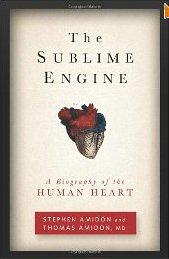 Listening to NPR on Saturday morning I caught part of Scott Simon’s interview with brothers Stephen Amidon and Thomas Amidon, M.D. discussing their book “The Sublime Engine: A Biography of the Human Heart.” The interview touched on the story of the human heart in science and medicine, history, and culture: