September 7th, 2012 by Dr. Val Jones in Health Tips, Opinion
No Comments »
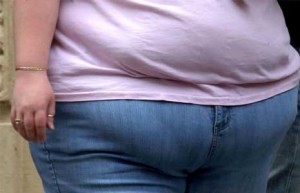 I recently found my way to an interesting NPR podcast via a link from Dr. Ranit Mishori (@ranitmd) on Twitter. The host of the show interviewed a physician (Dr. Mishori), an obesity researcher (Sara Bleich), and a family nurse practitioner (Eileen O’Grady) about how healthcare providers are trying (or not trying) to help patients manage their weight. Several patients and practitioners called in to participate.
First of all, I found it intriguing that research has shown that the BMI of the treating physician has a significant impact on whether he or she is willing to counsel a patient about weight loss. Normal weight physicians (those with a BMI under 25) were more likely to bring up the subject (and follow through with weight loss and exercise planning with their patients) than were physicians who were overweight or obese. Sara Bleich believes that this is because overweight and obese physicians either don’t recognize the problem in others who have similar body types, or that their personal shame about their weight makes them feel that they don’t have the right to give advice since they don’t practice what they preach. While 60% of Americans are either overweight or obese, 50% of physicians are also in those categories.
Although it’s not entirely surprising that overweight/obese physicians feel as they do, it made me wonder what other personal conditions could be influencing evidence-based patient care. Is a physician with high blood pressure less apt to encourage salt restriction or medication adherence? What about depression, smoking cessation, or erectile dysfunction? Are there certain personal diseases or conditions that impair proper care and treatment in others?
Several callers recounted negative experiences with physicians where they were “read the Riot Act” about their weight. One overweight woman said she handled this by simply avoiding going to the doctor at all, and another obese man said his doctor made him cry. However, the man went on to lose 175 pounds through diet and exercise modifications and said that the “tough love” was just what he needed to galvanize him into action.
Dr. Mishori felt that the “Riot Act” approach was rarely helpful and usually alienated patients. She advocated a more nuanced and sensitive approach that takes into account a patient’s social and financial situation. She explained that there’s no use advocating personal training sessions to a person on food stamps. Physicians need to be more sensitive to patients’ living conditions and physical abilities.
In the end, I felt that nurse practitioner Eileen O’Grady contributed some helpful observations – she argued that the rate-limiting factor in reversing obesity is not information, but motivation. Most patients know what they “should do” but just don’t have the motivation to start, and keep at it till they achieve a healthy weight. Ms. O’Grady devoted her practice to weight loss coaching by phone, and she believes that telephones have one big advantage over in-person visits: patients are more likely to be honest when there is no direct eye contact with their provider. Her secret to success, beyond a non-judgmental therapeutic environment, is setting small, attainable goals. She says that if she doesn’t believe the patient has at least a 70% chance of success, they should not set that particular goal.
Starting goals may be as simple as “finding a workout outfit that fits.” As the patient grows in confidence with their successes, larger, broader goals may be set. Weight loss coaching and intensive group therapy may be the most motivating strategy that we have to help Americans shed unwanted pounds. Apparently, the USPS Task Force agrees, as they recommend “intensive, multicomponent behavioral interventions” for those who screen positive for obesity in their doctors’ offices.
I think it’s unfortunate that most doctors feel that they “simply don’t have time to counsel patients about obesity.” Diet and exercise are the two most powerful medical tools we have to combat many chronic diseases. What else is so important that it’s taking away our time focusing on the “elephant in the room?” Pills are not the way forward in obesity treatment – and we should have the courage to admit it and do better with confronting this problem head-on in our offices, and also in our own lives.
June 20th, 2012 by Dr. Val Jones in Health Policy, Health Tips, News, Opinion
No Comments »
The American Medical Association (AMA) voted today to endorse taxation of sugary beverages as a means to raise money for anti-obesity programs. Interestingly, a recent physician survey at Medpage Today suggests that only 50% of physicians think that a soda tax is an effective public health strategy.
I am one of the 50% who feels that this policy will not be effective. In short, this is why:
1. You can become obese by eating and drinking almost anything in excess. Targeting sugary beverages is reductio ad absurdum. Did America become fat simply because of an excess supply of sugary fluids on grocery shelves? What about the super-sizing of our food portions, the change in workforce physical requirements, the advent of cars, escalators, healthy food “deserts” in poor neighborhoods, video games, and cutting gym class from schools?
Holding Coca Cola, et al. responsible for our own over-consumption of calories is both unfair and tantamount to spitting into the wind – something bad is going to come back at us. Consumers can easily get around the soda tax by buying sweet alternatives – which may have even more calories than soda. (Caramel latte anyone?) And then what? Are we really going to play public policy, food and beverage whack-a-mole?

Carmelita Jeter's Shopping Cart
2. You can be thin and fit while eating and drinking almost anything. Obviously nutrition science has shown that a diet rich in fresh fruits and veggies, lean meats, low-fat dairy, whole grains, and healthy fats is the best for our health. However, please consider that the world’s fastest woman, Olympian Carmelita Jeter, eats Hostess cup cakes, Teddy Grahams, Welch’s grape juice, whole milk, and Gatorade. How do I know? Because she posted a photo of her shopping cart on Twitter (see image to the left). I obviously have no idea how much of this she eats – or when she eats it – but if the world’s fastest woman is powered (to some degree) by “Twinkies” then I think we should all think twice about demonizing certain foods/beverages in our anti-obesity fervor.
3. You can’t regulate good behavior. Human behaviors that may lead to obesity are simply too complex to regulate. Who would want to live in a world where government becomes the de facto “Nutrisystem” for its citizens, mailing out pre-packaged, ingredient-controlled meals to 312 million people per day, three times a day, seven days a week? While that may save the post office from its imminent demise, we can neither afford to do that, nor do we need to.
People who believe that policy should drive behavior point to smoking bans that have cut down on smoking rates. While I agree that small improvements have been made in reducing smoking rates, roughly one in four people still smoke (depending on your source, this number could be as low as one-in-five), and one in every five deaths is still attributed to cigarette smoking. Hardly a resounding victory, alas.
But beyond the fact that policy changes (and the billions we’ve spent enacting and enforcing them) have resulted in a disappointing decrease in smoking rates, is the issue that cigarettes and food ingredients (such as sugar) are not analogous substances. While there is no safe minimum amount of cigarette smoke, our bodies need salt, glucose, and fat to survive. They cannot be cut out of our diet completely – nor should they. And the only way to force people to optimize their intake is to enact Draconian measures.
So instead of starting a food-fight, it’s important to accept the complexities associated with this particular health scourge and promote a broader, more-nuanced approach to wellness incentives. We have to attack this problem from the ground up, because a top-down approach requires our government to become an invasive, food and exercise nanny.
The good news is that one-third of Americans are not overweight or obese, despite our current “toxic” food/inactive lifestyle environment. Perhaps these thinner folks can be ambassadors for the rest of us, and reveal their secrets of healthy living despite our current limitations. Even with our best efforts, we need to understand that (like smokers) we will always have a segment of the population that is overweight or obese.
And as for the Olympians among us – they help to illustrate that obsessing over every morsel of food or cup of soda that we consume is not the way forward. Sorry AMA, I’m with Carmelita on this one.

Powered By Twinkies?
June 15th, 2012 by Dr. Val Jones in News, Opinion
No Comments »
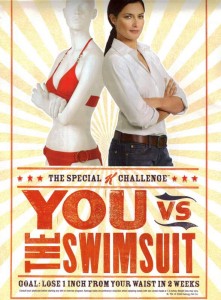 Kellogg’s Special K cereal brand has long been known for its iconic slim woman in a red bathing suit. In a bold, Dove-soap-like new ad campaign, they have decided to feature “real women” – which apparently means women with larger BMIs – in red bathing suits. A Special K spokeswoman explains,
“We want to encourage a responsible attitude when it comes to body image and to show that losing weight isn’t just about the way you look or a certain size you need to conform to, but more importantly about the way it makes you feel.
The fact that we are using real women for the first time of a variety of shapes and sizes is the perfect way to encourage women to think differently about losing weight and not just focus on the numbers on the bathroom scales.”
While I certainly appreciate the intent, I think there may be an even better way of achieving the objective of avoiding an over-emphasis on the bathroom scale. Instead of normalizing and accepting overweight bodies, why not show what women of the same percent body fat look like? That might be a healthier way to help us wrap our minds around the fact that (for example) 21% body fat on one woman might look very different than 21% body fat on another… Of course body fat alone is not a perfect measure of health – cardiovascular fitness doesn’t always correlate with it. But it’s a potential new way of normalizing healthy bodies rather than accepting a new overweight standard.
In fact, with the upcoming summer Olympic games, it might be fun to show the many faces of fitness. Women athletes at the peak of their performance look very different from one another. How about putting them all in red bathing suits?
Anyway, I thank Special K for opening the discussion – and I encourage us all to strive for optimal health. But as a physician, I believe that we shouldn’t accept overweight bodies as a new health standard. Good health does come in many shapes and sizes, but not in high levels of body fat.
January 5th, 2012 by RyanDuBosar in Research
No Comments »

Consuming excess calories increases body fat, regardless of how many calories come from protein. High-protein diets do affect energy expenditure and storage of lean body mass, just not body fat storage.
To evaluate the effects of overconsumption of low-, normal-, and high-protein diets on weight gain, researchers conducted a single-blind, randomized controlled trial of 25 healthy, weight-stable adults in an inpatient metabolic unit in Baton Rouge, La. Patients were ages 18 to 35 with a body mass index between 19 and 30. The study was headed by George A. Bray, MD, MACP.
After consuming a weight-stabilizing diet for 13 to 25 days, participants were randomized to diets containing 5% of energy from protein (low protein), 15% (normal protein) or 25% (high protein). Only the kitchen staff who supervised participants while they were eating knew the assignments. There was no prescribed exercise, and alcohol and caffeine were restricted.
Patients were Read more »
*This blog post was originally published at ACP Internist*
December 24th, 2011 by RyanDuBosar in Health Policy, Research
No Comments »
Obesity impacts income, especially among women, according to a report from The George Washington University School of Public Health and Health Services’ Department of Health Policy.
In 2004, wages among the obese were $8,666 less for females and $4,772 lower for males. In 2008, wages were $5,826 less for obese females, a 14.6% penalty over normal weight females, the researchers concluded after examining years 2004 and 2008 in the Bureau of Labor Statistics’ National Longitudinal Survey of Youth.
The research shows that there are significant differences in wages dependent upon race that couldn’t be accounted for by measuring pre-recession (2004) and recession (2008) measures. In 2004, Hispanic women who were obese earned $6,618 less than those who were normal weight. In 2008, Read more »
*This blog post was originally published at ACP Internist*














