April 11th, 2010 by Happy Hospitalist in Better Health Network, Health Tips, Humor, Opinion, True Stories
Tags: Aging, Alopecia, Baldness, Cosmetic Enhancement, Depression, Dermatology, Female Pattern Baldness, General Medicine, Genes, genetic, Hair Loss, Hair Restoration, Hormones, Minoxidil, Primary Care, Scalp, Wig, Women, Women's Health
No Comments »

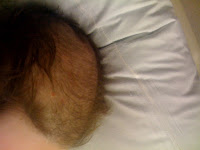 A reader sent me this really sad story that got me thinking about hair restoration for women
 :
:
Happy, I wanted to share with you this picture of a woman who’s lost all hope. I saw her a few years back during my psychiatry rotation. As you can see, it looks like she’s going bald, but in fact, during her fits of rage and depression she’s actually pulling out her own hair. How sad is that? Just another example of what we docs take care of on a daily basis.
Man, that’s unbelievable. I don’t know much about classic female pattern baldness. From what I’ve read it’s usually a diffuse loss of hair everywhere or a central expansion of hair loss but rarely does it encompass the entire scalp. It’s usually caused by hormones, aging and genes. In advanced age, I’ve seen more than my fair share of elderly women who have more hair on their chin then they do on their head. Read more »
*This blog post was originally published at The Happy Hospitalist*
April 10th, 2010 by DaveMunger in Better Health Network, Health Tips, Humor, Opinion, Research, True Stories
Tags: Exercise, General Medicine, iPad, Kinesiology, Mortality Rate, Physical Activity, Primary Care, Sedentary Lifestyle, Standing Up
No Comments »

 If you follow me on Twitter or read my personal blog, you probably know by now that I bought myself an iPad this week. The main reason I got it is because I’m a sucker for shiny new technology, but I also wanted to see if I could use it to help myself become a little less sedentary.
As I mentioned in my first two posts about fitness this month, there’s a growing body of research suggesting that a sedentary lifestyle is harmful to your health. I was interviewed about one such study a few months ago on the PRI show “The Takeaway,” and the evidence is fairly convincing: People who spend more hours watching TV also have a higher mortality rate than those who watch it less, even after accounting for exercise. Granted, it’s only a correlation, but the evidence converges quite well with several other studies.
But what am I supposed to do about it? My job requires me to spend long hours in front of a computer screen. If exercising a 30 or 40 minutes a day can’t prevent me from getting heart disease or cancer, what will? Some researchers, including David Dunstan, the lead researcher on the TV-watching study, suggest that just standing periodically, rather than sitting all day, can help a lot. That’s where the iPad comes in. Read more »
*This blog post was originally published at The Daily Monthly*
April 10th, 2010 by Medgadget in Better Health Network, Health Tips, News
Tags: Condom Use, Condoms, General Medicine, Grove Medical, Men's Health, Passion, Primary Care, Protected Sex, QuickStrips, Safe Sex, Sensis, Sexual Health, sexually transmitted diseases, STDs, The Mood, Women's Health
No Comments »

 According to Grove Medical, disruption of “the mood” is a main barrier to condom use. With their Sensis condoms with QuikStrips, the company tries to overcome this mental handicap by offering a new condom technology to protect the passion while practicing safer sex.
The QuikStrips are little handles on the side of the condom that work much like the pull-off tabs on a bandage, creating an application that helps to apply the condom quickly in the right way.
Presumed benefits include appropriate spacing at the reservoir, no touching of the condom as it’s being applied, and less chance of accidental inside-out-then-flip contamination. Read more »
*This blog post was originally published at Medgadget*
April 10th, 2010 by RamonaBatesMD in Better Health Network, News, Opinion, True Stories
Tags: Aetna, Assurant Health, Denied Coverage, Doctors, Health Insurance Policy, Health Insurance Rates, Health Insurance Reform, Health Savings Accounts, Healthcare Policy, Healthcare reform, House Committee on Energy and Commerce, HSAs, Humana, Medical Coverage, Medical Training, Personal Health Insurance, Physicians, Premium Increases, UnitedHealth Group, Wellpoint
1 Comment »

Physicians aren’t exempt from the struggles with personal health insurance coverage, affordability, denied coverage, etc.
When I finished my medical training and opened my practice 20 years ago, I had to buy individual coverage. All options included a rider that excluded coverage on my uterus and ovaries due to fibroid surgery during my training, so when I had my TAH & BSO a few years later, the entire cost came out of my pocket. Fortunately I knew how to ask for cost reductions, but still.
My husband and I are both small business individuals. I have always carried our health insurance under my name (office). Over the years we have gone to a health savings account with a high deductible to keep the cost reasonable. Fortunately, we have been mostly healthy. Last month we received a letter from Assurant Health. Read more »
*This blog post was originally published at Suture for a Living*
April 10th, 2010 by Peggy Polaneczky, M.D. in Better Health Network, Health Tips, Opinion, Research, True Stories
Tags: American Diet, Basal Metabolic Rate, Caloric Intake, Calories, Cardiovascular Disease Risk, Cholesterol, David Kessler, Diet and Nutrition, Dieting, Dietitian, Food and Nutrition, General Medicine, High-Protein Diet, Mediterranean Diet, Primary Care, Research Diet Study, The End of Overeating, Weight Loss, Which Diet Is Best, Zone Delivery Diet
1 Comment »

 I’ve been waiting for this soup for weeks. Eleven weeks, to be exact. That’s how long I was enrolled in a research diet study, and unable to eat anything other than the food they provided me, which was nowhere near as delicious as this soup.
The study is designed to compare the effects of three different diets — the American Diet, the Mediterrnean Diet, and a high-protein diet — on weight loss and cardiovascular disease risk.
I randomized to the American Diet, meaning that Thursday’s lunch was a slice of pizza with potato chips and an afternoon snack of Oreos and chocolate pudding, Saturday’s lunch was hamburger and fries, and the most veggies I ever saw at one sitting was a measly stalk of broccoli.
Despite this, I lost 30 pounds over the 11 weeks of the study, primarily because my caloric intake was only 1,200 calories per day, carefully calculated based on my basal metabolic rate. Read more »
*This blog post was originally published at The Blog that Ate Manhattan*