May 8th, 2011 by GarySchwitzer in Health Tips
No Comments »

All over the country in May, hospitals are offering “Free Throat Cancer Screening.” A Google search turned up dozens of results for that specific term or the related “oral, head and neck cancer screening.”
Here’s one example, promoting “Oral, Head and Neck Cancer Awareness Week, May 8-14.”
This promotion uses ominous warnings:
Can you live without your voice?
What about your jaw?
Would you miss it if you couldn’t swallow food?
Throat cancer can take all of those things away, along with your ability to eat, talk and breathe normally. These debilitating problems can be prevented, but you have to catch cancer early.
Some promotions – such as this one – use celebrity pitches such as “If it happened to Michael Douglas, it can happen to you.”
Here’s one that states, “A 10-minute, painless screening could save your life.”
But where’s the evidence for that? Read more »
*This blog post was originally published at Gary Schwitzer's HealthNewsReview Blog*
May 8th, 2011 by John Di Saia, M.D. in Health Tips, True Stories
No Comments »

 It frequently amazes me how patients can be wowed by technology and advertising hype. The attraction of newer technology in particular helps part many people from their money at times. The SmartLipo system is one of the laser-assisted liposuction systems on the market. I have blogged on it before having used it quite a bit a few years ago.
The system is being marketed with phrases like “almost anyone can be a good candidate for SmartLipo.” That is simply BS.
I saw an attractive young woman in the office who had had Smartlipo on her lower back. It looked like the Geiko Gecko had done it. Her smooth contour had been made irregular and discolored despite the fact that the surgery had happened quite a while prior. Her ribs had been a bit exposed by the loss of some of the fat that would normally have laid over them. Early lipo results do change, but this wasn’t something that was going to improve over time. I have seen worse but this was so unnecessary.
SmartLipo Led to a Dent
Why did this happen? Read more »
*This blog post was originally published at Truth in Cosmetic Surgery*
May 7th, 2011 by Happy Hospitalist in Opinion
No Comments »

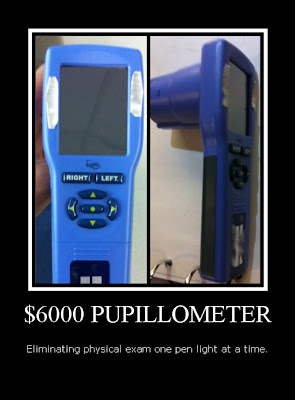 So I’m rounding in the ICU the other day when I came upon this new hospital medical device. It’s called a pupillometer. What does this pupillometer do? It measures subtle changes in the light reflex of the pupil to help take the physical exam to the next level of precision.
Or eliminate it, depending on how you look at it. What used to be a basic physical exam skill is now being replaced by a $6000 piece of medical technology that can distinguish tiny changes in pupil size. Now the real questions remain. Has this pupillometer device gone through the rigors of randomized trials in the ICU to define whether a $6000 flashlight changes outcomes or mortality? And if not, how do we allow medications to require such testing but not the technology that often changes nothing and simply makes health care more expensive.
The way I see things, if I’m trying to decide whether someone’s pupils constrict 1% vs 3% vs 10%, I’m getting a palliative care consult instead and putting the pupillometer back in my holster.
First the vein light. Now the pupillomter. And I thought the super bright LED pen light was all the rage.
*This blog post was originally published at The Happy Hospitalist*
May 7th, 2011 by RamonaBatesMD in Health Tips
No Comments »

Here’s the tweet I posted Sunday evening:
I’ve told pts this for years now>>> Liposuction Study Finds That Lost Fat Returns – http://nyti.ms/kheltN
The New York Times article reports on a liposuction study published in the April issue of the journal Obesity (full reference below). The NY Times article uses this photo as graphic illustration

and a quote from a plastic surgeon who says he is surprised.
Dr. Felmont Eaves III, a plastic surgeon in Charlotte, N.C., and president of the American Society for Aesthetic Plastic Surgery, said the study was “very well done,” and the results were surprising. He said he would mention it to his patients in the context of other information on liposuction.
I have told my patients for years to consider the fat cells in their body as drawers or storage bins. If I take away some of the drawers and they continue to take in “fat” that needs to be stored, the body will put it somewhere. If there are now fewer drawer options in the saddlebag or abdominal region, then where will it go? Most likely the upper body, etc. Read more »
*This blog post was originally published at Suture for a Living*
May 7th, 2011 by DavedeBronkart in Health Tips, Opinion
No Comments »

A vital aspect of participatory medicine is helping patients learn how to participate. This week I saw a great example of someone who’s doing it right. Here’s the story, including the patient aid for download.
 We hear a lot about “patient-centered”: patient-centered care, patient-centered thinking, everything. Frankly, a lot of it strikes me as patient-centered paternalism: people mean well, but patients sense that the thinking didn’t happen while standing in patients’ shoes, because the advice, policies, and publications just don’t hit home. It’s like somebody guessed what you want, instead of knowing (because they’re like you).
A couple of years ago I learned about Planetree, a terrific, small organization in Connecticut that’s been thinking from the patient’s point of view for thirty three years. (Yes, since 1978. Why are they not better known??)
This week I attended a live webcast at a “Planetree designated” hospital, Griffin Hospital, in Derby CT, produced by HealthLeaders Media. When somebody’s truly patient centered, you rarely hear a puzzled “Do people really need that?” or “Isn’t this good enough?”, because they start with what patients want. (See founders’ story at bottom.)
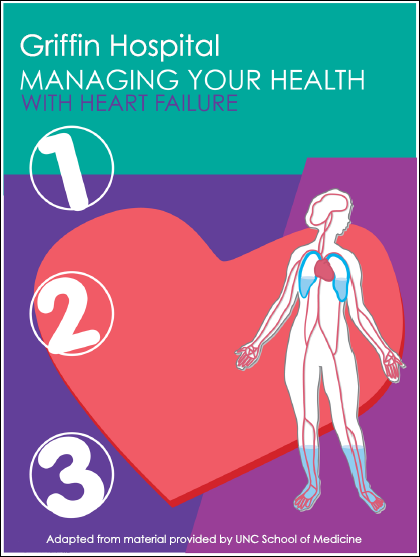
A great example is this booklet about CHF (congestive heart failure), which Griffin Hospital was kind enough to share. (Click the image to download the entire PDF, (1.7MB).) In my day job I did a bit of instructional development, so I can appreciate how well this was done: the “to-do” items are clearly presented, with NO extraneous explanation, and top-class use of icons and images. It’s all essential information, clearly presented, and nothing else. It’s what you need to do to succeed as a patient. Read more »
*This blog post was originally published at e-Patients.net*














