May 4th, 2011 by Lucy Hornstein, M.D. in Humor, True Stories
No Comments »

9:00 pm:
Hello. It’s Mrs. Mumbledimumbler; I need the doctor to call me right away. My hip is driving me crazy. Please call me.
I listen to the message three times so I can sort of make out the name. The problem is that even though I think I can understand it, I don’t recognize it at all. But I call her because she said she needed me to call her right away.
Hello. I need you to call me in some tramadol right away.
“What was your name again?”
She repeats it clearly enough for me to confirm that I really don’t recognize it.
“Have I ever seen you in the office?”
No.
Let me get this straight: it’s 9:00 at night and your hip is hurting, so you call a doctor who’s a complete stranger and insist that they call you in a powerful painkiller without ever having seen you, taken your medical history, or examined you? I don’t think so.
“Um, I’m sorry ma’am, but I really can’t do that unless you’re an established patient in my office.”
Oh, okay; never mind.
I suppose I should count my lucky stars that she didn’t want vicodin.
*This blog post was originally published at Musings of a Dinosaur*
May 4th, 2011 by Medgadget in Health Tips, News
No Comments »

 “Are you a super-spreader?” That’s the catchphrase for a new study out of the University of Cambridge. However, if you answered “yes”, you may want to stay home and cover your mouth, because the study was designed to track the spread of influenza using cellular phone technology.
The study (and accompanying app) is called FluPhone, and it uses cell phones to collect information on social encounters within the study sample of participants in Cambridge. A phone’s Bluetooth antenna detects encounters with other participants and also records the proximity to each other. The built-in GPS chip tracks each user’s location, but this feature was disabled due to recent ethical concerns. Finally, the phone’s 3G/GPRS antenna sends all the proximity data automatically back to researchers for analysis. Other features include the ability to program a specific disease model by introducing a virtual “pathogen” which can be transmitted via Bluetooth when at least two users are near each other.
In addition to revealing useful data about the spread of disease and how to minimize its effects, the study could also be helpful for creating more effective public health messages.
More from the University of Cambridge: FluPhone: disease tracking by app…
Research project page…
FluPhone participant website…
*This blog post was originally published at Medgadget*
May 4th, 2011 by Bryan Vartabedian, M.D. in Opinion
No Comments »

Should physician social networks include chiropractors? I don’t think so.
My human signal likely wouldn’t benefit from a chiropractor’s input. Similarly, I’m not sure that a chiropractor would benefit tremendously from the input of allopaths and osteopaths. This isn’t a judgment about any chiropractor’s value, it’s just that our worlds are too divergent. To suggest that ‘we all just need to get along‘ is missing the point. Complementary physical care has its place. But a great community is about people who have the capacity to make one another stronger through cooperative relationships.
I suspect that the chiropractors have the numbers to support a tidy little vertical of their own. There’s a big opportunity for someone so inclined.
Would I willingly participate in a network that connects MDs and chiropractors? I would if the network proved valuable. And that can be a challenge independent of who you invite. Sermo, for the record, excludes chiropractors from membership.
Nicholas Christakis in Connected suggests that all of this should evolve on its own, independent of what any of us individually believe.
We do not cooperate with one another because a state or a central authority forces us to. Instead, our ability to get along emerges spontaneously from the decentralized actions of people who form groups with connected fates and a common purpose.
What do you think?
*This blog post was originally published at 33 Charts*
May 4th, 2011 by Peggy Polaneczky, M.D. in Health Tips, Research
No Comments »

 Two studies published in this weeks’ British Medical Journal, one from the US and the other from the UK, report that users of drosperinone containing oral contraceptives (Yaz, Yasmin and their generics) have increased relative risks for non-fatal blood clots compared with users of pills containing levonorgestrel.
While neither study is perfect, and indeed have some very major limitations, they add to a growing body of evidence that pills containing drosperinone may impart higher risks for blood clots than older pills. Yaz is not alone in this regard – other studies have suggested that pills containing the newer progestins gestodene and desogestrel also impart slightly high clot risks than the so-called first and second generation pills containing the older progestins norethindrone and levonorgestrel.
I won’t go into the studies’ limitations here, but will say that trying to get our hands around comparative data on clot risks between various pills is an extraordinarily difficult process given that the diagnosis of blood clots is not always straightforward (or correct), pill choices are not randomized and fraught with prescribing bias, and confounding risk factors for clotting are numerous and difficult to control for. I wish folks would stop trying to answer these questions on the quick and cheap using claims and pharmacy databases without requiring chart review and strict diagnostic criteria. But that’s the way these studies are being done, and that’s the data I am being forced to contend with in my practice, so let’s talk about it. Read more »
*This blog post was originally published at The Blog That Ate Manhattan*
May 3rd, 2011 by Happy Hospitalist in Opinion, True Stories
No Comments »

 America’s handicap bathroom definition has officially left the train depot for the next station. In America, we are entitled to life, liberty and the pursuit of happiness.
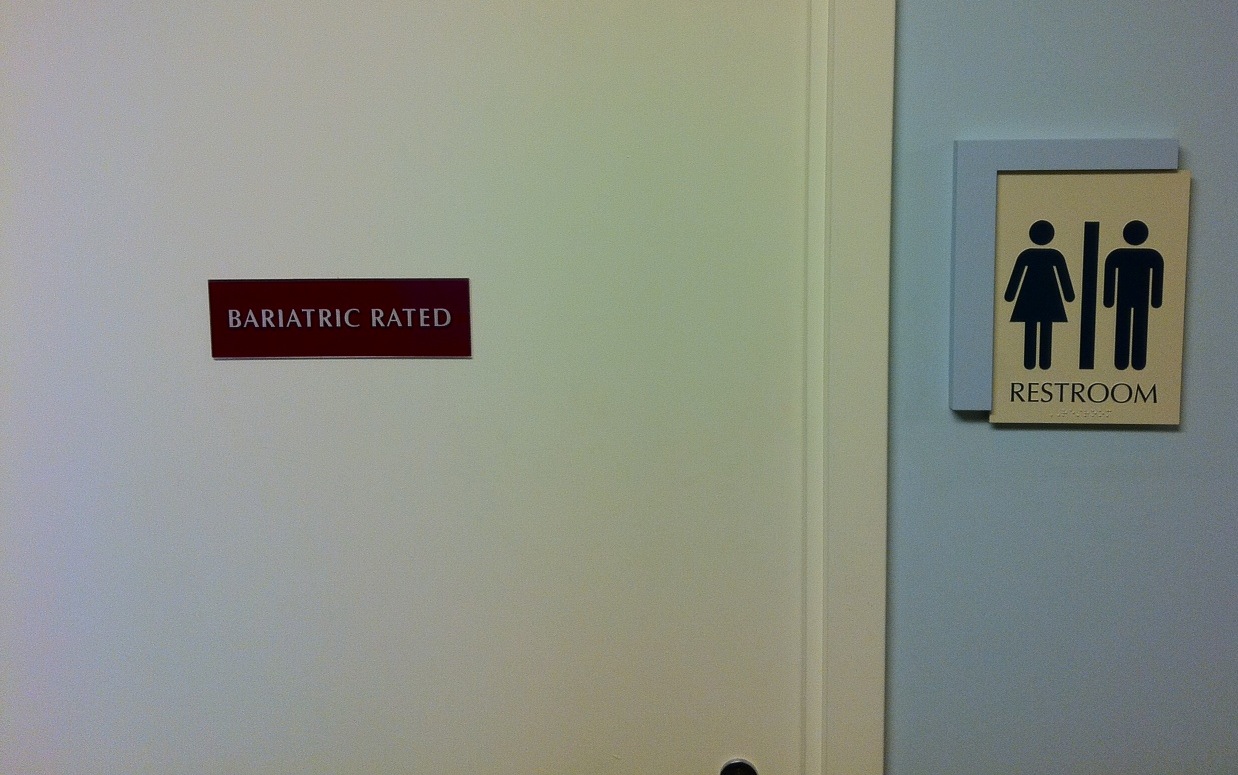
Oh yeah, and bariatric rated bathrooms. I snapped this picture of a bariatric rated “handicap bathroom” at the hospital Mrs Happy delivered Zachary
A part of me feels for folks who struggle through life outside their home in search of a toilet adequate enough to do their thing. Bathrooms and toilets simply aren’t made to hold the weight or size of 300, 400 or 500 pound people and neither are the hospital toilets.
Part of me wants to believe these bariatric rated bathrooms are for the oversized pregnant women on the floor. But the rational side in me knows otherwise. America is fat. And we have the bariatric rated handicap bathrooms to prove it.
*This blog post was originally published at The Happy Hospitalist*