February 21st, 2011 by Bryan Vartabedian, M.D. in Opinion, Research
No Comments »

 More in the evolving meme of narrative medicine: Researchers at the University of Massachusetts Medical School (my alma mater) have found that for a select population of individuals, listening to personal narratives helps control blood pressure. While the power of stories is old news, the connection to clinical outcomes is what’s newsworthy here. Read Dr. Pauline Chen’s nice piece in the New York Times. The implications for ongoing work in this area are mind boggling.
The Annals of Internal Medicine study authors sum it up nicely:
Emerging evidence suggests that storytelling, or narrative communication, may offer a unique opportunity to promote evidence-based choices in a culturally appropriate context. Stories can help listeners make meaning of their lives, and listeners may be influenced if they actively engage in a story, identify themselves with the storyteller, and picture themselves taking part in the action.
This nascent field of narrative medicine caught my eye when I stumbled onto the work of Rita Charon and the concept of the parallel chart. Extrapolation to social media may be the next iteration of this kind of work.
*This blog post was originally published at 33 Charts*
February 21st, 2011 by RyanDuBosar in Better Health Network, Research
No Comments »

The use of temporary physicians is rising, filling in until permanent physicians can be hired amid the ongoing shortage of doctors nationwide, a locum tenens firm has found. The company estimates between 30,000 and 40,000 physicians worked on a locum tenens basis in 2010.
The survey, by Staff Care, polled hospital and medical group managers about their use of locum tenens. Eighty-five percent said their facilities had used temporary physicians sometime in 2010, up from 72 percent in 2009.
Psychiatrists and other behavioral health specialists were the most sought-after specialty (22 percent of all requests), followed by primary care physicians, defined as family physicians, general internists and pediatricians (20 percent) and internal medicine subspecialists (12 percent). Hospitalists were 9 percent.
According to the survey, the primary reason cited by 63 percent of healthcare facilities was to fill a position until a permanent physician could be found. Forty-six percent of healthcare facilities now use locum tenens physicians to fill in for physicians who have left the area, compared to 22 percent in 2009. Fourteen percent use locum tenens doctors to either help meet rising patient demand for medical services or to fill in during peak times, such as flu season. Fifty-three percent use locum tenens physicians to fill in for physicians who are on vacation, ill or for other absences.
Most locum tenens physicians plan to stick with temporary practice in the short-term, the company noted. Sixty percent said they plan to practice on a locum tenens basis for more than three years, 28 percent for one to three years and 12 percent for less than a year.
Freedom trumps pay, the company noted, as 82 percent cited flexibility as a benefit, compared to 16 percent who identified pay as a benefit. Other reasons cited for working as a locum tenens include absence of medical politics (48 percent), travel (44 percent), professional development (21 percent) and searching for permanent practice (20 percent).
The locum tenens option is important to maintaining physician supply, the company concluded, because during a time of physician shortages it allows doctors who might be considering full retirement to remain active in medicine.
*This blog post was originally published at ACP Internist*
February 20th, 2011 by LouiseHBatzPatientSafetyFoundation in Opinion, True Stories
No Comments »

This is a guest post by J. Paul Curry, M.D.
I was inspired when I lost my best friend 15 years ago to a common medical-error phenomenon: The lack of monitoring patients in the hospital.
Losing Mark altered my entire career in medicine and started me on a long journey of trying to understand how this particular problem happens. The journey has been eye-opening for me for many reasons, and probably most importantly by striving to learn and understand how the human brain can deceive itself into believing that thoughtful, rational, goal-directed tactics are always the solution to finding the answers to highly-complex enigmas.
 Actually, the blockbusting solutions that change the course of our culture — how we do things — are most often totally unpredictable and discovered by accident by disruptive innovators, such as Dr. Larry Lynn of the Sleep and Breathing Research Institute, willing to tinker on their own and against the grain of thousands of smart people who dismiss this kind of outlier work as fantasy. To get just how often this happens and why, I’d invite those unfamiliar with Nassim Nicholas Taleb’s work to read “The Black Swan : The Impact of the Highly Improbable” and other books of his. This is what we’re up against today.
I was recently operated on, having a significant multi-level back surgery at one of the outstanding university spine programs in the country, supported by one of the elite anesthesia programs. I was told by the resident that I’d be going to the general care floor following my surgery, where I’d be checked on regularly. This was a given because I’m a fitness fanatic, but the resident wasn’t prepared for my followup questions. As I probed for more detail, it became apparent that no one in the organization had any inkling that nursing checks only occurring every four or eight hours on a patient fresh from surgery with patient-controlled narcotics was less than standard of care.
I told them I have mild sleep apnea and wanted pulse oximetry at minimum. I had to be upgraded to telemetry to get it. What’s more interesting is that there was so little understanding of this problem that they put me on pulse oximetry in a room where the only one who could watch it was me — the patient. Read more »
February 20th, 2011 by KerriSparling in Humor, True Stories
No Comments »

 A few weeks ago, Chris and BSparl and I went out to dinner. Dining out with our little bird is a bit of a tangled experience, and we don’t spend as much time people watching as we used to because we’re very preoccupied with the baby wrangling.
That night, though, we were sitting and settled and throwing gluten-free puffs (yes, all of us) around the dinner table like confetti when I saw this woman walk in with her family. She settled her family in at the table, and then reached to remove her coat, revealing a beeper clipped to her pocket.
Only it was one of them fancypants beepers with the tubes and the buttons and the accompanying not-making-insulin pancreas. I reckon it was an insulin pump.
Immediately, I wanted to swing mine over my head like a lasso and say “OMG lady, me too!!!” I’ve had this feeling before, of wanting to sidle up next to someone and say, “I like your pump — want to see my pump?” but to me that sounds more like an awkward attempt to flirt instead of a moment of diabetes bonding. Living in a very comfortable bubble of diabetes advocacy makes me think that everyone who has a visible “symptom” of diabetes wants to talk about it. I have to remind myself that some people just plain don’t want to talk about it.
But since I still wanted to say something, I targeted Chris instead. “Dude, 12 o’clock. Actually, my 12 o’clock, your six o’clock. MiniMed pump on that lady.” I said to Chris without moving my lips, as if a pump sighting was a covert Navy Seals operation. Read more »
*This blog post was originally published at Six Until Me.*
February 20th, 2011 by John Mandrola, M.D. in Opinion, Research
No Comments »
 It tastes sweet. It’s pleasurably fizzy. And free of calories. What’s more, the FDA says NutraSweet (aspartame) is safe. So what’s not to like about diet soft drinks?
A bunch. The ongoing debate about the healthiness of diet soft drinks reminds me of the old adage, “If something sounds to be true, it probably is.”
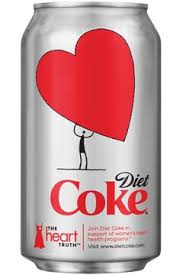
Artificially-sweetened “diet” drinks get touted as healthy alternatives to sugary drinks because they contain no calories or carbohydrates. On paper it seems plausible to think they are inert, no more dangerous than water. The Coca-Cola Company sublimely strengthens this assertion by putting a big red heart on Diet Coke cans.
But diet-cola news (Los Angeles Times) presented at the International Stroke Conference 2011 suggests otherwise. This widely-publicized observational study of 2,500 older patients (average age=69) from New York showed that drinking diet soda on a daily basis increased the risk of having a heart attack or stroke by 61 percent. The abstract — not a peer-reviewed study — stated that this association persisted after controlling for other pertinent variables.
Sure, this is only a look back at 559 patients who had a vascular event. The study asserts only an association, not that diet colas cause heart attacks and strokes. That’s a big difference.
That said, however, I don’t view these results as trivial either. This trial builds on the results of prior studies of diet drinks which strongly suggest that despite their lack of calories, diet drinks don’t prevent obesity. Read more »
*This blog post was originally published at Dr John M*












