August 7th, 2010 by Berci in Better Health Network, Research
No Comments »

Psychological Science, a journal of the Association for Psychological Science, published a very interesting paper focusing on the genetic background of social drinking. Specific gene variants might increase the risk for extensive alcohol use or abuse when spending time with heavy-drinking peers. An excerpt from Medical News Today:
Drinking alcohol increases levels of dopamine –- a brain chemical that causes pleasure and makes us feel good. The dopamine D4 receptor gene (DRD4) has been shown to be involved in motivation of seeking out rewards. Research has suggested that carrying a specific form (or variant) of this gene –- one that includes seven or more repeats of a certain section of the gene –- may be associated with craving caused by alcohol-related cues. Psychological scientist Helle Larsen from Radboud University in The Netherlands and her colleagues wanted to investigate if this 7-repeat gene variant plays a role in how an individual responds to alcohol-related cues.
The results showed an effect between how much the confederate drank and the gene variant on volunteers’ alcohol consumption: When the confederate was seen consuming three or four drinks, carriers of the 7-repeat form of the gene drank more than twice as many glasses of alcohol than did noncarriers of the gene variant. However, when the confederate consumed only one drink, there was no difference in alcohol consumption between carriers and noncarriers. These findings suggest that individuals carrying this form of the DRD4 gene may be more sensitive than noncarriers to other people’s drinking behavior.
*This blog post was originally published at ScienceRoll*
August 7th, 2010 by Bryan Vartabedian, M.D. in Better Health Network, Health Tips, Humor
No Comments »

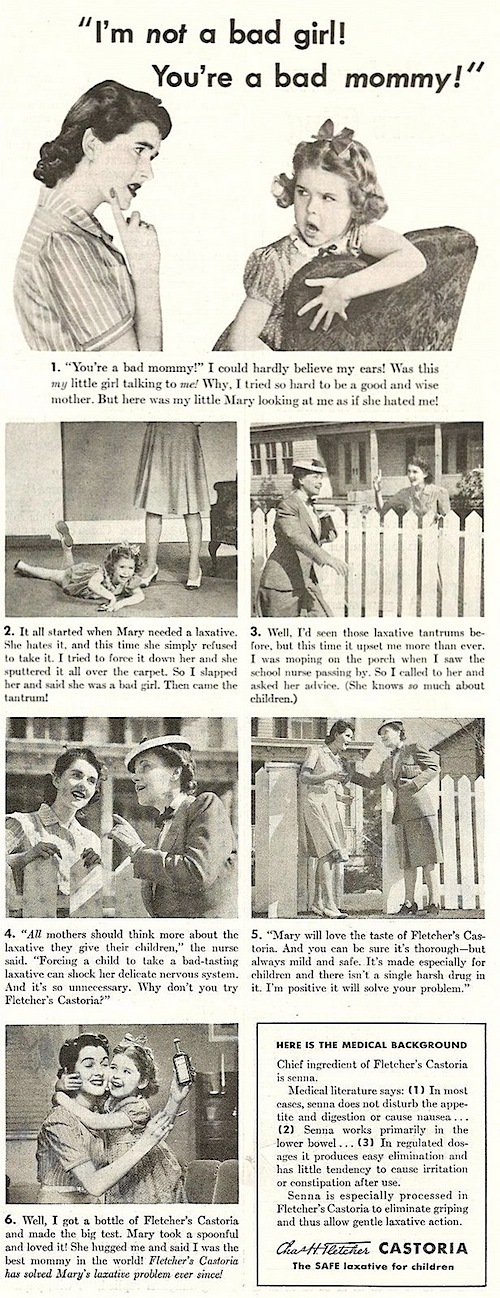
This “Fletchers Castoria” ad from 1941 is priceless. And as someone who spends his days working with bound-up grumps like Mary, I was reassured to know that horrific constipation is not a me-generation problem born of chicken fingers and Goldfish. ”Laxative tantrums,” however, are new to me. I seem to have pretty good luck with Miralax and Kristalose in my office. Your mileage (or tantrums) may vary.
*This blog post was originally published at 33 Charts*
August 7th, 2010 by KevinMD in Better Health Network, News, Opinion, Research
No Comments »

A recent study from the Annals of Internal Medicine found that doctors often discounted a patient’s social situation when making a medical diagnosis.
Lead researcher Saul Weiner “arranged to send actors playing patients into physicians’ offices and discovered that errors occurred in 78 percent of cases when socioeconomic concerns were a significant factor.”
Evan Falchuk, commenting on the results, provides some context:
It’s hard to expect even the most gifted clinician, trying to make it through yet another week of a hundred or more patient encounters, to get these difficult decisions right. Too much of the context of a patient’s care gets lost in the endless churn of patient visits that the health care system imposes on doctors.I suspect this is enormously frustrating for doctors, although it’s worse for patients. What the researchers call a failure to “individualize care,” a patient might call “not being paid attention to.” It’s a dynamic that anyone who’s been ill has probably seen firsthand.
These findings are entirely unsurprising. Read more »
*This blog post was originally published at KevinMD.com*
August 6th, 2010 by Edwin Leap, M.D. in Better Health Network, Humor, Opinion, True Stories
No Comments »

I have a new “smartphone.” It’s a Droid from Verizon. Pretty cool. I like what it can do, though it tends to enable me tendency to chronically check my email. I like the features, between ease of texting, voice dialing, etc. But it’s big, compared to me dear departed flipphone, whose corpse lies in state in my pickup truck.
But I noticed one day, as I reached around my side, that the large phone now on my hip felt remarkably like my revolver. Odd feeling that. I was in public and I remember panicking, wondering if I had forgotten to conceal my concealed weapon for some reason.
And as I pondered this, I realized that both represent fundamental differences in the way we view individuality. Maybe it’s a stretch, but I’m a writer so I’m supposed to stretch. Read more »
*This blog post was originally published at edwinleap.com*
August 6th, 2010 by Happy Hospitalist in Better Health Network, Humor
No Comments »

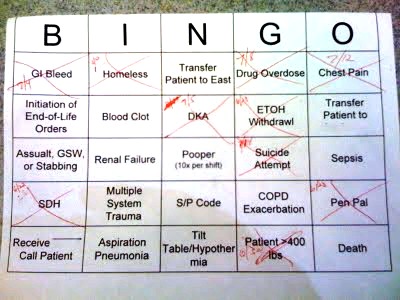
Ever wonder how ICU nurses get through their daily grind? Why, with ICU Bingo, of course.
How does ICU Bingo work? It works just like regular bingo. Every nurse receives their own Bingo card with different ICU diagnoses. And every time they take care of one of these conditions, they get to “x” it out. Fill out a line or any other predetermined design pattern, and you are the ICU Bingo winner, and you win a prize.
This is quite similar to my 2010 March Madness Hospitalist Bracket, only in this case the game is Bingo. As you can see, this nurse has already cared for a GI bleed, a homeless man, a drug overdose, chest pain, DKA, alcohol withrawal, subdural hematoma, a prisoner, and someone with super-morbid obesity. That’s ICU medicine for you.
*This blog post was originally published at The Happy Hospitalist*












