March 7th, 2010 by Toni Brayer, M.D. in Better Health Network
3 Comments »

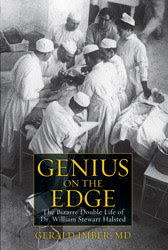 I am one who loves medical history and Genius On The Edge – the bizarre double life of Dr. William Stewart Halsted, was a captivating read. For those who don’t know, Dr. Halsted is known as the “Father of Surgery” and practiced medicine after the civil war. Written by author physician, Dr. Gerald Imber, the medical facts are sound and the story is fascinating for any reader.
We learn that in 1850 there was no anesthesia, no knowledge of germs, no IVs or blood transfusions and no more than 200 surgeries a year were performed because the outcomes were usually disastrous. The patient who needed emergency surgery died of overwhelming infection, gangrene or shock from blood loss.
Dr. William Halsted, like all physicians of that time, was born into wealth and privilege. He began his training in 1875, ten years after Louis Pasteur showed sour milk was caused by a bacteria and when Robert Koch was able to cultivate the anthrax bacillus. At a time when surgeons were not washing their hands and were operating in dirty clothes, the concept of antisepsis was a critical advance that Dr. Halsted seized for his own training. Medical Schools were for-profit trade schools and no laboratory or clinical work was required but like many wealthy young physicians, he traveled to Europe to study the newest techniques. Read more »
*This blog post was originally published at EverythingHealth*
March 6th, 2010 by Debra Gordon in Better Health Network, News, Opinion
1 Comment »

 So the American Academy of Pediatrics just came out with a statement that–gasp!–hot dogs (and hard candy, peanuts/nuts, seeds, whole grapes, raw carrots, apples, popcorn, chunks of peanut butter,
marshmallows, chewing gum, and sausages) pose a choking hazard to young children.
Maybe about a dozen children a year die from choking on hot dogs. So the AAP would like hot dog manufacturers to put warning labels on their products and consider changing the wiener’s shape so they pose less of a risk to young children.
I honestly do not know where to start. Read more »
*This blog post was originally published at A Medical Writer's Musings on Medicine and Health Care*
March 6th, 2010 by Emergiblog in Better Health Network, True Stories
1 Comment »

 Well, this is creepy!
It’s a photo from the Library of Congress‘ digital nursing collection.
It looks like a still from a Hitchcock film.
She’s going to the light….
Actually, she is probably going down to central supply for gauze.
Wouldn’t be surprised if Rod Serling stepped into view…
“Nurse Nell is about to take a step…into the Twilight Zone…”
Oh geeze, now I’m freaking myself out.
********************
I came across a blog post today. I was floored.
I have reprinted it here with permission: Read more »
*This blog post was originally published at Emergiblog*
March 6th, 2010 by KerriSparling in Better Health Network, True Stories
No Comments »

I love “free shower” – which, if you’re diabetic and using an insulin pump or a CGM, you know that means “the shower when you’re changing sites and you don’t have any hubs connected to you.”
It’s nice to lather up and not worry about catching on an infusion set or a sensor edge. Thing is, this is what’s waiting for me when I’m done getting all cleaned up:

The potlock o’ diabetes crap
Read more »
*This blog post was originally published at Six Until Me.*
March 5th, 2010 by Dr. Val Jones in Audio, Expert Interviews, Interviews
No Comments »
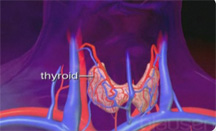 January is thyroid disease awareness month, and since an estimated 25 million people in the U.S. have various thyroid problems, I thought it would be a good idea to get an expert update on this often over-looked gland.
Victor Bernet, FACP, is Director of the National Capitol Consortium Endocrinology Fellowship at Walter Reed Army Medical Center in Washington, D.C., and the author of MKSAP 15’s chapter on disorders of the thyroid gland. I interviewed him about why thyroid disorders go undiagnosed, what alternative treatments are available, and how primary care physicians and specialists can work together to manage thyroid disease. Please listen to the audio of our conversation or check out the written summary below.
[audio:https://getbetterhealth.com/wp-content/uploads/2010/01/burnetthyroid.mp3]
Read more »


 I am one who loves medical history and Genius On The Edge – the bizarre double life of Dr. William Stewart Halsted, was a captivating read. For those who don’t know, Dr. Halsted is known as the “Father of Surgery” and practiced medicine after the civil war. Written by author physician, Dr. Gerald Imber, the medical facts are sound and the story is fascinating for any reader.











