September 15th, 2009 by Dr. Val Jones in Announcements, News
No Comments »
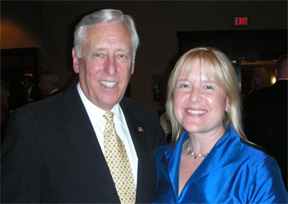
Rep. Steny Hoyer & Dr. Val
House Majority Leader Steny H. Hoyer offered the keynote speech at the Youth of the Year awards for the Boys & Girls Clubs of America (BGCA). Rep. Hoyer was himself a member of the club in his late teens, and credits it for turning his life around and setting him up for career success.
Rep. Hoyer reminded the audience about how critical it is for young Americans to have positive role models, a safe place to socialize, and adults who believe in them. The BGCA is also involved in reducing and preventing childhood obesity – a national crisis of great medical importance.
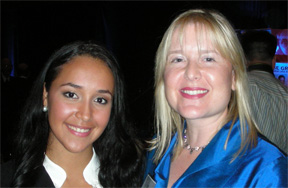
Carolina Correa & Dr. Val
Young Carolina Correa, the 2009 Northeast Region Youth of the Year, introduced herself to me at the event. She was bright and confident – and it was only during her speech to the crowd that I discovered that she had survived a triple family homicide in Colombia, moved to the US with her mom and ailing step dad, and worked as a child laborer to provide for her family and younger brother. Thanks to the Boys & Girls Clubs, she managed to overcome all her obstacles and find peace in the midst of her personal storm, achieving academic and athletic excellence in the process.
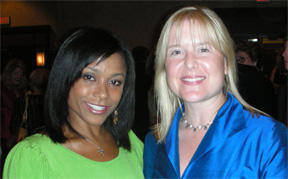
Dominique Dawes & Dr. Val
Olympic gymnast Dominique Dawes is a strong supporter of the BGCA – and helps to inspire young members to get fit and pursue athletic careers.
Tomorrow I’ll be moderating the Be Healthy event on behalf of the BGCA. A panel of experts will be revealing promising new research results – demonstrating how BGCA’s Triple Play program has dramatically reduced obesity rates among those who enroll in the program.
With 70% of obese children becoming obese adults, and obesity itself costing at least 10% of all healthcare spending – any program that bends the obesity curve is welcome news. So stay tuned for more coverage on BGCA’s approach to helping kids get fit – and developing lifelong character in the process.
I myself am humbled to spend time with youth (like Carolina) of such character and perseverance. They are truly inspirational.
September 15th, 2009 by Kenneth Trofatter, M.D., Ph.D. in Better Health Network, Health Tips
No Comments »

Patient question about “Amniocentesis is Not Without Risk”:
I am 29 years old and am 21 weeks along. I just had an ultrasound a couple of days ago and was told that the nasal bone is not showing up which puts me at higher risk for a baby with Down Syndrome. I have yet to have someone tell me how much of an increased risk. I did not have the 1st trimester screenings as I’ve always said that it wouldn’t make any difference but now that it’s staring me in the face I am seriously considering an amniocentesis. I just wonder if I can go through the next 19 weeks wondering. Can you tell me what my risk is for a Down Syndrome baby? Thank you.
Previously we published a post that discussed the role of assessment of the fetal nasal bone in first trimester screening for fetal chromosomal abnormalities and, in particular, screening for Down syndrome (trisomy 21). Confirmed absence of the fetal nasal bone in first trimester has been correlated with a detection rate for Down syndrome in the range of 70% (with false positive rates dependent on maternal ethnicity – 2.2% in causcasians; 5% in Asians; and 9% in Afro-Carribeans) (Cicero, et al. Ultrasound Obstet Gynecol. 2003;21:15–18; Prefumo, et al., BJOG 2004; 111:109–112). Although determining the presence or absence of the nasal bone can clearly contribute to the risk assessment in first trimester, unfortunately, the technical difficulty of reliably obtaining an image and accurately interpreting the findings have led to more restricted use here in the U.S., even at many major academic centers.
In contrast, in midtrimester genetic screening, often done at 18-20 weeks, the finding of an absent nasal bone and to a lesser degree a hypoplastic nasal bone, is becoming more widely recognized as a major ‘marker’ for trisomy 21. In midtrimester, complete absence of the fetal nasal bone occurs in about one-third of Down syndrome babies. If a ‘short’ nasal bone (nasal bone hypoplasia), is included in the evaluation, 60% or more fetuses with Down syndrome may be detected, again with false-positive rates depending on ethnicity and the variable cut-off values for defining a “short nasal bone” in different studies (Bromley; et al., J Ultrasound Med 2002; 21:1387–1394; Bunduki; et al., Ultrasound Obstet Gynecol 2003; 21:156–160; Lee, et al., J Ultrasound Med 2003; 22:55–60; Gamez, et al., Ultrasound Obstet Gynecol 2004; 23:152–153).
One small study using 3D ultrasound found an absent nasal bone in 9 of 26 babies with Down syndrome (34.6%) and only 1 of 27 (3.4%) chromosomally normal babies, but this also meant that 9 of the 10 (90%) babies in whom complete absence of the nasal bone was found had Down syndrome (Goncalves, et al., J Ultrasound Med 2004;23:1619-27). In a recent study of 4373 babies evaluated in midtrimester, complete absence of the nasal bone was found in about 30% of Down syndrome and only 1% of chromosomally normal fetuses . (Odibo; et al., Am J Obstet Gynecol 2008;199:281.e1-281.e5). Nasal bone hypoplasia, defined in this study as <0.75 MoM, identified 47% of Down syndrome pregnancies and occurred in 6% of normal pregnancies.
So, to our reader, I cannot give a precise estimate of increased risk based on the ultrasound findings you report. However, if the ultrasound was performed by an experienced examiner and adequate images were obtained for evaluation, the complete absence of a fetal nasal bone at 21 weeks, even as an isolated finding, is disconcerting. The risk for Down syndrome could be as high as 90% and the false positive rate 5% or less. And, if you really need to know whether or not your baby is affected, an amniocentesis would be the best way to get that information. Best wishes and please let us know what you find out.
Dr T
This post, Absence Of Fetal Nasal Bone Is A Marker For Down Syndrome, was originally published on
Healthine.com by Kenneth Trofatter, M.D., Ph.D..
September 15th, 2009 by Medgadget in Better Health Network, News
No Comments »

 Researchers from the University of Sheffield, with collaboration of a team from the University of Edinburgh, are experimenting with a voice replacement technique for people who are about to lose their vocal cords. The group partnered with a woman that was going to have her vocal cords removed in a scheduled cancer surgery. Prior to the procedure, her voice was recorded on a computer and then used as a template to create a digitized voice that sounds very much like her. We are 100% for this new technology, as we can’t stand that terrible, scary, artificial voice converter that’s being used nowadays.
The voice was built using around seven minutes of speech from the client, which amounted to 100 sentences. This method is therefore much more practical than established `Voice Banking´ technologies which require two or three hours of recording to build a voice.
The client´s regenerated voice was developed by University of Sheffield Master´s student Zahoor Khan as part of his dissertation, with guidance from research student Sarah Creer, whose doctoral work uses the same technique to improve the voices of people with speech disorders. Their work forms part of the research done within the CAST (Clinical Application of Speech Technology) group, which is a multidisciplinary research group interested in applying speech technology in clinical areas such as assistive technology, speech and language therapy and electronic control systems.
Researchers have since assessed the quality of the recordings by getting listeners to judge the similarity of the simulated voice with the original and by asking Mrs Chapman and her family what they think of the voice. All listeners have thought the regenerated voice sounded very similar to the original.
Researchers in CAST hope to use these personalised synthetic voices in communication aids for people whose speech has become intelligible, speaking for them like a human interpreter.
Bernadette Chapman [the study subject] said: “For many years the Servox machine, or artificial larynx, has been the main means of communication for patients following laryngectomy or for those who have had severe speech impairment. The machine tends to sound very like a dalek and can be very embarrassing to use, especially in public places.”
Press release: Researchers rebuild a voice
Image: soundman1024
(hat tip: The Engineer Online)
*This blog post was originally published at Medgadget*
September 15th, 2009 by Bongi in Better Health Network, True Stories
No Comments »

 M and M was never fun. Sometimes I would walk out feeling I’d just escaped by the skin of my teeth. Sometimes I would feel like my teeth had had too close a shave. But once…just once, it could have been worse.
It was a pretty standard call. It was very busy. In the early evening I was called to casualties for a patient with severe abdominal pain. When I examined him it was clear there was something seriously wrong inside. He had a classical acute abdomen with board like rigidity. He clearly had a perforated peptic ulcer and needed surgery. I set my house doctor to work to get him admitted and on the list. Meanwhile I went back to theater to work through the number of equally critical patients already on the list.
Things then settled down into a rhythm. I was in theater with a student operating the cases one after the other while the house doctor separated the corn from the chaff in casualties. Finally it was time to do the laparotomy for the guy with the acute abdomen. I needed to shoot through casualties before we started so I decided to swing past the ward and make sure the guy was still ok.
The ward was dark. Pretty much everyone was asleep. Without wanting to wake the other patients I turned on the small bedside light of my patient. Even in that dim light I could see a bit of oral thrush. I was surprised. I was thinking to myself how the hell did I miss that in casualties. I felt his abdomen. It was no longer quite so tender. I turned to the student.
“See why it is important to make your decision before giving opioids?” I said with an air of authority. “Now he is actually not so tender but he definitely had an acute abdomen. We must go ahead with the operation.”
I quickly felt for lymph nodes. He had them everywhere. Once again I was quietly thinking that my clinical skills must be slipping because that I also didn’t pick up in casualties. I kept this new information to myself. Imagine the shock to the student if he realised I was not all knowing. i just didn’t want to be responsible for that level of devastation in his life. But I started considering other causes for his condition. It was clear he had AIDS and TB abdomen started looking like a possibility.
While we were still with the patient, the theater personnel arrived to take him to theater. I told them to get things going so long while I quickly shot down to casualties to evaluate a patient the house doctor was unsure about. And off I went at a brisk walk.
I walked into casualties. The house doctor led me to the patient in question, but as we approached his bed my blood went cold. In the exact bed where my acute abdomen had been lying about four hours previously was my acute abdomen still lying there!! I turned and ran back to theater. Fortunately I was in time.
Later I found out what had happened. Once we had admitted the acute abdomen, the porter had come in to take him to the ward. One of the patients lying in casualties was a guy that had just come in. His HIV had wreaked havoc in his life causing a number of unpleasant things, including AIDS dementia syndrome. The exchange went something like this;
“Timothy Mokoena? Is there a Timothy Mokoena here?” the porter called out.
“Here I am, but it’s not Mokoena. It’s Magagula.”
“Ok, Timothy Magagula, I’m going to take you to the ward.”
“Ok, but it’s not Timothy. It’s Michael.”
“Ok, Michael Magagula. Let’s go.”
And thus Michael Magagula, the AIDS dementia patient (not to be confused with Timothy Mokoena, the acute abdomen patient), thinking he had just jumped the queue to see a doctor was carted off to the ward and prepared for theater. He even signed for a laparotomy without even having seen a doctor.
In the end it all turned out well. Timothy got his operation and the hole in his stomach was patched. Michael was referred appropriately to the physicians. But I couldn’t help wondering how this could have looked in the next M and M meeting.
“Well, prof, the patient died on the table basically because I operated him unnecessarily.”
“And how is the other patient? The one you should have operated?”
“Well, he died too because I didn’t operate him.”
200% mortality for one operation. Not easy to achieve.

*This blog post was originally published at other things amanzi*
September 15th, 2009 by KerriSparling in Better Health Network, Health Tips, True Stories
No Comments »

 Taking a cue from Rachel and Cherise, I wanted to post my diabetes “bad habits.” (Unfortunately, it didn’t take long to come up with six.) But thankfully, after months and months of extreme tweaking, my bad habits aren’t nearly as bad as they used to be.
1. Bolus-Stacking. (See also: rage bolusing) I have a very, very bad habit of stacking boluses when my blood sugar is high. You know … test and see that 212 mg/dl, take two units to correct it back to 100 … test again 45 minutes later to see 245 mg/dl staring back at you … freak out and take another unit for good measure … test one more time an hour later to see no real change … lace in two more units because you’re angry and frustrated and sick of the high … only to crash five hours later with a 45 mg/dl with your face mushed into a can of Pillsbury frosting. Not that I’ve done that. But if I were to do that, it might play out just like that.
2. Carb Winging It. Until recently, I’ve been an estimator. A SWAGger (scientific wild-ass guesser). Someone who kind of wings the whole carb-counting thing and hopes that there were only about 15 grapes in that snack bag or that the apple was really “small” instead of “medium.” With the little weeny doses of insulin I take, counting carbs with precision is crucial to making sure my numbers stay stable, so when I’m guessing as to the carb count, the blood sugar results go all over the place.
3. Shooting with a Mouthful. This is a bad habit pointing out by my endocrinologist a few months ago, and one that was wicked hard to break. And I have no idea how I ended up in this terrible habit to begin with, but it’s not good. I had a terrible tendency to start eating, then decide to bolus. Even if the carbs were counted perfectly and the insulin dose went in without issue, I wasn’t giving the insulin any time to act before introducing the carbs. Thus, making my numbers go berserk after meals. No more shooting while I’m eating. Now I need to shoot up before eating. Makes a big difference.
4. Self-Consious During Workouts. Another bad habit. When I go to the gym, I used to leave my insulin pump at home and then reconnect when I returned. It worked out to keep me from going low during workouts, yes, but it was also because I didn’t like having the device attached to me while I was wearing form-fitting workout clothes. Stupid Kerri. Sure, I was avoiding the lows, but I was also ending up close to 180 mg/dl by the end of my workout. With pre-pregnancy goals of 150 or lower, this is unacceptable. So I have to suck it up and wear the pump while I exercise and even sometimes go easier during a workout to avoid lows, instead of sacrificing blood sugar control for an extra mile on the treadmill.
5. Log Lagging. I have a good habit of starting logbooks, but a terrible time keeping up with them. This has been a hard habit to break (habit to break), but I’m close to turning it around. Logbooks are my diets – I am excellent at the outset, but then I fall apart. Thankfully, I’ve got a team at Joslin and a husband at home who are helping keep me accountable, and it’s making a world of difference.
6. Blame Game. And a sixth (but certainly not the last) bad diabetes habit that I have is my role in the blame game. I put a lot of pressure on myself to get things “right” and when the diabetes outcome isn’t what I’m hoping for, I tend to blame myself. I have to constantly remind myself that strong efforts and a decent attitude go a long way in this marathon, and I can’t beat myself up for every low or high that crops up randomly. Diabetes isn’t fair, and it isn’t easy, and it sure as hell isn’t my fault, so I just need to roll with the punches as gracefully as I can.
What are your diabetes bad habits? Or maybe it’s better to ask – what are your good diabetes habits? I’m going to have to concoct another “good” list soon – they’re way more fun. 🙂
*This blog post was originally published at Six Until Me.*














