March 29th, 2010 by BobDoherty in Better Health Network, Health Policy, News, Opinion
Tags: ACP, American College Of Physicians, FactCheck.com, General Medicine, Healthcare Legislation, Healthcare Policy, Healthcare reform, Kaiser Family Foundation, Politifact.com, Primary Care, Washington Post
No Comments »

With the vote on the healthcare reform legislation behind us, it’s nice to believe that we can now move to the stage where people begin looking at what the legislation will and will not do — not based on speculation or the political rhetoric, but what is actually in the legislation itself.
I realize that this is unlikely, since we all tend to engage in cognitive dissonance when confronted with information that does not square with our own pre-conceived notions, political leanings, and philosophical bent. I know I do it (as much as I try not to) and I’m sure this is true of just about all of us. Still, there are trusted and highly-credible sources of information that I hope will be of value to anyone who is open to learning more about the new healthcare legislation and its potential impact. Read more »
*This blog post was originally published at The ACP Advocate Blog by Bob Doherty*
March 29th, 2010 by Toni Brayer, M.D. in Better Health Network, Health Policy, News, Opinion
Tags: General Medicine, Health Insurance, Healthcare Policy, Healthcare reform, Primary Care
No Comments »

It’s history — healthcare reform has finally passed. Yes, it’s a watered-down bill that leaves much to be desired, but it’s a start. After months of stops, starts, rhetoric, fear mongering, empty promises and long, heated debate, many Americans aren’t sure of what just passed. It will have different effects on different people and many of the provisions are delayed until 2014. Here are a few features of the new bill:
– Insurers will be prohibited right away from excluding children with pre-existing health conditions. Adults will have to wait until 2014 to be assured of coverage.
– Health plans will have to provide immunizations and other preventive health services for children and adolescents.
– Insurers cannot charge higher insurance premiums for woman and maternity care is covered.
– Most U.S. citizens and legal residents must purchase “minimal essential coverage” for themselves and their dependents, either through the employer or exchanges that will sell policies to individuals. By 2014 you will pay a tax penalty if you ignore this mandate. Read more »
*This blog post was originally published at EverythingHealth*
March 29th, 2010 by Shadowfax in Better Health Network, Health Policy, News, Opinion
Tags: ACEP, American College of Emergency Physicians, Emergency Medicine, Emergency Room Patients, ER Doctors, Healthcare Policy, Healthcare reform
1 Comment »

Last year when I interviewed then-American College of Emergency Physicians (ACEP) President Nick Jouriles I was disappointed that the ACEP had not staked out a clear position on healthcare reform. However, it wasn’t terrible that they didn’t have a position at that time, because the House bill was still being finished up and the Senate was still mired deeply in the fruitless “Gang of Six” negotiations. If ACEP wasn’t going to endorse reforms sight unseen, that was pretty reasonable, I thought. President Jouriles suggested that, in time, ACEP would weigh in with a position, one way or the other.
But we never heard ACEP take a position in the intervening months. So when I saw this post appear over at The Central Line, linking to this letter on the ACEP web site from ACEP’s current president, Angela Gardner, I was not surprised to see that ACEP has taken the weasel’s path and abstained from taking a position on the more or less final healthcare reform package. It’s pathetic, and brings into question whether ACEP can fulfill one of its most crucial functions: advocating for emergency room patients and advocating for emergency medicine physicians. The excuses offered by Dr Gardner for ACEP’s reticence to take a stand are fairly lame. Read more »
*This blog post was originally published at Movin' Meat*
March 28th, 2010 by Happy Hospitalist in Better Health Network, Health Tips, Opinion, True Stories
Tags: General Medicine, HIPAA, Medical Records, Patient Confidentiality, Patient Privacy, Primary Care
No Comments »

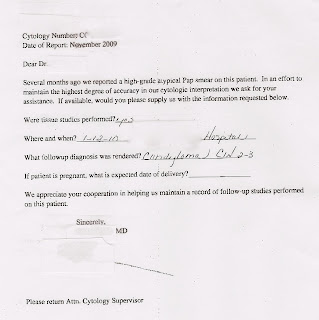 Have you ever asked yourself the question: “Who has access to my medical records?” It’s supposed to be secure. Your medical records are supposed to be protected. For many people, they don’t want anyone knowing they have genital warts or that they were treated for depression five years ago.
Many people believe that those with access to their medical records protect their privacy according to HIPAA rules. Well folks, I’m sorry to be the one to tell you, but your medical records aren’t as secure as you may think they are. In fact, if you live in Happy’s town, you might even be lucky enough to have ME get access to your medical records without even trying.
You see, my home fax number is very similar to a laboratory fax number in my city. And because of that, every week I’m getting faxes from hospitals and doctors’ office with lab results. I used to call them back to let them know, but so often I’d get put on hold or have to navigate through twenty phone options that I just said “forget it.”
Now when I get these faxes I chuck them. If I feel like taking the time to shred them I may. Otherwise, they go straight into the garbage. Except for the fax I got last week regarding Mary Smith and her condyloma results. Read more »
*This blog post was originally published at The Happy Hospitalist*
March 28th, 2010 by PhilBaumannRN in Better Health Network, Opinion
Tags: FDA, Food and Drug Administration, Life Sciences, Pharmaceutical Companies, Pharmacology, Social Media
No Comments »

 There’s been an ongoing discussion about how the Life Sciences industries can face and integrate recently-evolving media which the Web has been and continues to sprout. Remarkable as they are, the discussions are endless and most loop back into themselves without generating sufficient voltage to power an army of macrophages. Additionally, pharmaceutical companies (pharma) –- beset by a myriad of constraints –- are anxious about flipping on social connection switches which the Web furiously creates every day. We could say that pharma has a sort of social media anxiety disorder. What to do?
The answer isn’t in social media. It’s not in what the FDA decides to do. It’s not in echo chambers found within Twitter or blogs or conferences. It lies in simple, basic economic truths. It lies in radical acceptance and in brave recreation. It lies beneath the proverbial nose of obviousness. It lies far beyond any discussion about the meanings and promises and purposes of new media on the Web. Pharma’s social media anxiety disorder is merely a peripheral symptom of deeper pathologies. Let’s assess the patient. Read more »
*This blog post was originally published at Phil Baumann*












