March 28th, 2010 by Bryan Vartabedian, M.D. in Better Health Network, Opinion, True Stories
Tags: Creative Thinker, Curiosity, Daniel Pink, Multi-tasking, Niche, Personal Brand, Psychology, Steven B. Johnson, Tim Sanders
No Comments »

Last week I scribbled about the future of the social health community. This week I’m in Australia speaking about screaming babies, practical parenting, and social media — such divergent things.
I’ve listened to author Tim Sanders suggest that a person needs to stick to just one thing or folks will be confused about who you really ARE — your “brand” will get fuzzy. I’m not sure. While having a niche is important, it’s not everything.
Case in point: Steven B. Johnson is one of this generation’s most talented nonfiction authors. By day he oversees his social startup outside.in. By night he travels the globe speaking about his bestselling books, among them Ghostmaps and The Invention of Air. In his free time you’ll find him writing cover features for Time magazine.
And then there’s Daniel Pink, former speechwriter for Al Gore and peripatetic bestselling author, speaker, and thinker. Manga, motivation, videos on travel tips — nothing is outside his realm it seems.
Two remarkable people defined more by their curiosity and thinking than the imposed confines of a tangible niche — and it works for them. I’m guessing that Johnson and Pink don’t spend a lot of time fashioning their look. They just “do” — and do it well. Perhaps that’s how I’d like to be seen.
*This blog post was originally published at 33 Charts*
March 28th, 2010 by DrWes in Better Health Network, Health Policy, Opinion, Research
Tags: Cardiology, Health Insurance, Healthcare Systems, Heart, uninsured
No Comments »

BACKGROUND
For those who are landing on this page for the first time, be sure to read the background FIRST to these case presentations. The intent here is to compare and contrast two patients, one insured and the other uninsured, from the United States and England as care is delivered today. The U.S. cases are described in detail in this blog and the corresponding cases, British-style, are described on Sarah Clarke, MD’s blog from England.
CASE #1: The U.S. Case of Mr. Thurgood Powell
The ER radio sounds: (*bleeeeee, deeeeeeeeeppppp*) “Rampart, we have a 57 year old white male en route with a 45 minute history of substernal chest pain and diaphoresis. Initial single-lead EKG discloses ST segment elevation. One ASA given, nitro given, BP 96/47, pulse 110, respirations 22, pt diaphoretic…”
ER doctor: “Code cor activated. Cath lab ready. Proceed as soon as possible.” Read more »
*This blog post was originally published at Dr. Wes*
March 28th, 2010 by Medgadget in Better Health Network, News, Research
Tags: Brain, Cognitive Function, Communicate With Thought, EEG-Based Writing System, Electrodes, Head, Katholieke Universiteit Leuven, Mind Speller, Nano-Technology, Nanoelectronics, Neurology, Neurophysiology, Psychophysiology, University of Wisconsin-Madison, Wireless EEG Signals
No Comments »

 Belgian researchers from the European nanoelectronics and nano-technology research center Imec, Holst Centre, and Katholieke Universiteit in Leuven developed an EEG based writing system that may be helpful for people with severe disabilities.
The Mind Speller, though, seems very similar to University of Wisconsin-Madison’s communication tool we wrote about a year ago that flashes rows and columns of characters and monitors when the brain notices the character it wants to type.
It detects and interprets P300 event-related potentials in the EEG-signals of a person that is selecting characters from a display presenting alternate rows and columns of characters. P300 potentials are often used as metrics of cognitive function in decision making processes. However, currently available P300 devices are large, expensive and uncomfortable in use. Read more »
*This blog post was originally published at Medgadget*
March 28th, 2010 by Berci in Better Health Network, Health Tips, News, Research
Tags: Capsules, FDA, FDA-Approved Drugs, Food and Drug Administration, National Library of Medicine, NLM, Pharmacology, Pill Indentification System, PillBox, Solid Dosage Pharmaceuticals, Tablets
1 Comment »

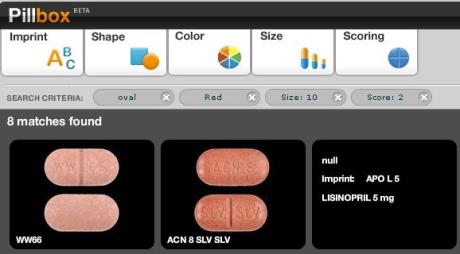 Pillbox is the result of a partnership between the National Library of Medicine and the Food and Drug Administration. It helps you identify unknown pills and tablets by parameters such as form, color, size or imprint. The constantly updated database now has more than 7,000 entries with images.
Pillbox was developed to aid in the identification of unknown solid dosage pharmaceuticals. The system combines high-resolution images of tablets and capsules with FDA-approved appearance information (imprint, shape, color, etc.) to enable users to visually search for and identify an unknown solid dosage pharmaceutical. Read more »
*This blog post was originally published at ScienceRoll*
March 27th, 2010 by Peggy Polaneczky, M.D. in Better Health Network, News, Opinion, Research
Tags: Breast Cancer Death Rates, Breast Cancer Mortality, Breast Cancer Screening, British Medical Journal, Denmark, Imaging Studies, Mammogram, Mammography, Preventive Screening, Promised Effect, Radiology
No Comments »

 A well-done analysis in the BMJ this week calls into question previous research that has been used to tout mammography as an effective tool for lowering breast cancer mortality in Denmark. That previous study compared breast cancer death rates in Copenhagen, where women were offered screening mammography in 1991, to areas in Denmark where mammograms were not offered until 17 years later, and concluded that the introduction of mammogram screening resulted in a 25 % reduction in breast cancer mortality in screened areas.
The new study adds an additional county where screening was offered (with a little implication that perhaps the previous researchers should have included this other area, but I’ll stay out of the academic finger pointing) and then reanalyzes the data. Read more »
*This blog post was originally published at The Blog that Ate Manhattan*