March 15th, 2010 by EvanFalchukJD in Better Health Network, Health Policy, Opinion
Tags: Conspiracy Theories, Ezra Klein, Government, Health Insurance, Healthcare reform, Industry
1 Comment »

 Why has health care reform run into so much trouble?
Well, it could be because people think reform plans will affect them in ways they aren’t going to like. Or because people don’t believe politicians in Washington who say that spending huge amounts of money will actually save money. Or because confusing mixed messages and ever-shifting sales pitches create a lot of anxiety about what’s really going on. It could be all of those things.
Or, it could be something more….sinister…. Read more »
*This blog post was originally published at See First Blog*
March 15th, 2010 by Paul Auerbach, M.D. in Better Health Network, Health Tips
Tags: Ankle, Ankle rules, Broken Ankle, Emergency Medicine, Pediatrics, wilderness medicine
No Comments »

 There are rules that have been advocated for doctors to use to determine the need for x-rays (radiographs) in the setting of a possible ankle fracture (broken ankle). The purpose for using rules is to avoid unnecessary exposure to radiation. In the wilderness, there is not likely to be an x-ray machine available. Therefore, the rules might be useful to give the rescuer (or a parent) more confidence about what clinical presentation is likely to be or not be a broken bone. This would be important in terms of deciding whether or not to allow weight-bearing, such as would occur if a victim needed to walk out under his or her own power. Read more »
This post, How To Tell If A Child’s Ankle Is Broken, was originally published on
Healthine.com by Paul Auerbach, M.D..
March 14th, 2010 by DrCharles in Better Health Network, True Stories
Tags: Depression, Psychiatry, Shopping
No Comments »

 He wasn’t like some other men who moan and protest the very idea of shopping with their wives. He wouldn’t throw small tantrums at the idea of spending money on beauty, belts, and blouses. He enjoyed strolling around the city streets, feeling the sun warm the concrete, watching the wild array of people and their interactions with the world. But as soon as he would step into a small boutique and close the door behind him, the tinkling of little bells on the door handle was like a Pavlovian cue to feel a different sort of anxiety beyond spending money. For the walls seemed to close in on both him and those sad, tragic characters looking up from their registers, smiling and greeting him with: Hello, is there anything I can help you with today? Read more »
*This blog post was originally published at The Examining Room of Dr. Charles*
March 14th, 2010 by Joseph Scherger, M.D. in Better Health Network, Health Tips, Research
Tags: Abdominal Fat, Belly Fat, Central Obesity, Dementia, Family Medicine, Geriatrics, Neurology
No Comments »

One of the great fears we all have is to lose our mental ability as we grow old. No one wants to end their life with dementia (such as Alzheimer’s Disease). We all should be highly motivated to do things to avoid this tragic outcome. We already know that regular exercise is good for the mind and may reduce the risk of dementia. Recent evidence shows that the use of statin medications to lower cholesterol may help reduce dementia risk. Now we have evidence that the roll of fat around your waist may be a marker for increased dementia risk.
The University of California, Berkeley Wellness Letter (February, 2010) reports on a study published in the journal Neurology that followed 1500 Swedish women for 30 years. Those with more fat around the waist were twice as likely to have dementia by age 70 compared with thinner women. A 2008 study from Kaiser Permanente that included men and women showed similar results. Read more »
*This blog post was originally published at eDocAmerica*
March 14th, 2010 by Toni Brayer, M.D. in Better Health Network, Health Tips
Tags: Comfort Food, Diet, Food and Nutrition, Healthy, Psychiatry, Psychology, Weight Loss
No Comments »

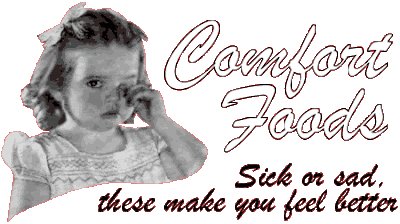
Comfort food is usually home made and carries some emotional significance with it. During times of stress or illness people often turn to “comfort foods” to feel better. Most everyone has a favorite comfort food and comfort foods are not necessarily one’s favorite food. Ask yourself…what is my favorite food? Then ask “At the end of a long day, when I’m tired and stressed or sick in bed, what food would I like a loved one (mom) to fix for me?
Comfort foods are often fattening or unhealthy…macaroni and cheese, chocolate cake, fried chicken, chocolate pudding. Foods that are high in carbohydrates and sugar are often connected to childhood and make you feel homey and good. And different cultures have different comfort foods. Rarely is yogurt or a handful of almonds a comfort food in any culture. Read more »
*This blog post was originally published at EverythingHealth*


 Why has health care reform run into so much trouble?