September 8th, 2009 by KerriSparling in Better Health Network, True Stories
Tags: Caffeine, Coffee, Diabetes, Obstetrics And Gynecology, Pregnancy
No Comments »

I did it.
I started my mission while we were on vacation in Barcelona, because between the time change and our eating schedule and the fact that sleep was a hot commodity, it was a good time to let go of the caffeine addiction. No real withdrawal, no extreme headaches, and no unrighteously sassy moments where I can’t function “WITHOUT MY CUP OF COFFEE DAMNIT!”
This is a big step for me, because coffee and I were buddies.

Bestest pals.

Friends all day long.
But now, I have a new pal. Someone who can still be part of the collection of stupid iPhotos that the editorial team snaps every few days. (These photos are known as the Friday Face-Off, where we take one photo to emulate, like this one (my version) or this one, and we all recreate it ourselves, then paste them together as a college. My favorite so far was when we all tried to look like my chubby-cheeked niece. But I’ve once again digressed. Ignore me.)
My new pal is decaf, and I have embraced the change. The coffee shop downstairs makes a mean iced decaf coffee, and just a short walk away from my office is a fabulous graham cracker flavored coffee that comes in delicious decaf. I am finally weaned off the caffeine, but I still get to enjoy the taste and the “coffee runs” that are part of the social routine in my office.
It’s nice to feel free.
It’s also nice to not drink so much coffee that my fingertips actually jitter to the point where I can’t type a sentence without mangling most of the words.
FutureBaby, I hope you appreciate this. Because it was HAAARD. But I know it was worth it.
*This blog post was originally published at Six Until Me.*
September 8th, 2009 by Dr. Val Jones in Health Tips, True Stories
Tags: Family Medicine, Geriatrics, Long Life, Oncology, Prostate Cancer, Secret, Urology
No Comments »
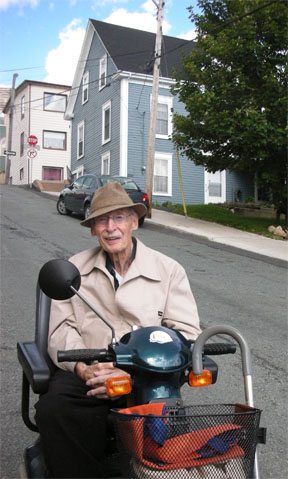 Ed Walker is 102 years old. I met him by chance on a steep hill in Lunenburg, Nova Scotia – not long after my husband blurted, “I hope you’ve got good brakes on that scooter!” Ed pulled up next to us (to demonstrate his brakes) and jubilantly announced his age, along with his suspected reason for it: “I have prostate cancer but chose to leave it alone.”
I chuckled to myself, thinking that he was probably right about his longevity-hospital avoidance connection.
Of course, the diagnosis and treatment of prostate cancer is being hotly debated these days. While no one likes the idea of leaving cancer untreated, slow-growing prostate cancer may be less of a threat to men at a certain age than the treatment required to cure it. And that’s a difficult truth to accept – especially for Americans.
My fellow blog contributors have noted the disconnect between scientific evidence and clinical practice in regards to prostate cancer. According to a recent study in the New England Journal of Medicine, PSA (a screening test for prostate cancer) testing has not made a difference in overall longevity. Urologists still favor testing (the American Urological Association guidelines recommend initiating PSA testing for all men starting at age 40) while family medicine physicians don’t usually recommend it. Is there a conflict of interest driving this difference in recommendation? Perhaps – though I suspect it has more to do with a surgical mentality (to cut is to cure!) than a conscious decision to protect one’s income. If you think there’s a shortage of urologic procedures to go around, then I’d recommend you simply consider the increasing age of the US population. It’s not as if the prostate gland is the only thing that needs work “down there.”
Perhaps Americans can take some cues from their elderly neighbors to the north – and try to accept that doing something is not always better than “doing nothing.” In the case of some prostate cancers, it’s cheaper, safer, and a lot less painful.
Just ask Ed Walker.
September 7th, 2009 by Shadowfax in Better Health Network, Quackery Exposed, True Stories
Tags: Complementary And Alternative Medicine, Gerson Protocol, Lymphoma, Oncology, Primary B-Cell Lymphoma
No Comments »

I saw one of the most disturbing things of my career recently — and that is really saying something.
This was a young woman, barely out of her teens, who presented with a tumor in her distal femur, by the knee. This was not a new diagnosis — it had first been noted in January or so, and diagnosed as a Primary B-Cell Lymphoma. By now, the tumor was absolutely huge, and she came to the ER in agonizing pain. Her physical exam was just amazing. The poor thing’s knee (or more precisely, the area just above the knee) was entirely consumed by this massive, hard, immobile mass about the size of a soccer ball. She could not move the knee; it was frozen in a mid-flexed position. She hadn’t been able to walk for months. The lower leg was swollen and red due to blood clots, and the worst of the pain she was having seemed due to compression of the nerves passing behind the knee. It was like something you see out of the third world, or historic medical textbooks. I have never seen its like before.
So we got her pain managed, of course, and I sat down to talk to her and her family.
What I learned was even more amazing. The patient had been seen by the finest oncologists in the region upon diagnosis. They had all recommended the standard treatment of a combined regimen of chemotherapy and radiation. She had, however, steadfastly refused this treatment. She preferred, she said, the “Gerson Protocol.” This is, she continued, “a way for the body to heal itself with a combination of detoxification and boosting the immune system.”
In a less grave situation I might have laughed and asked “So how’s that working for ya?” As it was, the tears from her only partially-controlled pain took any humor out of the situation. She was very frustrated that the Gerson therapy wasn’t working yet, but she did not perceive this as a failure of the treatment. Her theory was that the severity of her uncontrolled pain was keeping her immune system suppressed and preventing it from working. If, she hoped, she could just get her pain under control, she would finally start to get better.
I spent a lot of time with this young lady. Listening as well as explaining. She was dead set against chemo, which to her mind was equated with the “toxins” which had caused her cancer in the first place. She wrote off the oncologists as pushing chemo “because that’s all they know how to do, and it never works.” She had, in fact, burnt all the bridges with the various oncologists who had treated her, and was now left with only a pain specialist and a primary care doctor trying to do what little they could for her. She was equally frustrated by doctors in general, who “won’t do anything to help me.”
I could see why she felt that way; when a patient refuses the only possible effective treatment, there is not really much we can do to help her.
I did what I could. I talked to both her doctors, and I called a new oncologist. The oncologist, a wonderful man, promised to make time to see her in his clinic, even fully forewarned of the “baggage” she would be bringing with her. She was happy to receive the referral, though I warned her that the new oncologist would be recommending more-or-less standard treatments. Ultimately, she went home and I was left to reflect on the futility of the situation and the absolute wickedness of the charlatans and hucksters out there who promote this sort of thinking. From the late Dr Gerson, to his modern-day counterparts Andrew Wakefield and Jenny McCarthy.
Most woo is harmless — but that’s because most woo is directed at chronic, ill-defined, or otherwise incurable conditions. Think chronic fatigue or fibromyalgia. Wave a magnet at somebody, get them to do a lot of enemas and go on a special diet, and you get to write a book and go on Oprah and collect a lot of money. If the subjects of the “magical thinking medicine” think they are better from the intervention, then so much the better.
But the really pernicious thing about allowing fantasy medical theories and treatments into the mainstream is that when they gain enough credence among the masses, they will tend to be used in place of real medical treatments that work. Like vaccines. Even the anti-vaxxers have a limited and indirect harm — of the many thousands of children who go unvaccinated, only a very few get measles and even fewer die. It’s a real harm, but one which is easy to miss if you’re not affected personally. But when woo supplants real medicine against lethal diseases that actually have effective treatments, the harm is so much more severe and so apparent that it cannot be left unrecognized. Because of the practitioners of “alternative” medical treatments who irresponsibly and dishonestly teach people to distrust medicine and embrace unscientific treatments, this young woman is enduring incalculable pain, and may well lose her life.
It’s sad, and it’s an outrage.
*This blog post was originally published at Movin' Meat*
September 6th, 2009 by Dr. Val Jones in Health Tips, True Stories
Tags: Canada, Colon Cancer, Gastroenterology, General Surgery, Healthcare System, Perforated Colon, Peritonitis, Ruptured Bowel
No Comments »
Today an elderly physician friend of mine woke up with some very mild abdominal pain. He is a stoic man, and never complains about anything – not even the pain associated with a dislocated/shattered hip and multiple bone fractures from a car accident (he was very nonchalant about that event 2 years ago).
So when I heard that he was going to see a doctor about his belly pain – I knew that something serious was afoot. His doctor ordered an abdominal x-ray series, noted a tumor, and sent him to the O.R. within the hour.
In the O.R. the surgeons found a perforated colon (it must have ruptured minutes to an hour or two prior) without signs of peritonitis. There was a cancerous mass (without metastases) that they were able to remove completely. They washed his peritoneal cavity extensively to remove all fecal matter and potential cancer cells and transferred him to the ICU for observation overnight and IV antibiotics.
So far it seems that my friend will make a full recovery – and there is no evidence of remaining cancer, though we’ll need to be vigilant with follow up.
I can’t get over how lucky he was to have discovered the perforated colon within hours of it occurring, that the surgeons took care of him immediately, and that the cancer seems to have been contained and removed. I don’t know if his “luck” was partially due to his physician’s intuition about his own body, professional courtesy extended to him by peers, or that the Canadian healthcare system is not as burdened in his part of the country (Nova Scotia) as it is in others where there may be longer wait times.
All I can say is that my friend is one lucky Canadian!
September 5th, 2009 by Bongi in Better Health Network, True Stories
Tags: Medical School, Memories, South Africa, Tree
No Comments »

 When I got accepted into medicine as a last minute add-on due to one of their other applicants turning down the post, I knew how lucky and privileged I was. It was the first step in a very long journey and I wasn’t going to mess it up.
The first year in those days was spent at the main campus and we would only be at the medical campus from second year onwards. Second and third years would be spent on the pre-clinical campus and only from fourth year onwards would we be in close proximity to the big boys. All this I didn’t know when, during first year orientation they bussed us to the medical campus so we could see the preclinical buildings and watch with a fair amount of jealousy when the higher year students walked past. The whole medical training thing was very hierarchical. It didn’t bother me. I had been in a similar system before and had moved up the ladder. I could do it again.
The preclinical campus was a very relaxed place. There were essentially only two buildings (ok, ok there was also the dentistry building but we didn’t go there) with a large grassy lawn between them. There were a few trees providing shade for groups of students lying on the grass and reading or chatting. Our group of first years on orientation clearly didn’t seem to fit in. None-the-less we found a tree to sit under during a short break in the orientation program.
And there I sat in a state close to euphoria with my hopes and my dreams all layed before me. I knew I stood at the beginning of a journey that would lead me to what I one day would be. What I was at that stage was of little significance other than the fact that it was a pointer to what I would become.
I lay under the tree and, as best I could, told my friend who was with me about these thoughts. I then added that I would use the tree as a sort of temporal marker that I could come back to when I was finally what I would be. Then I would stand under the tree and remember that exact moment when I looked into the unknown future with innocent hopes and dreams.
Recently I had the opportunity to go back to the preclinical campus. I remembered that moment so many years ago and was quite eager to stand under that same tree and reflect about the years that had passed and what I had become. On that day, so long ago, I would never have guessed that I would have gone on after medicine to specialise in surgery, so I actually achieved more than I dared dream. I was really looking forward to a moment that would link one specific moment in the past with the present.
The campus was just as I remembered it. The lawn was still there and there were still students sitting in small groups. they just looked so much younger than I remember being. Then Iwent towards the far side of the lawn to have my moment under the tree.
They had cut the tree down! It was gone. Everything else was exactly the same except my tree. Is there nothing sacred?
*This blog post was originally published at other things amanzi*