October 16th, 2011 by Toni Brayer, M.D. in News
1 Comment »

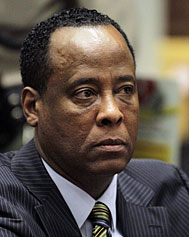 The 2nd degree manslaughter trial of Dr. Conrad Murray, the doctor who attended Michael Jackson at the time of his death June 25, 2009, is now underway in LA. The testimony that is taking place is certainly revealing of the last day of Mr. Jackson’s life. Michael Jackson died of an acute Propofol overdose and the toxicology report also revealed Valium, Lorezepam, Versed, Lidocaine and Ephedrine in his system. There were no illegal drugs.
Propofol is used as a powerful anesthetic and is given intravenously. It is not a drug that would be used outside of a medical facility or hospital. Versed (Midazolam) is also a drug that is used for conscious sedation for procedures in hospitals.
Dr. Conrad Murray is a cardiologist and served as Michael’s personal physician. He was trained at Meharry Medical College and did post graduate work at Mayo Clinic and Loma Linda University Medical Center in California. He studied Cardiology at Read more »
*This blog post was originally published at EverythingHealth*
October 16th, 2011 by Linda Burke-Galloway, M.D. in True Stories
No Comments »

 The story of Tanya* is compelling. She was 24 weeks pregnant with her third child and the hospital was threatening to send her home. Two years ago, she faced similar circumstances and delivered a baby at 23 weeks. Luckily, the baby is now two years old but the one before that was not so lucky. Tanya presented to a local hospital during her first pregnancy because of complaints of abdominal pain. She was sent home because her contractions “weren’t regular.” Ten hours later, Tanya returned to the hospital because of a “nagging feeling that something was wrong” although her contractions were still not regular. Unfortunately, her cervix was dilated and the contractions could not be stopped. Her son was born alive but died one hour later because the hospital was not equipped to deal with premature newborns. Tanya’s second pregnancy was similar to her first because she developed premature contractions again, at 23 weeks. As with the first pregnancy, her contractions were not strong and regular so she was discharged home from the hospital with a monitor that was supposed to help. It didn’t. Read more »
*This blog post was originally published at Dr. Linda Burke-Galloway*
October 15th, 2011 by Bryan Vartabedian, M.D. in Opinion
1 Comment »

I woke up this morning, tapped my digital signal, and found this from Brian McGowan on Twitter: “What happens when complexity races ahead of the mind’s ability to adapt? When progress outpaces evolution? We need new solutions.”
Like a slow hunch, a version of this idea has been rattling around in my head for some weeks. Specifically: Is there a new kind of human intelligence evolving? Will our ability to work with knowledge in the face of limitless information select for a new kind of thinker in the 21st century? I suspect it will. Thinking and the creation of new ideas will require Read more »
*This blog post was originally published at 33 Charts*
October 15th, 2011 by AndrewSchorr in Opinion, True Stories
No Comments »

It’s too young to die at age 56. It’s too young to die when you have four children and a wife. It’s too young to die when you have led one of the most successful technology companies ever. It’s too young to die when you are very rich, have so much more to do and to give back. But pancreatic cancer doesn’t care. This time, again, one of our most deadly cancers won.
Medicines, nutrition, surgery, liver transplant, apparently Steve Jobs, celebrated CEO of Apple, tried them all. But, as I wrote in a recent blog, continuing was just too much. To be sure, Jobs did not have the most common type of cancer in his pancreas. His was a neuroendocrine tumor and life expectancy can be longer. But, as has been noted widely in the media, Steve Jobs came to know that his mortality clock was ticking. His eight year-survival was probably what he knew he was facing all along. Read more »
*This blog post was originally published at Andrew's Blog*
October 15th, 2011 by CynthiaBaileyMD in Health Tips, Research
4 Comments »

 Medical science is getting closer to understanding one of the most common causes of chronically itchy arms called brachioradial pruritus.
This means we’re also getting closer to helping people who suffer from this extremely frustrating condition!
A new study exploring the cause of brachioradial pruritus was just reported in the October issue of the Journal of the American Academy of Dermatology. The authors used MRI imaging to look at the cervical spine of 41 patients suffering from chronic itching of what was otherwise normal appearing skin on the outer surface of their forearms arms (called brachioradial pruritus). MRI imaging showed a very strong correlation between the itch and nerve compression in the patient’s neck. In fact, the exact site of the itch on the skin correlated precisely with the spinal location in the neck where the nerve resides that supplies that part of the arm skin (we call this a dermatome*).
What’s so interesting is that Read more »
*This blog post was originally published at Dr. Bailey's Skin Care Blog*


 The 2nd degree manslaughter trial of Dr. Conrad Murray, the doctor who attended Michael Jackson at the time of his death June 25, 2009, is now underway in LA. The testimony that is taking place is certainly revealing of the last day of Mr. Jackson’s life. Michael Jackson died of an acute Propofol overdose and the toxicology report also revealed Valium, Lorezepam, Versed, Lidocaine and Ephedrine in his system. There were no illegal drugs.










