October 12th, 2011 by Peggy Polaneczky, M.D. in Health Tips, Opinion
No Comments »

 A well-written and balanced article on mammography from USA Today may help move the conversation about this screening test away from hype and a bit closer to reality. The title – “Mammogram is ‘terribly imperfect’, though recommended.”
For women in their 40s, mammograms reduce the risk of dying from breast cancer by about 15%… But mammograms miss some cancers and raise false alarms about others, causing women to go through unnecessary follow-up tests… “We’re saying, ‘Mammography is a terribly imperfect test, but we’re recommending women get it,’” Brawley says. “The task force was saying, ‘Mammography is a terribly imperfect test, and Read more »
*This blog post was originally published at The Blog That Ate Manhattan*
October 12th, 2011 by Paul Auerbach, M.D. in Health Tips, Research
No Comments »

There were no real surprises for me in the article entitled “Television Viewing and Risk of Type 2 Diabetes, Cardiovascular Disease, and All-Cause Mortality” by Anders Grøntved and Frank B. Hu that appeared in the Journal of the American Medical Association (JAMA 2011;305(23):2448-2455). As stated in the abstract: “Prolonged television (TV) viewing is the most prevalent and pervasive sedentary behavior in industrialized countries and has been associated with morbidity and mortality. However, a systematic and quantitative assessment of published studies is not available.”
The authors performed an analysis of eight previously published studies to determine the association between TV viewing and risk of type 2 diabetes, fatal or nonfatal cardiovascular disease, and all-cause mortality.
The risk of all-cause mortality appeared to increase with TV viewing duration of greater than Read more »
This post, Risk Of Type 2 Diabetes And Cardiovascular Disease: Don’t Be A Couch Potato, was originally published on
Healthine.com by Paul Auerbach, M.D..
October 11th, 2011 by KennyLinMD in Health Policy
No Comments »

The buzzwords of cutting-edge primary care reform – the medical home, coordination of care, electronic health records – have usually been associated with large integrated health systems such as Intermountain Healthcare, Group Health, and Kaiser Permanente. If you believe the arguments that economies of scale and financial resources give such organizations built-in advantages over the traditional small group practice, you may be inclined to believe that solo practice is going the way of the dodo. Indeed, immediate past AAFP President Roland Goertz, MD, MBA penned an editorial a few months ago, “Helping Small Practices Survive Health System Change,” that, while touting some services that the Academy offers family physicians in these practices, betrayed a decidedly pessimistic outlook on their long-term future.
Not everyone agrees, however. In the September issue of the Journal of Family Practice, Jeff Susman, MD cast solo practices as vital engines of primary care innovation: Read more »
*This blog post was originally published at Common Sense Family Doctor*
October 11th, 2011 by Iltifat Husain, M.D. in Opinion
No Comments »


Doctors love their Apple Products. Just walk into any hospital ward, and see the types of mobile devices we are using. At weekly Grand Rounds conferences, you see plenty of iPads in use. At physician meetings, the laptop of choice is often the Macbook Pro. The data backs these anecdotal examples as well.
Doctors love their Apple Products – and Steve Jobs was obviously an extension of these products, often times cited as the singular force behind these products, and it’s why physicians who love his products mourn his passing.
There are three specific reasons why :
1) Simplicity
In medicine, we deal with enough complexity. Knowing disease pathology and the mechanism of various illnesses and their treatments is a fascinating exercise, but it’s taxing. For every known in medicine, there are at least five unknowns. It’s what makes being a physician exciting, but stressful as well. We’re always on high alert – especially those of us who practice in the critical care arena.
Juxtaposed to this is Read more »
*This blog post was originally published at iMedicalApps*
October 11th, 2011 by DavedeBronkart in Health Policy, Opinion
No Comments »

Last week the New York Times reported that some health insurers have applied to regulatory agencies to push premiums sharply higher – usually double-digit increases, while citizens are suffering. This falls on top of the 11 year history reported last year by the Kaiser Family Foundation: wages and inflation are up ~40%, while health costs and worker contributions were up 138% and 159%:
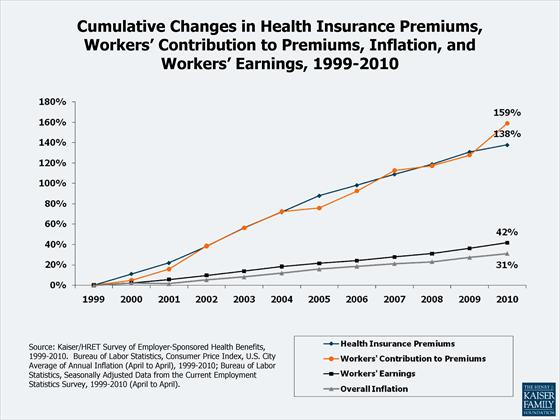
No wonder we feel squeezed. (Last week’s announcement comes on top of this history.)
This has enormous human impact. Read more »
*This blog post was originally published at e-Patients.net*