October 8th, 2011 by RamonaBatesMD in Opinion, Research
3 Comments »

A study on this topic was presented at the recent American Society of Plastic Surgeons (ASPS) annual conference in Denver. The article is also in the October issue of the Plastic and Reconstructive Surgery journal (reference #2 below).
The article notes that more than 220,000 bariatric procedures are done annually in the United States. This number (IMHO) is likely to increase as these procedures have become an major tool in the treatment of obesity which now affects a third of adults in this country.
Massive weight loss, regardless of whether by bariatric procedure or by diet/exercise, will often leave the individual with excess skin. This excess skin can be both a cosmetic and functional issue for the individual.
Jason Spector, MD and colleagues designed their study to “explore demographic features and patient education regarding body contouring procedures in the bariatric surgery population.”
Their study consisted of Read more »
*This blog post was originally published at Suture for a Living*
October 8th, 2011 by Stanley Feld, M.D. in Health Policy, Opinion
No Comments »

Mechanism Design has demonstrated that the most efficient systems are created when everyone’s vested interests are aligned.
“An example is defense contracting. If you agree to pay on a cost plus basis you have created incentive for the contractor to be inefficient.
The defense contractor will build enough extra into a fixed price system to account for cost overruns. The cost overrun would be permitted in the rules if the price was transparent. If there were no cost overruns the contractor’s profit would be increased. It would provide incentive to be efficient.
“If you agree to pay a fixed price, you can come close to an efficient price if you have all the truthful information.”
A reader wrote,
Stanley:
History has proven over and over again that only the market mechanism of willing sellers and willing buyers is the optimal way to allocate economic resources. This presumes an informed buyer, and a willingness of sellers to compete for buyers. Adam Smith was clear on this in the Wealth of Nations.
If incentives are aligned and truthful price information is available an efficient system is created. Most stakeholders think they can do better by not sharing truthful information. If the rules of the game require truthful information the system can become an efficient market driven solution.
The healthcare system must become market driven. At present Read more »
*This blog post was originally published at Repairing the Healthcare System*
October 7th, 2011 by BobDoherty in Health Policy, News
No Comments »

Last week, Medicare’s Center for Medicare and Medicaid Innovation announced a Comprehensive Primary Care (CPC) Initiative, which asks private payers and state Medicaid programs to join with Medicare to “help doctors work with patients to ensure they:
1. Manage Care for Patients with High Health Care Needs;
2. Ensure Access to Care;
3. Deliver Preventive Care;
4. Engage Patients and Caregivers; and,
5. Coordinate Care Across the Medical Neighborhood,”
according to an email from CMS’s press office. The initiative will provide qualified practices with risk-adjusted, per patient per month care managements payments, in addition to traditional fee-for-service payments, along with the opportunity to share in savings achieved at the community level.
I believe that the Initiative is a potential game-changer in helping to support and sustain primary care in the United States. But Read more »
*This blog post was originally published at The ACP Advocate Blog by Bob Doherty*
October 7th, 2011 by Michael Kirsch, M.D. in Opinion
No Comments »

 Physicians are still debating whether prescribing placebos is ethical. Dissenters argue that this is dishonest and would erode trust between patients and their physicians. If the practice were to gain acceptance, then physicians’ credibility would be diminished. Patients would wonder whether the medicines their doctors are recommending are evidenced-based or fraudulent.
Patients can now push their own snake oil right back onto their physicians. I learned that the ‘secret shopper’ mechanism for quality assessment has been introduced into the medical profession. I first read about this in the March/April 2010 issue of the Journal of Medical Practice Management, a periodical that I suspect is not widely read by physicians.
Folks are hired as pretend patients and are dispatched to doctors’ offices and hospitals to document their findings. Their mission is to assess office staff, appointment issues and the waiting room experience. I wonder if Read more »
*This blog post was originally published at MD Whistleblower*
October 7th, 2011 by admin in Opinion, Research
2 Comments »


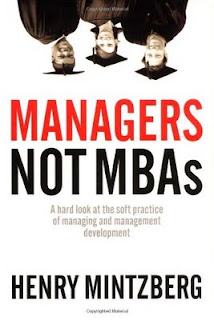 It’s been more than five years since Henry Mintzberg released the enlightening book ‘Managers, not MBAs’, a well-reasoned criticism of prevailing management education that basically revolves around Master in Business Administration (MBA) programs. Financial crisis was not even in sight but Mintzberg, a professor at McGill University in Montreal and one of the most important guiding lights in the questionable field of management, already pointed out that it was a serious danger for modern organizations to rely on professionals that had just finished their MBAs as the prime source for senior managerial positions.
Mintzberg focused his criticism on two essential aspects. First, most programs are aimed at people with no previous experience or knowledge about organizations and how they look like from the inside… and these same people then storm into companies believing that the real world works exactly as business school taught them it does. The second point is that many of these business schools spread a perverted set of values, such as the hunt for short-term profit, the belief that a good aim justifies any means and the urge to translate all human behaviors into accountable figures (the ‘countophrenia’ depicted by Vincent de Gaulejac in his must-read ‘La Société Malade de la Gestion’).
Then the crisis rose, and many CEOs of the biggest organizations had their share of responsibility for it, as they were enjoying multi-million dollar bonuses while taking their companies to the edge of bankrupcy. Most of them came from the most famous business schools in the world. I have outlined in the past the outrageous conflict of interests of many of these institutions, starting with Harvard, as Charles Ferguson perfectly displayed in his brilliant documentary ‘Inside Job’.
‘Social Science and Medicine’ published in its August issue a very interesting work by Amanda Godall, professor at the IZA Institute for the Study of Labor in Bonn, Germany. Godall’s is the first empirical research on the correlation between hospital results and having MDs in their top managerial positions. Read more »
*This blog post was originally published at Diario Medico*













