August 24th, 2011 by admin in Health Policy, Opinion
1 Comment »


I must confess that I have a weakness for medical tourism. Patients have always been ready to go on a pilgrimage to find the world’s leading expert (we call it ‘key opinon leader’ now) hoping to find a cure. As long as traditional leaders in the field of Medicine have been the Germans, the French and the English -with some occasional Austrian and Spanish name in the mix- traffic of wealthy patients across Europe is nothing new.
Since we entered the antibiotics era, these leaders started to be located mainly in the United States, the cradle of modern, technology-driven Medicine. Thus hi-tech centers got ready to welcome foreign patients, building strong International Customer Support departments. A random example -by no means the only one- would be the Mayo Clinic. On their website you can see that their wealthy patients speak Arabic or come from Latin America. These healthcare services have a long tradition of client-oriented work because they work for private clients that pay for their treatment (sometimes the client is not the patient himself but his family). The important thing was never the price, but the patient. Read more »
*This blog post was originally published at Diario Medico*
August 24th, 2011 by admin in Health Tips, Research
No Comments »

 A recent article in the Archives of General Psychiatry by Hallmayer et al. discussed the role of genetic and environmental factors in autism and autism spectrum disorders (ASD). The study was a heritability analysis of 192 pairs of twins, which attributed 37 percent of the variation in risk of autism to genetic factors and 55 percent to shared environmental factors. The authors contrasted their findings with those of previous studies, which had given genetics a much higher share (up to 90%).
Rather than contradicting previous research, the new results provide more evidence that autism, like many other common diseases, results from both genetic and environmental factors. The way that these elements – often called “nature and nurture” – influence health outcomes has been discussed for decades but is often misunderstood, even among scientists.
Disease Causation is Not as Easy as… Pie Read more »
*This blog post was originally published at Genomics and Health Impact Blog*
August 23rd, 2011 by DavidHarlow in Health Policy, News
No Comments »

 Partners Health Care (the dominant provider network in Greater Boston) and Neighborhood Health Plan (a local mostly-Medicaid HMO) just announced that the former intends to acquire the latter, and maintain it as a separate operating entity. No money will change hands between the parties, but an unspecified amount of money will be given by Partners as grants to community health centers where NHP members receive much of their health care services. Gary Gottlieb, CEO of Partners, graciously allowed that it would not seek to interfere with the current referral patterns of NHP members to the two local safety-net hospitals (which get disproportionate share hospital payments; Partners hospitals do not).
The deal is contingent on several layers of regulatory review, including Read more »
*This blog post was originally published at HealthBlawg :: David Harlow's Health Care Law Blog*
August 23rd, 2011 by Michael Kirsch, M.D. in Health Policy, Opinion
1 Comment »

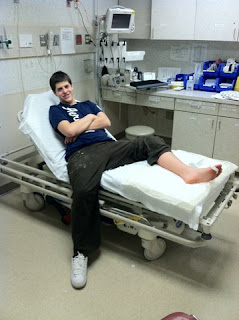 A few months back, while we were on vacation in Washington, D.C., my 17-year-old son Noah sustained an injury at 1:00 a.m. I was asleep, but this is usually a few hours earlier than he typically retires. In our hotel room’s bathroom, he dropped a glass and then managed to step in the wrong place. A sharp shard sliced through the soft skin between his great and second toes. Blood was spurting wildly and he woke me up with a shout. He was spooked.
We gastroenterologists are experienced at stanching bleeding, although I was uncertain how to do so without some kind of scope in my hand. I reflected on my ACLS training, which is a comprehensive 2 hour course that my partners and I take every 2 years. In between those sessions, I neither think about nor practice any advanced life saving procedures. It doesn’t seem rational that a community gastroenterologist should be schooled in temporary pacemakers, when most of us haven’t interpreted an EKG in decades.
I still remember the fundamentals of life support, the famed A, B, Cs, standing for airway, breathing and circulation. I decided to apply this to the hemorrhage at hand.
Airway: the windpipe was open and functioning
Breathing: the kid was breathing
Circulation: BINGO!
After going through this brief but critical checklist, I now knew where to focus. Read more »
*This blog post was originally published at MD Whistleblower*
August 23rd, 2011 by Berci in Opinion
No Comments »

There is a very interesting thread on Quora. Users want to find the most iconic scientific image ever. It might sound like an easy job but it’s truly not. My vote is for the Watson-Crick DNA double helix photo. What is yours?

*This blog post was originally published at ScienceRoll*














