August 17th, 2011 by RamonaBatesMD in Opinion
2 Comments »

A couple of nice articles recently on latex allergy have crossed my path – one in a journal I subscribe to (Aesthetic Surgery Journal) and the other via twitter and @Allergy (Ves Dimov, M.D., blogs at Allergy Notes). I’ve put both full references below.
Latex allergy became widely recognized in the late 1980s and early 1990s. The increase in latex allergies cases is felt to be associated with the increase use of latex gloves and implementation of universal precautions (now known as standard precautions) in the 1980s.
Management of possible or confirmed latex allergic patients begin with history and suspicion:
All patients who present for surgical procedures or exams which require latex gloves (pelvic exam, dental exams, etc) should be questioned about possible latex allergy.
Patients at highest risk include those who Read more »
*This blog post was originally published at Suture for a Living*
August 17th, 2011 by Stanley Feld, M.D. in Health Policy, Opinion
1 Comment »

Twenty seven million individuals were enrolled in Medicare Part D as of December 2009. The government spent $51 billion to subsidize Medicare Part D in 2009. The $51 billion spent is in addition to seniors’ premiums and co-pays. The government subsidy was $1,889 per individual subscriber.
Who is making the money?
“A provision in the Medicare Modernization Act (MMA), known as the “noninterference” provision, expressly prohibits the Medicare program (the government) from directly negotiating lower prescription drug prices with pharmaceutical manufacturers.”
This was a gift to the healthcare insurance industry by the government as a result of intense lobbying efforts.
Over 300 private plans (Medicare Plan D sponsors) enter into negotiations with pharmaceutical manufacturers separately to deliver Medicare Part D benefits.
Medicare Part D eligible seniors are forced to deal with Read more »
*This blog post was originally published at Repairing the Healthcare System*
August 16th, 2011 by Happy Hospitalist in Opinion, Research
No Comments »

Association of Hospitalist Care With Medical Utilization After Discharge: Evidence of Cost Shift From a Cohort Study.
That’s the title of the latest medical study making the viral rounds. I had an opportunity to read the study in full. I called Happy’s hospital library and Judy had the pdf article in my email in less than 24 hours. Now, that’s amazing. Thanks Judy for a job well done. You deserve a raise.
Presented in the August 2nd, 2011 edition of the journal Annals of Internal Medicine, Volume 155 Number 3 Page 152-159, the study concludes that decreased length of stay and hospital costs associated with hospitalist care are offset by higher medical utilization and costs after discharge.
In summary, hosptitalist patients had an adjusted length of stay 0.64 days shorter and $282 less than patients cared for by primary care physicians, but total 30 day post discharge costs were $332 higher. These additional charges were defined as 59% from rehospitalization, 19% from skilled-nursing facilities, and 22% from professional and other services.
OK fair enough. Let’s come to that conclusion. Let’s say Read more »
*This blog post was originally published at The Happy Hospitalist*
August 16th, 2011 by StevenWilkinsMPH in Opinion
No Comments »

I am a big fan of Infographics. They are great for turning otherwise complex data into practical information. Here’s an Infographic I built to describe the “disconnect” that often occurs between physicians and patients and the impact of adherence.


*This blog post was originally published at Mind The Gap*
August 16th, 2011 by DavedeBronkart in Opinion
No Comments »

An SPM member emailed this, with the playful subject line “A New e-Patient”:
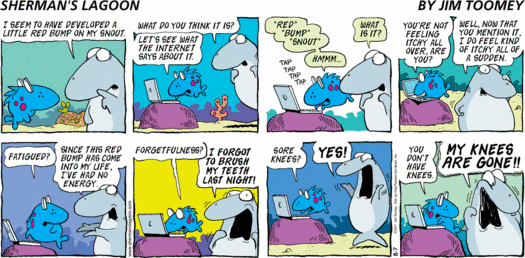
(Click the image to go to the high-res on the comic’s site; © Copyright 2011 King Features Syndicate, all rights reserved.)
Funny comic, but it’s a common misconception that “e-patient” = anyone who googles (or bings, or webmd’s, or…). Wrong. E-patients are empowered, engaged, educated etc – not mindless, and not likely to freak out at the first thing they read.
When you search Read more »
*This blog post was originally published at e-Patients.net*