July 2nd, 2011 by Happy Hospitalist in Health Policy, Opinion
No Comments »

Over the last few years, you may have heard a lot about the value of checklists in ICU medicine and their ability to reduce mortality, reduce cost and reduce length of stay. But a recent study took the concept one step further and suggested that checklists by themselves may not be effective unless physicians are prompted to act on the checklist.
As reported in the American Journal of Respiratory and Critical Care Journal, a single site cohort study performed at Northwestern University Feinberg School of Medicine’s medical intensive care unit compared two rounding groups of physicians. One group was prompted to use the checklist. The other group of physicians had access to the checklist but were not prompted to use it.
What they found was shocking. Both groups had access to the checklist. However, patients followed by physicians who were prompted to use the checklist had Read more »
*This blog post was originally published at The Happy Hospitalist*
July 2nd, 2011 by DavedeBronkart in Opinion
No Comments »

e-Patients who want to collaborate with their physicians, and be responsible for their medical decisions, need to clearly understand what constitutes good evidence. It’s not always easy.
Now Richard Smith, a 25 year editor of the British Medical Journal, has written another piece for the BMJ blog, citing a JAMA study showing “that of the 49 most highly cited papers on medical interventions published in high profile journals between 1990 and 2004 a quarter of the randomised trials and five of six non-randomised studies had been contradicted or found to be exaggerated by 2005.”
What’s an e-patient to do?? Especially when we “patients who google” are so often sneered at by physicians who rely on these same journals.
Well, we need to educate ourselves, and learn to speak calmly, confidently and understandingly to anyone who doesn’t understand – just as we expect clinicians to do with us.:–) In short, we need to Read more »
*This blog post was originally published at e-Patients.net*
July 1st, 2011 by PJSkerrett in Health Tips, Research
1 Comment »


Without meaning to, you’ve gained a few pounds over the last few years. How did that happen? Certain foods, especially the humble potato, may be partly to blame.
In a fascinating study of 120,000 healthy, non-obese women and men taking part in long-term studies of diet and health, the participants gained an average of 3.3 pounds every four years over a 13-year period. When the researchers tallied up the foods that contributed most to this weight gain, potatoes topped the list—twice:
- potato chips
- potatoes
- sugar-sweetened beverages
- red meat
- processed meats
Other contributors to weight gain included sleeping less than six hours a night or more than eight hours, drinking alcohol, and watching television. The results were just published in The New England Journal of Medicine.
The study offered some good news and tips for losing weight, too. Foods and lifestyle choices associated with losing weight included Read more »
*This blog post was originally published at Harvard Health Blog*
July 1st, 2011 by Berci in News
No Comments »

 Did you know that Natalie Portman (under the name, Natalie Hershlag) published a paper in a scientific journal in 2002 while at Harvard?
Frontal lobe activation during object permanence: data from near-infrared spectroscopy.
The ability to create and hold a mental schema of an object is one of the milestones in cognitive development. Developmental scientists have named the behavioral manifestation of this competence object permanence. Convergent evidence indicates that frontal lobe maturation plays a critical role in the display of object permanence, but methodological and ethical constrains have made it difficult to collect neurophysiological evidence from awake, behaving infants. Near-infrared spectroscopy provides a noninvasive assessment of changes in oxy- and deoxyhemoglobin and total hemoglobin concentration within a prescribed region. The evidence described in this report reveals that the emergence of object permanence is related to an increase in hemoglobin concentration in frontal cortex.
*This blog post was originally published at ScienceRoll*
July 1st, 2011 by Dr. Val Jones in Audio, Health Tips
No Comments »
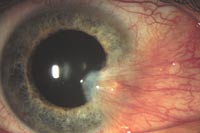
A Pterygium
Dermatologists have done a great job promoting sun safety. We all know that we should use sunscreen or sunblock to avoid burns, and to reapply it religiously when we plan to be outdoors for long periods of time. But how often do we think about protecting our eyes from the same UV rays?
A dear friend of mine has been on a long-term medicine that makes her skin especially sun-sensitive. She did not take sufficient precautions to protect her eyes from UV radiation (though she always wore sunscreen on her skin), and she developed a pterygium that looks just like the photograph above. Her condition reminded me of the importance of eye protection, and I thought I’d offer you 5 excellent reasons to start shielding your eyes from the sun. UV protection is critical for avoiding:
1. Photokeratitis. Photokeratitis is essentially a sunburn of the front layer (cornea) of your eyeball. If you’ve ever had a burning sensation in your eyes after a long day at the beach, or in the snow, you may have burned your eyes. Just as skin sunburns are painful and take a few days to calm down, eye pain can be very uncomfortable. But worse than the temporary discomfort is the increased long-term risks of pterygia, cataracts, and other eye conditions (see below).
2. Pterygia. Pterygia are overgrowths of corneal tissue that can grow across the iris and pupil. They can be cosmetically unsightly, and can block vision if they grow large. They are caused almost exclusively by UV damage, and are most common in people who live near the equator (because their exposure to UV radiation is highest). Surgery is the only known treatment for pterygia, though as many as 50% grow back, and surgical divets in the cornea can cause visual problems.
3. Cataracts. Cataracts are opacities of the eye lenses that lead to partial or total blindness. The exact mechanism by which they occur is unclear, though we know that sun exposure contributes to their development. Cataracts are the number one cause of blindness in the world.
4. Skin Cancers. Basal cell carcinoma (BCC) is a type of skin cancer that primarily develops on skin that has been sunburned, especially in childhood. Melanoma is a deadly form of skin cancer that is much rarer than BCC, but also most commonly develops on skin that has been burned. Squamous cell carcinoma (SCC) is the least invasive type of skin cancer, and usually develops on skin that has had the largest total amount of sun exposure over a lifetime. People who don’t protect the thin eye skin and lids from UV radiation (beginning in childhood) are more likely to develop cancer around the eyes
5. Macular Degeneration. Exposure to the sun’s UV rays can cause damage to the deep structures of the eye, including the retina. Light focused on the macula (the most important part of the retina for vision) can cause damage in the area over time. Macular degeneration results in visual damage and even blindness.
Ok, so I hope I’ve convinced you that UV protection is critically important for your eyes… How can you protect yourself? There are 4 primary strategies:
1. Wear UV protective sunglasses. When buying sunglasses, check out their product labels and avoid glasses that are purely cosmetic – opt for those that block 99-100% of UV A and B rays. Larger glasses and wrap-arounds offer the most coverage. Remember that kids need sunglasses too!
2. Wear a wide-brimmed hat. Although a hat doesn’t always protect you from glare and light reflection from other surfaces, it can reduce the total amount of radiation that reaches your eyes and skin.
3. Wear UV-protective contact lenses. Most people don’t realize that some contact lenses are manufactured with a UV protective layer already built in. Although they are not large enough to protect the entire eye surface (or the skin around the eye) they offer an added layer of protection against harmful UV rays. However, not all contact lenses offer UV protection, and of those that do, not all provide similar absorption levels. An eye care professional can prescribe Class 1 UV-blocking contact lenses, which provide the greatest level of UV protection and which have a Seal of Acceptance for UV Absorbing Contact Lenses from both the American Optometric Association and the World Council of Optometry’s Commissions on Ophthalmic Standards. These lenses block more than 90 percent of UVA rays and 99 percent of UVB rays.
4. Protect your eyes all day. UV radiation for the eyes is actually worse when the sun is lower in the sky. Researchers at the Kanazawa Medical University in Japan found that during early morning and late afternoon, UV exposure to the eyes was about double that of the hours around noon during Spring, Summer and Fall.
For more information about protecting your eyes from the sun, you may enjoy listening to my recent interview with Dr. Stephen Cohen.* He is an optometrist who lives in Arizona – and is therefore well acquainted with UV radiation! Scroll down to the bottom of the page after clicking on the link and you’ll see the podcast.
***
Note that I was paid by Johnson & Johnson Vision Care, Inc. to host the radio show with Dr. Cohen.












