June 22nd, 2011 by Paul Auerbach, M.D. in Health Tips
No Comments »

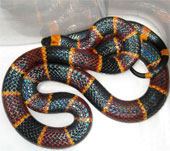 Eastern coral snake, photo courtesy of Norman Benton, CC-BY-SA 3.0
The Wilderness Medical Society held its annual meeting at Snowmass last summer July 23-28, 2010. There were numerous terrific educational sessions. In a series of posts, I am going to highlight some of what we learned from the presenters.
Jonathan Allen gave a presentation on venomous snakebite management. Here are some facts to remember:
Snakebite Statistics
Approximately 15 percent of the 3,000 snake species worldwide are dangerous to humans. There are annually 400,000 to 2,000,000 envenomations from snakebite worldwide, with 20,000 to 100,000 deaths. In the U.S., there is at least one species of venomous snake in every state except Alaska, Maine, and Hawaii. There are approximately 20 venomous species, including pit vipers and coral snakes, and an estimated 6,000 to 7,000 venomous snakebites each year, including six to 10 deaths. Perhaps only 20 percent of bites are reported.
Deaths from snakebites typically Read more »
This post, What You Need To Know About Snakebites, was originally published on
Healthine.com by Paul Auerbach, M.D..
June 21st, 2011 by Shadowfax in True Stories
1 Comment »

Tomorrow we’ll be far away
Tomorrow is the judgement day
Tomorrow we’ll discover what our God in heaven has in store
One more dawn…
On an unrelated note, tomorrow morning at 5AM our new ER opens and the old one closes down. I’ll be there working clinically. To the degree that it doesn’t interfere with patient care, I’ll live-tweet the experience.

For those not familiar with the institution or the project — it’s a 110,000 annual visit ER closing down and reopening next door in a new, state of the art 83 bed ER, with an entire new 10-story hospital opening directly above at the same time, more or less. The logistics of the transition are pretty staggering. The ER will be the first unit to open. The old ambulance bay will have a barrier put up at 5AM and the new department’s ambulance bay and drop-off will be illuminated at that time and all new patients will go there. The staff closing out the old shop will dispo all the patients they can, and at a certain point, maybe by ten AM, any patients still in the old ER will roll across the skybridge to the new facility. We will open one cath lab and one OR in the new hospital while retaining capability at the old rooms. New patients admitted will go to the new tower and the old inpatient units will start discharging patients. By Friday, any patients still in the old tower will move across to the new inpatient units. They’ll be bringing the other ORs and interventional labs online in a stepwise fashion during the week. Interestingly, a lot of expensive equipment is being “salvaged” from the old hospital. For example, the telemetry monitors in the ICU — about half of the new ICU beds have monitors now. When a patient is discharged from the old ICU, they will take that monitor across to the new building and install it in a new ICU bed, which will only then become open for a new patient. Eventually, all the monitors will be re-installed in the new units. Elective surgeries are pretty much out this week. When everything is open we will have 16 ORs and 8 cath/vascular/EP labs with room for four more as need demands.
For the ER (and more importantly for ER patients) this will be Read more »
*This blog post was originally published at Movin' Meat*
June 21st, 2011 by Jennifer Wider, M.D. in Health Policy, Opinion
No Comments »
Women are the fastest growing segment in the US military, already accounting for approximately 14 percent of deployed forces. According to statistics from the Department of Veterans Affairs (VA), 20 percent of new recruits and 17 percent of Reserve and National Guard Forces are women. As the number of women continues to grow in the military, so does the need for health care specifically targeted to their unique concerns.
Historically, lower rates of female veterans have used the VA system. “Research has shown that women didn’t define themselves as veterans in the past, and this is changing,” said Antonette Zeiss, PhD, a clinical psychologist and Acting Chief for Mental Health Services at the VA Central Office in Washington, DC.
Now, “Women are among the fastest growing segments of new VA users with as many as 44 percent of women returning from Iraq and Afghanistan electing to use the VA compared to 11 percent in prior eras,” said Sally Haskell, MD, Acting Director of Comprehensive Women’s Health, at the VA Central Office.
This change is due in large part to Read more »
*This blog post was originally published at Society for Women's Health Research (SWHR)*
June 21st, 2011 by Berci in Video
No Comments »

Human Health Project is a non-profit organization funded by donations aiming at giving feedback on medical cases uploaded by medical professionals. Here is the description:
 The Human Health Project began in California in 2006 as a non-profit organization when its founder, Dr. Phil Harrington, M.D., decided to create a platform for medical professionals to discuss rare and unusual health problems. The idea came from personal experience – for three years he went from doctor to doctor and struggled to find a diagnosis for his own illness. Even with access to modern healthcare and a background in medicine, the answers were still elusive, and the process was frustrating. For someone without the same access to healthcare, such as a patient in a developing nation, the challenge would have been even greater. This experience was telling of the lack of integration among the medical sciences and sparked the idea for the Human Health Project.
*This blog post was originally published at ScienceRoll*
June 21st, 2011 by Harriet Hall, M.D. in Health Tips, Research
No Comments »

Science has found no evidence that vaccines cause autism; but the true cause(s) of autism have not yet been determined. So far the available evidence has pointed towards a largely genetic cause with possible interaction with environmental factors. A new study supports that interpretation. It also supports previous evidence that autism is triggered prior to birth, rather than at the time of vaccinations.
Schmidt et al. published a study in Epidemiology on May 23, 2011, entitled “Prenatal Vitamins, One-carbon Metabolism Gene Variants, and Risk for Autism.” It was a population-based case control study of 566 subjects comparing a group of autistic children to a matched control group of children with normal development. They looked at maternal intake of prenatal vitamins in the 3 months before conception and the first month of pregnancy, and they looked for genotypes associated with autism. They found that mothers who didn’t take prenatal vitamins were at greater risk of having an autistic child, and certain genetic markers markedly increased the risk. There was a dose/response relationship: the more prenatal vitamins a woman took, the less likely she would have an autistic child. There was no association with other types of multivitamins, and no association with prenatal vitamin intake during months 2-9 of pregnancy.
They had a large sample size, and they tried to eliminate confounders. They looked for these potential confounders of the association between prenatal vitamin intake and autism: child’s sex, birth year, parent-reported race/ethnicity, family history of mental health conditions, paternal age at child’s birth, maternal age at child’s birth, education, prepregnancy body mass index (BMI) category, cereal intake from 3 months before through the first month of pregnancy, cigarette smoking, alcohol consumption, and residence with a smoker during the period 3 months before pregnancy to delivery. Only maternal education and the child’s year of birth proved to be confounders. They adjusted for these two factors in their analyses. A weakness of their study is that it depends on patient recall long after the fact. Also, it did not attempt to gather any diet information.
Mothers of children with autism were less likely to report taking prenatal vitamins (odds ratio 0.62). Having certain genotypes increased the odds that a vitamin-omitting woman would have an autistic child. Children with the COMT 472 AA gene were at increased risk of autism. If their mothers took prenatal vitamins, the odds ratio for the risk of autism was 1.8; if their mothers didn’t, the odds ratio jumped to 7.2. This suggests that the maternal-fetal environment can magnify the effects of a child susceptibility gene. There was an association with certain maternal genes as well: those odds ratios went as high as 4.5.
The association was robust. The authors think Read more »
*This blog post was originally published at Science-Based Medicine*