June 7th, 2011 by Bryan Vartabedian, M.D. in Medblogger Shout Outs
No Comments »

I love finding new physician voices. Here are a few that I’ve been peeking at over the past couple months. They’re worth checking out.
Linda Pourmassina. Linda is an internist in Seattle and one of the finest writers in the medical blogosphere. You can find her over at Pulsus where she offers commentary on an eclectic mix of medical goodness ranging from social media to the subtleties of patient interaction. Really good stuff. Check out The Internet and Delusional Thinking. Beyond her blog, Linda’s Twitter output is the perfect balance of valuable links and dialog. Put her in your feed and she’ll bring you good things.
Chris Porter. Chris is a surgeon who has been writing at On Surgery, Etc. since April. This guy has an incredible voice and offers rare insight into the experience of the surgeon. He has a remarkable way of seeing medicine at its most granular level. When he corrals his narrative in just the right way I expect we may see him on the new release table at Barnes & Noble. Check out his experience as a surgeon in Guatemala. And from the narrow column Blogger template to the liberal use of crazy images, his site offers the raw feel of some of the vintage medical bloggers. His bio reflects the mindset of a next-gen physician: I’m Phoenix-based and world oriented. How can you resist that? Read more »
*This blog post was originally published at 33 Charts*
June 7th, 2011 by Lucy Hornstein, M.D. in True Stories
No Comments »

Say you’re a bariatric surgeon. You’d think Americans would be beating a path to your door. After all, this is the land of Instant Gratification! Who wants to just eat less for the better part of a year to lose 50 lbs when one can be cut open and have one’s gastrointestinal anatomy rearranged — resulting in the necessity of eating less, but why quibble — to lose that same 50 lbs (or more)? Changing lifestyles is boring; surgery is exciting!
Funny how it turns out that in order for the surgery to succeed long-term, patients have to commit to lifestyle changes anyway. In fact, before any reputable bariatric surgeon will operate, patients have to demonstrate their dietary commitment by actually losing some weight on their own, prior to surgery. What I don’t understand is why people then go ahead with the damn surgery anyway? Logically, it’s almost like you have to prove you don’t need it before you can have it. Hey, I’ve never said I understand people.
Perhaps overcoming this paradox is the explanation for the behavior of a certain bariatric surgeon, brought to my attention by a mutual patient. Read more »
*This blog post was originally published at Musings of a Dinosaur*
June 7th, 2011 by Paul Auerbach, M.D. in Health Tips
No Comments »

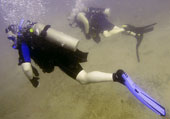 Outdoor recreation is intended for everyone, and can be enormously beneficial for persons with disabilities. I am in awe of disabled skiers, climbers, divers, and others who have learned to coordinate their bodies and take great enjoyment and a sense of accomplishment from their wilderness activities.
It behooves everyone in the healthcare profession to be aware of certain special medical concerns for persons who are disabled physically or emotionally. Additionally, family members and friends are often well aware of what they can do to help in providing a joint effort to support the disabled.
At the 2010 Wilderness Medical Society annual meeting in Snowmass, Colorado, JenFu Cheng, MD (a pediatric rehabilitation specialist from NJ), gave a wonderful presentation on the medical aspects of (scuba) diving with a disability. He pointed out that there may be up to nine million certified recreational scuba divers in the United States alone. His presentation, rather than focusing on persons who are fully capable physically and emotionally, examined the lesser-known benefits of being in the water for individuals in need of additional support. For instance, aqua therapy (largely enacted in swimming pools) takes advantage of the buoyancy of water to allow a range of mobility that is not possible on land. For example, aquatic exercise has been shown to improve lung capacity and mobility skills in children with cerebral palsy. Read more »
This post, SCUBA Diving With A Disability, was originally published on
Healthine.com by Paul Auerbach, M.D..
June 6th, 2011 by Linda Burke-Galloway, M.D. in Health Tips
2 Comments »

 Of the 4 million babies born in the U.S. each year, approximately 12.3 percent of them will be premature and 3.56 percent will occur before 34 weeks. Premature birth is one of the leading causes of severe handicaps and has an annual cost of approximately $26 billion dollars. Although risk factors for preterm labor have been identified, there is still no cure. As stated in a previous blog post, when the cervix becomes weak (a condition called cervical insufficiency), the patient is at risk for second trimester miscarriages and preterm labor. Also, if a patient has a previous history of premature birth then she needs her cervix measured in a future pregnancy. If her cervix is short and measures between 16 mm and 25 mm before 23 weeks, she is at risk for premature labor and delivery. The recommended treatment for a short cervix is either progesterone suppositories or injections. A few months ago, there was profound controversy over an FDA approved injection that would cost approximately $1500.00 if purchased by the manufacturer, K-V Pharmaceuticals. Bending under political pressure, K-V reduced their price to $690.00.
The more options that are available for treatment of premature labor, the greater the chances are of achieving a full term baby. In the past two months, a new study has emerged which describes a progesterone gel that reduced birth rates before 33 weeks by 45 percent and improved newborn outcomes. This is a significant result. Read more »
*This blog post was originally published at Dr. Linda Burke-Galloway*
June 6th, 2011 by AndrewSchorr in True Stories
1 Comment »

You may recall, I have a beef with Madison Avenue ad agencies that keep serving up the same New York actors in television commercials for different illnesses. I take it personally. The woman with cancer also has asthma. The man with arthritis also has erectile dysfunction. I feel bad for them!
Last night the quest by an actor to find work got ridiculous for me as my wife, Esther, and I were watching one of our favorite shows, “Criminal Minds,” on CBS. It was a particularly violent episode where a Bonnie and Clyde-type couple shot their way across Montana and proved to be the sickest of cold blooded killers. As the story develops, both the young man and the young woman were abused as children and their plan becomes to mete out retribution to the parents who ruined their lives.
Late in the show the young woman confronts a gray haired man in his 50’s behind the counter at his service station-convenience store. It was her father. She points a gun at him while he pleads for his life. I turned to Esther and said “I know that man! Where do I know him from?” Esther didn’t know and I couldn’t remember. Back on the screen things go from bad to worse, and while the young woman hesitates, her boyfriend sends the father to the hereafter. It was so sad. Where do I know that guy from???? Read more »
*This blog post was originally published at Andrew's Blog*