The weather is heating up, and soon most of us will be back in shorts and t-shirts… and worrying about looking good in our dreaded bathing suits. I had the opportunity to offer some evidence-based weight loss and fitness tips to ABC News in Washington, DC. You can view the clip or read my summary below:
In an ideal world ACOs should work. There is no evidence that untested and complex organizational structure of ACOs developed by Dr. Don Berwick (head of CMS) will improve quality of care and reduce costs.
ACOs are supposed to provide financial incentives to health care organizations to reduce costs and improve quality. There are too many defects in the ACOs infrastructure to improve the financial and medical outcomes.
At a conceptual level, the incentive for ACOs would be to increase efficiency and avoid overuse and duplication of services, resources, and facilities. In this model, ACO members would share the savings resulting from the increased coordination of care.
The only stakeholders who can demand that this waste be eliminated are consumers/patients. Patients must control their healthcare dollars. They will make sure there are competitive prices and will not permit duplication of services. Read more »
A paper in a recent edition of Journal of the American Medical Association (JAMA) offers the contradictory conclusion that taking in less salt—a key goal of U.S. health and dietary recommendations—is bad for you. But before you roll your eyes and groan about flip-flops in science, know that this study isn’t the kind of work on which you or anyone should base dietary decisions.
In this study of 3,681 men and women from Belgium, Bulgaria, Italy, Poland, Romania and Russia whose health was followed for eight years, participants with the lowest sodium excretion (which is a good measure of sodium intake) were 56% more likely to have died from cardiovascular disease than those with the highest sodium excretion. Among the nearly 2,100 participants with normal blood pressure at the study’s start, sodium excretion (sodium intake) had no effect on the development of high blood pressure.
These are startling findings. If true, they would undercut major programs by the U.S. government to reduce Americans’ intake of salt—the main source of sodium—from prepared and processed foods and at home. Read more »
Up until now, there have been three anti-histamine nasal sprays in the United States market available only by prescription… Astelin, Astepro, and Patanase.
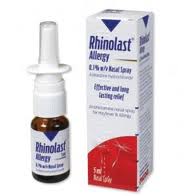
However, in May 2011, Meda Pharma announced a new anti-histamine nasal spray Rhinolast Allergy that is available over-the-counter.
The active ingredient is azelastine, the same one as found in the prescription nasal spray Astelin and Astepro.
Azelastine has a triple mode of action: anti-histamine effect, mast-cell stabilizing effect, and anti-inflammatory effect. Azelastine has a rapid onset of action of 15 minutes.
It can be used from the age of 5 years.
This nasal spray can be used in combination with other over-the-counter anti-histamines medications taken orally like zyrtec, claritin, allegra, and benadryl.
My son has always loved books. They were among his first objects his eyes fascinated and focused on. He’s learning to read right now and his love of books remains as strong as it was in his infancy.
It’s clear that books – the traditional kind: made of paper and ink and labor – are being replaced by digital media. The Kindle and the iPad and other tablets are making it easier to acquire and consume material once only available on books.
For children today, the iPad is very intuitive. In fact, some parents have reported that their children have become so used to the iPad screen, that they “pinch” pages in books – expecting them to zoom-out.
Perhaps some parents believe we can let books go and just let our kids skip them in favor of digital media without any cost. They *may* be right. Or they may not.
As for me, books are still a critical foundation for civilization.
Neurons are amazing things: the more they’re used, the better they get (generally). So as a child grows, the more exposure they get to different kinds of learning and feeling and experiences, the healthier their brains grow. Read more »
*This blog post was originally published at Phil Baumann*
It’s no secret that doctors are disappointed with the way that the U.S. healthcare system is evolving. Most feel helpless about improving their work conditions or solving technical problems in patient care. Fortunately one young medical student was undeterred by the mountain of disappointment carried by his senior clinician mentors…
I am proud to be a part of the American Resident Project an initiative that promotes the writing of medical students residents and new physicians as they explore ideas for transforming American health care delivery. I recently had the opportunity to interview three of the writing fellows about how to…
I m often asked to do book reviews on my blog and I rarely agree to them. This is because it takes me a long time to read a book and then if I don t enjoy it I figure the author would rather me remain silent than publish my…
When I was in medical school I read Samuel Shem s House Of God as a right of passage. At the time I found it to be a cynical yet eerily accurate portrayal of the underbelly of academic medicine. I gained comfort from its gallows humor and it made me…
I am hesitant to review diet books because they are so often a tangled mess of fact and fiction. Teasing out their truth from falsehood is about as exhausting as delousing a long-haired elementary school student. However after being approached by the authors’ PR agency with the promise of a…