March 30th, 2011 by Emergiblog in Health Policy, Opinion
1 Comment »

We hear so much about health care fraud and how much it costs us all in terms of higher Medicaid, Medicare and private insurance costs, and if we could just rein in this fraud we could make our health care system pay for itself.
My trusty Mac widget dictionary defines fraud as:
- a person or thing intended to deceive others, typically by unjustifiably claiming or being credited with accomplishments or qualities and
- wrongful or criminal deception intended to result in financial or personal gain.
Well, I’m wondering, what is actually considered fraud?
Let me give some examples, and help me understand whether or not this is fraudulent behavior. The examples are purely hypothetical and do not represent any known individuals, living or dead, or specific situations in any known emergency department, living or dead. Read more »
*This blog post was originally published at Emergiblog*
March 30th, 2011 by PhilBaumannRN in Opinion, True Stories
No Comments »

 Dear @Twitter,
I so totally know how this sounds to write to a service, but I must confess: your little wings have changed the trajectory of my life and – for the most part – I think it’s been for the best.
I’ve been around for over 40 years, have seen many things, met all sorts of people and have – mostly – enjoyed my life. But I think every several hundred years, a tiny and almost insignificant tool comes out of nowhere and changes the world – like the wheel and zero, both of which are truly “nothing” (both are each shaped the same way). And yet the each not only changed the course of civilizations but also created them. Read more »
*This blog post was originally published at Phil Baumann*
March 30th, 2011 by DavedeBronkart in Health Policy, News
No Comments »

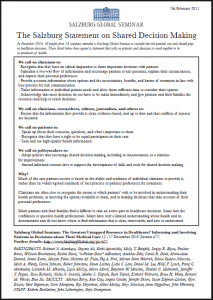 Last Thursday at the headquarters of the British Medical Journal in London, an important announcement will be made about patients’ rights to be actively involved in decisions about their treatment. Below is the press release about it.
The subject is shared decision making, which we’ve been posting about recently (series here; initial post here.) Developed by the participants in a Salzburg Global Seminar last December, the document is called the Salzburg Statement. The pivotal distinction here is the difference between informed consent, in which the physician assesses the options and selects one, and gets your consent to do it; and informed choice, in which clinicians tell you the options, with all the pros and cons, and let you choose, based on your preferences.
Click the image to download. (It’s an A4 PDF; to print, those using letter size paper should select “Page Scaling: Fit.”)
Here’s today’s press release: Read more »
*This blog post was originally published at e-Patients.net*
March 29th, 2011 by admin in Health Policy, Opinion
1 Comment »

According to American Medical News, the U.S. health system is demonstrating better performance on most measures of health care quality, but it’s failing to improve access to care or cut racial and ethnic health disparities, according to two reports released in February by the Agency for Healthcare Research and Quality. “Quality of care continues to improve, but at a slow rate,” said Ernest Moy, MD, leader of the team at AHRQ that produced the reports. ”In contrast to that, focusing on issues of access to care, not much has changed. Focusing on disparities in care, not much changed…Those are bigger problem areas than overall quality of care.” Measures related to hospital quality are showing the most improvement. For example, in 2005, just 42% of patients with heart attacks received angioplasties within the recommended 90 minutes of arriving at the hospital. That figure improved to 81% by 2008.
While the quality improvement indicators are encouraging, the disappointing access and disparities numbers are not very surprising.
The US health care system is still largely focused on acute hospital based care. It says we are doing better at what we are doing. Read more »
*This blog post was originally published at CFAH PPF Blog*
March 29th, 2011 by Bryan Vartabedian, M.D. in Opinion
No Comments »

I frequently talk about the visibility of doctors in the online space. How can doctors make content, contribute to the broader dialog, and be more visible? Maybe I need to spend less time pushing the idea that every doctor needs to create. Most doctors, after all, just want to listen and watch. Maybe we need to be cultivating dedicated communicators.
There’s a role evolving where physicians are formally involved in the creation of content and the maintenance of dialog. Wendy Swanson at Seattle Children’s Hospital and Claire McCarthy at Boston Children’s Hospital come to mind as good examples. Both serve as models for how institutions can leverage the voice of an individual for a branded online identity while contributing to the common good. Both are evolving as conversation agents on social platforms and IRL. Call them medical conversation agents of new media. Read more »
*This blog post was originally published at 33 Charts*













