March 17th, 2011 by ChristopherChangMD in Health Tips, Opinion
No Comments »

 Occasionally, I see patients who have received throat swabs for strep that have come back positive… even if they have no signs or symptoms of pharyngitis.
In this situation, there are 2 main actions a physician may take (I am biased towards one):
1) Prescribe antibiotics until throat cultures are normal
2) Do nothing
Personally, if a patient is without throat symptoms and has no history of rheumatic fever or kidney damage, I would not have even bothered obtaining a strep test. What for??? Read more »
*This blog post was originally published at Fauquier ENT Blog*
March 17th, 2011 by Jeffrey Benabio, M.D. in Opinion
1 Comment »

I recently wrote a paper on social media with some of my colleagues at Kaiser Permanente: Ted Eytan, MD @tedeytan, Rahul Parikh, MD @docrkp, Vince Golla @vincegolla, and Sara Stein, MD @sarasteinmd. In the article, “Social Media and the Health System,” we argue that the benefits of engaging patients and colleagues in social media outweigh potential risks.
The two most common reasons that physicians resist participating on blogs, Twitter and Facebook are: 1. Fear of liability. 2. Lack of compensation for the time invested.
If we would like more physicians to be part of the conversation, then we’ll need to find ways to overcome these barriers.
What has your experience been like interacting with physicians on social media? Is there a place for physicians on sites such as Twitter and Facebook?
For physicians reading this post, you can also join the over 160 others who have commented on this article on Sermo.
*This blog post was originally published at The Dermatology Blog*
March 17th, 2011 by Felasfa Wodajo, M.D. in News
No Comments »

 The regulatory status of medical apps, i.e mobile medical software, has been in limbo for some time now while observers have been watching the FDA for clues as to what role it will play. Clearly, some apps do play a role in guiding physicians in making diagnoses or making treatment decisions. Others simply provide information that would otherwise be available in textbooks or online.
What the FDA will consider a medical device or not has been an important topic, with many clues that it will consider its provenance broadly, as we have reported previously. As of now, only a few medical apps have been granted FDA approval, including AirStrip and MobileMIM.
According to the medical device consulting firm Emergo, the FDA said conclusively that they will be starting regulatory review of medical apps starting in 2011 at the recent FDA townhall meeting on March 10: Read more »
*This blog post was originally published at iMedicalApps*
March 17th, 2011 by DavidHarlow in Health Policy, Opinion
No Comments »

HealthNet either lost, or had stolen from it, computer hard drives with PHI of 1.9 million subscribers that had been in a California facility. This latest HealthNet data security breach, which may have included names, Social Security numbers, addresses, health information and financial information comes a little over a year after a widely-reported data security breach by HealthNet in Connecticut which resulted in the first state Attorney General action under the HIPAA amendments contained in the HITECH Act. HealthNet is notifying affected individuals and is offering two years of no-cost credit monitoring and fraud resolution services, and credit restoration and identify theft insurance as needed.
It’s both surprising and unsurprising that this has happened again to HealthNet. In these cases, and in recent cases in Massachusetts (Mass General Hospital HIPAA settlement) and Maryland (Cignet HIPAA violations and CMPs), we have seen examples, collectively, of individual sloppiness, of ineffective corporate policies and procedures, and possibly of gross neglect/fraud/incompetence. The question arises: Is HIPAA the right instrument to address all three sorts of problems? Since it seems that it is not having an effect on any of them, I would suggest that the answer is no. Read more »
*This blog post was originally published at HealthBlawg :: David Harlow's Health Care Law Blog*
March 16th, 2011 by StevenWilkinsMPH in Opinion, Research
3 Comments »

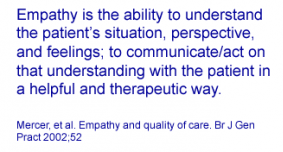 Is anyone else tired of hearing about how important empathy is in the doctor-patient relationship? Every other day it seems a new study is talking about the therapeutic value of empathy. Enough already!
It’s not that I don’t believe that empathy is important — I do. I also believe the data that links physician empathy with improved patient outcomes, increased satisfaction, and better patient experiences.
A recent study released in Academic Medicine reported that “patients of physicians with high empathy scores were significantly more likely to have good control over their blood sugar as well as cholesterol, while the inverse was true for patients of physicians with low scores.”
Findings from this study by Hojat, et al. are consistent with a 2009 study by Rakel, et al. which found that among patients with the common cold, those with physicians displaying high empathy had a significantly shorter duration of illness and trend toward lesser severity of illness and higher levels of immune response compared to those patients whose physician displayed less empathy. Read more »
*This blog post was originally published at Mind The Gap*












