February 18th, 2011 by Michael Kirsch, M.D. in Book Reviews, Opinion
No Comments »

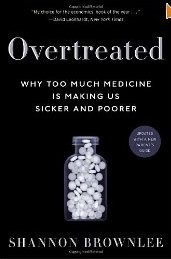 My daughter, Elana, home from college on winter break, offered me a book to peruse from one of her classes. She correctly suspected that her father, the MD Whistleblower, would enjoy reading a book authored by a whistleblower pro.
The book, “Overtreated: Why Too Much Medicine Is Making Us Sicker and Poorer” by Shannon Brownlee should be required reading for first year medical students, who have not yet acquired views and habits that promulgate excessive medical care and treatment. For those of us already in practice, this book should be a required element of board recertification.
Brownlee understands the medical system well and describes a culture of excess, conflicts of interests, absence of universal quality control mechanisms and fractured and disorganized care with no one in charge of a particular patient. She presents some chilling anecdotes of medical tragedies that have occurred at our most prestigious medical institutions. And she introduces us to reform leaders who understand the system’s inherent deficiencies and their proposals to remedy them.
Brownlee states that explanations for waste in the healthcare system include:
- Cost of a gargantuan bureaucracy
- Medical malpractice fear and defensive medicine
- Incentives for patients with medical insurance to overutilize care
- Rising medical costs
The most important cause, she argues, is unnecessary medical care, which costs the nations hundreds of billions of dollars and exposes patients to the risk of harm from medical complications. She writes, “If overtreatment were a disease, there would be a patient advocacy group out there raising money for a cure.” Read more »
*This blog post was originally published at MD Whistleblower*
February 18th, 2011 by Lucy Hornstein, M.D. in True Stories
2 Comments »

 Never in a million years would I have dreamed I would be able to say this, but I actually recommended a homeopathic remedy today. To briefly review, for anyone who may be under the mistaken impression that homeopathic remedies actually do anything — they don’t. Here’s why in a nutshell:
Homeopathy is an unscientific and absurd pseudoscience, which persists today as an accepted form of complementary medicine, despite there never having been any reliable scientific evidence that it works.
So what on earth possessed me to seriously recommend it? I’ll tell you.
I saw a beautiful little four-month-old today whose mother thinks he might be teething. Everyone thinks their four-month-olds are teething because they start getting more drooly as their hand-mouth coordination improves, allowing them to get more things into their mouths. Most of the time they don’t actually get their teeth until about six months, though four month olds pop out teeth often enough to keep us on their toes. I told her this. She’s cool. Here’s her problem:
“The daycare is getting fussy. They want me to bring in the Oragel. I don’t really think he needs it, and I don’t like the idea of giving medicine when it’s not really necessary.”
Daycares can be fussier than babies sometimes. That’s when I realized that a homeopathic teething remedy is the perfect solution:
- The baby is happy because someone’s rubbing his gums.
- Mom is happy because the baby’s not getting any medicine.
- Daycare is happy because they’re “doing something.”
Win-win-win.
*This blog post was originally published at Musings of a Dinosaur*
February 18th, 2011 by Berci in Better Health Network, Health Tips
No Comments »

As a part of the TheraFlu campaign, Novartis has developed free Android, Blackberry and iPhone applications for tracking flu outbreaks in the U.S. These days it’s become inevitable to develop free apps on all platforms in order to promote your product. From Novartis:
 Keep up-to-date on the most active cold and flu reports around the country. The WheresFlu™ app follows sickness incidence levels from week to week and keeps track of the current top 5 affected cities in the nation. The WheresFlu™ app will find your current location and provide you with results for that area. Or you can enter a ZIP code to get information for that area.
If you’re wondering how it actually works and how it differs from Google Flu Trends, here it is:
WheresFlu™ measures weekly activity for cold and flu based upon real-time reports of symptoms from SDI FAN® (a source used by the Centers for Disease Control and Prevention). As the longest-running respiratory tracking program in the US, SDI FAN® covers illness levels in 135 regions across the country utilizing panel-member reporting along with patient-specific data. Advanced tracking uses illness status levels to predict change in the affected population for the nine US Census Regions.
*This blog post was originally published at ScienceRoll*
February 17th, 2011 by Peggy Polaneczky, M.D. in Health Tips, Research
No Comments »

 Bioadhesives are a reasonable alternative to sutures for repair of perineal lacerations sustained during childbirth, according to a poster presentation at last week’s annual meeting of the Society for Maternal-Fetal Medicine.
Researchers at the Hadassah Hebrew University Medical Center in Jerusalem randomized women with first degree perineal tears to either 2-octyl cyanoacrylate (Dermabond) adhesive glue or suture for wound closure. While healing and incisional pain was similar, women who received the adhesive closure were more satisfied than those who were sutured.
In Portugal, bioadhesives have been studied for closure of the top skin layer of an episiotomy repair, and found to shorten the duration of the procedure with similar outcomes to suture in terms of pain, healing, and infection.
Biologic adhesives are chemically related to Super Glue, which is ethyl-cyanoacrylate. Midwives have been using Super Glue for perineal wound repair for some time, according to Anne Frye, who has authored a book on wound closure for midwives, and who gives instructions for its use in repair of perineal lacerations. Apparently Super Glue was also used by the military during Vietnam for wound closure.
A PubMed search on Dermabond finds multiple studies of its use, from plastic surgery to mastectomy, surgical wound closure, retinal surgery, lung and gastric leak closure, and even on esophageal varices. RL Bates mentions Dermabond as an option to repair skin tears in elderly patients. This stuff is turning into the duct tape of the medical profession.
It’s important to remember that adhesives are only for superficial skin closure, as use in deeper layers can cause irritation and burning of tissues. Side effects of their use include irritation and allergic reactions and of course wound infections, and pain can always occur no matter how one closes a wound.
*This blog post was originally published at The Blog That Ate Manhattan*
February 17th, 2011 by RyanDuBosar in Health Policy, Research
No Comments »

Less than one in three primary care practices offer all 10 recommended adult vaccines, citing a variety of financial and logistical reasons.
Researchers sponsored by the Centers for Disease Control and Prevention sampled 993 family physicians and 997 general internists. Of the respondents, 27 percent (31 percent of family practitioners and 20 percent of internists) stocked all 10. Results appear in the Feb. 17 issue of the journal Vaccine.
The 10 vaccines were hepatitis A; hepatitis B; human papillomavirus vaccine (HPV); combined measles, mumps, and rubella (MMR); meningococcal conjugate vaccine (MCV4); pneumococcal polysaccharide (PPSV23); tetanus diphtheria (Td); combined tetanus, diphtheria, and pertussis (Tdap); varicella; and zoster.
Of the responding practices, two percent plan to stop vaccine purchases, 12 percent plan to increase them and the rest had no plans to change their vaccination stocking habits. But physicians who identified themselves as their respective practices’ decision makers for stocking vaccines were more likely to decrease the number of different vaccines stocked for adults (11 percent vs. three percent; P=.0001).
The National Vaccine Advisory Committee, a group that advises the various federal agencies involved in vaccines and immunizations, arrived at even bleaker figures in 2009, reported the April 2009 issue of ACP Internist. For example, 62 percent of decision makers in practices said they had delayed purchase of a vaccine at some time in the prior three years due to financial concerns. And in the prior year, 16 percent of practice decision makers had seriously considered stopping vaccinations for privately-insured patients due to the cost and reimbursement issues. Read more »
*This blog post was originally published at ACP Internist*












