With the aging of America, it’s well known that there will be a shortage of registered nurses and nursing assistants to take care of the population. It’s predicted that the shortage of nurses in California will climb to 80,000 by 2015. California has just 653 registered nurses employed per 100,000 people.
One of the problems is a lack of qualified faculty to teach at nursing schools. California was forced to turn away 23,000 qualified applicants from nursing programs during 2008-2009. And this week Humboldt State University announced plans to discontinue the school’s nursing program because of financial concerns and inability to retain nursing faculty. Shortage of nurses and closing nursing programs — now there’s a big disconnect.
It was sometime in the mid-nineties that parents started showing up in my office with reams of paper. Inkjet printouts of independently unearthed information pulled from AltaVista and Excite. Google didn’t exist. In the earliest days of the Web, information was occasionally leveraged by families as a type of newfound control.
A young father and his inkjet printer
One case sticks clearly in my mind. It was that of a toddler with medically unresponsive acid reflux and chronic lung disease. After following the child for some time, the discussion with the family finally moved to the option of a fundoplication (anti-reflux surgery). On a follow-up visit the father had done his diligence and appeared in the office with a banker box brimming with printed information. He had done his homework and his volume of paper was a credible show of force.
At the time in Houston, the Nissen and Thal fundoplication were the accepted fundoplication procedures in children. Deep from the bottom of one of the boxes, the father produced a freshly-reported method of fundoplication from Germany. He had compared the potential complications with other types of fundoplication and this was the procedure he wanted.
What he didn’t understand was that an experimental technique used on a limited numbers of adults didn’t necessarily represent the best option for his toddler. I gave it everything I had but didn’t get very far. The tenor of his argument was slightly antagonistic. Ultimately there was nothing more I could do. I deferred the remainder of the discussion to one of our best “talking” surgeons, but knew the father wouldn’t get the time and consideration that I had offered.
I never saw the child again. As they say, the father voted with his feet. Read more »
*This blog post was originally published at 33 Charts*
The National Geographic Channel is currently featuring the latest in organ generation technology in its “Explorer” series. Here’s a snippet from the full show:
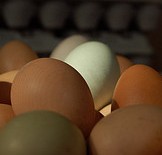
Enriched chicken feed may have resulted in eggs having less cholesterol and more Vitamin D than previously measured, reports the U.S. Department of Agriculture (USDA).
A large egg today has about 185 milligrams of cholesterol, down 14 percent from 215 milligrams in 2002, according to new research from the USDA’s Agricultural Research Service, reports USA Today. Also, an egg today has 41 international units (IUs) of Vitamin D, up 64 percent from 25 IUs measured in 2002. (That’s still only about 7 percent of the 600 IUs recommended per day.)
The agency regularly does nutrient checks on popular foods, this time analyzing eggs taken from store shelves in 12 locations around the country. The American Egg Board said in a press release that hen feed is made up mostly of corn, soybean meal, vitamins and minerals. Nutrition researchers at Iowa State University are also looking into reasons why cholesterol in eggs is decreasing.
One egg a day fits within the average, healthy American’s diet, reports WebMD, citing research funded by the Centers for Disease Control and Prevention and by the American Egg Board — owners of the slogan “the incredible, edible egg.”
*This blog post was originally published at ACP Internist*
I’ve written a few times about Veneta Masson, a nurse practitioner who wrote in Health Affairs and the Washington Post about her decision to forego further mammograms despite the fact that she was in a higher-risk category.
Veneta is also a poet. She sent me a video animation of her poem “Reference Range,” which I’m pleased to share with you. I think the poem and the video are beautiful, touching on important issues of how meaningless numbers and scores may be, subject to misinterpretation. She writes:
It’s no secret that doctors are disappointed with the way that the U.S. healthcare system is evolving. Most feel helpless about improving their work conditions or solving technical problems in patient care. Fortunately one young medical student was undeterred by the mountain of disappointment carried by his senior clinician mentors…
I am proud to be a part of the American Resident Project an initiative that promotes the writing of medical students residents and new physicians as they explore ideas for transforming American health care delivery. I recently had the opportunity to interview three of the writing fellows about how to…
I m often asked to do book reviews on my blog and I rarely agree to them. This is because it takes me a long time to read a book and then if I don t enjoy it I figure the author would rather me remain silent than publish my…
When I was in medical school I read Samuel Shem s House Of God as a right of passage. At the time I found it to be a cynical yet eerily accurate portrayal of the underbelly of academic medicine. I gained comfort from its gallows humor and it made me…
I am hesitant to review diet books because they are so often a tangled mess of fact and fiction. Teasing out their truth from falsehood is about as exhausting as delousing a long-haired elementary school student. However after being approached by the authors’ PR agency with the promise of a…