January 3rd, 2011 by KevinMD in Better Health Network, Research
No Comments »

I’ve written in the past that more medicine and tests do not necessarily reflect better care.
There is no test that is 100 percent specific or sensitive. That means tests may be positive, when, in fact, there is no disease (“false positive”), or tests may be negative in the presence of disease (“false negative”).
It’s the latter that often gets the most media attention, often trumpeted as missed diagnoses. But false positives can be just as dangerous. Consider this frightening case report from the Archives of Internal Medicine:
A 52-year-old woman presented to a community hospital with atypical chest pain. Her low-density lipoprotein cholesterol and high-sensitivity C-reactive protein levels were not elevated. She underwent cardiac computed tomography angiography, which showed both calcified and noncalcified coronary plaques in several locations. Her physicians subsequently performed coronary angiography, which was complicated by dissection of the left main coronary artery, requiring emergency coronary artery bypass graft surgery. Her subsequent clinical course was complicated, but eventually she required orthotropic heart transplantation for refractory heart failure. This case illustrates the hazards of the inappropriate use of cardiac computed tomography angiography in low-risk patients and emphasizes the need for restraint in applying this new technology to the evaluation of patients with atypical chest pain. Read more »
*This blog post was originally published at KevinMD.com*
January 3rd, 2011 by EvanFalchukJD in Health Policy, Opinion
No Comments »

Unconstitutional? How can the mandate to buy health insurance be unconstitutional? It must be some kind of misguided resistance to progressivism. Or maybe it’s someone finally taking a stand against a power-grabbing government program.
But it’s actually about something else entirely. And if you don’t know what it is, you won’t understand why the Virginia court ruled the way it did. Here’s the secret:
The U.S. Constitution grants to the federal government certain powers. These are things like raising an army, controlling currency and establishing courts. It also gives it the power to regulate interstate commerce, through something called the “Commerce Clause.” Everything else is the domain of the states.
Notice that the Commerce Clause only gives the federal government power over interstate commerce. The word “interstate,” in 1789, was probably easy to understand. Since the original 13 states were more like little countries, than part of one big country, the idea of trading goods from one state to another was identifiable as a special kind of thing. Read more »
*This blog post was originally published at See First Blog*
January 3rd, 2011 by Davis Liu, M.D. in Book Reviews, Health Policy
1 Comment »

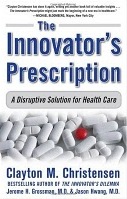 The best book on health care reform — or surviving it — is the “The Innovator’s Prescription: A Disruptive Solution for Health Care.” The decade worth of research spent understanding, studying, and ultimately offering solutions to make the health care system more accessible, higher quality, and affordable is clear.
Unlike other books, the authors, respected Harvard Business School (HBS) professor Clayton Christensen, Jerome Grossman, a doctor who also was the Director of Health Care Delivery Policy Program at Harvard Kennedy School, and Jason Hwang, another doctor and graduate of the MBA program at HBS, avoid the traps the plague most other solutions by taking a completely different perspective by looking at other industries where products and services offered were “so complicated and expensive that only people with a lot of money can afford them, and only people with a lot of expertise can provide or use them.” Yet convincingly through plenty of examples, it shows how telephones, computers, and airline travel moved from only accessible to those with the resources to become available and affordable to all.
The book tackles every aspect of health care and asks how will those in health care be disrupted and subsequently surpassed by other providers which deliver care that is more convenient, higher quality, and lower cost. Read more »
*This blog post was originally published at Saving Money and Surviving the Healthcare Crisis*
January 2nd, 2011 by Harriet Hall, M.D. in Uncategorized
No Comments »

A number of buzz-words appear repeatedly in health claims, such as natural, antioxidants, organic, and inflammation. Inflammation has been implicated in a number of chronic diseases, including diabetes, Parkinson’s, rheumatoid arthritis, allergies, atherosclerosis, and even cancer. Inflammation has been demonized, and is usually thought of as a bad thing. But it is not all bad.
In a study in Nature Medicine in September 2011, a research group led by Dr. Umut Ozcan at Children’s Hospital Boston (a teaching hospital affiliated with Harvard Medical School) reported that two proteins activated by inflammation are crucial to maintaining normal blood sugar levels in obese and diabetic mice. This could be the beginning of a new paradigm. Ozcan says Read more »
*This blog post was originally published at Science-Based Medicine*
January 2nd, 2011 by Shadowfax in Better Health Network, True Stories
1 Comment »


This year has been a weird one for me and cancer. In the ER, we see cancer patients pretty infrequently. The occasional chemotherapy with fever, but that’s about it. I think the oncologists try hard to keep the patients out of the ER — to everybody’s benefit.
But this year, I’ve had a weird rash of cases where I’ve made primary diagnoses of cancer in the ER — several times over and over and over again. In ten years I don’t think I’ve made as many cancer diagnoses as I have this year alone. Just very strange.
Unfortunately, it came home to roost. My wife was diagnosed with breast cancer last week. Read more »
*This blog post was originally published at Movin' Meat*