December 7th, 2010 by Peggy Polaneczky, M.D. in Better Health Network, Health Tips, News, Opinion, Research
1 Comment »

Not as often as you think, even though Medicare may be willing to pay for it every two years. Via Science Daily:
Now a new study led by Margaret L. Gourlay, MD, MPH of the University of North Carolina at Chapel Hill School of Medicine finds that women aged 67 years and older with normal bone mineral density scores may not need screening again for 10 years.
“If a woman’s bone density at age 67 is very good, then she doesn’t need to be re-screened in two years or three years, because we’re not likely to see much change,” Gourlay said. “Our study found it would take about 16 years for 10 percent of women in the highest bone density ranges to develop osteoporosis. That was longer than we expected, and it’s great news for this group of women,” Gourlay said.
The researchers suggest that for T scores > -1.5, repeat testing needn’t be done for 10 years. Women with T scores between -1.5 and -2.0 can be re-screened in 5 years, and those with T scores below -2.0 can have every other year testing as is done now.
To be honest, I’ve been spacing out bone density testing in woman with good baseline scores for some time, but not knowing how long I can go. This is great information for me and for my patients.
*This blog post was originally published at tbtam*
December 7th, 2010 by Medgadget in Better Health Network, News, Research
No Comments »

 Because current sepsis tests can take up to two days to provide a diagnosis, many patients fail to receive proper treatment until it is too late.
However, researchers at the Fraunhofer Institute for Cell Therapy and Immunology hope to improve survival rates with the MinoLab, a new testing platform which they claim will be able to provide results in under an hour. The MinoLab uses magnetic nanoparticles to carry the analyte through multiple reaction chambers before providing a final diagnosis.
More from the announcement:
Dr. Dirk Kuhlmeier, a scientist at the Fraunhofer Institute for Cell Therapy and Immunology, explains how all that works: “After taking a sample of blood, magnetic nanoparticles bind themselves to the target cells in the blood sample through specific catcher molecules. We then use a simple magnet to transfer the particles onto the plastic card along with the pathogens and move them through various miniaturized reaction chambers which is where the polymerase chain reaction takes place. This is a method for copying even the smallest DNA sequences of pathogens millions of times. After it is copied, the nanoparticles transport the pathogen DNA into the detection chamber where a new type of magnetoresistive biochip can identify pathogens and antibiotics resistances.”
Link: Fast sepsis test can save lives…
*This blog post was originally published at Medgadget*
December 7th, 2010 by Bryan Vartabedian, M.D. in Better Health Network, Opinion
No Comments »

 We all want technology to improve communication between doctors and patients. We fantasize that social tools will open doors and bridge the expanding divide between doctors and patients.
I’m wondering if it’s a case of unicorns and rainbows: Fancy new tools to do the old thing in a less-effective way. I’m guessing that if Facebook was the old platform for doctor-patient dialog and the telephone was invented this year, everyone would be clamoring to use the phone (“Dude, this is amazing…you can hear them talk.”)
I like the telephone. Written copy misses intonation, timing, pitch, and all the other rich elements of human speech. Subtle changes in a parent’s voice tell me if I’ve made my point and exactly how I need to proceed [with caring for their child]. Unspoken words on a screen are so one-dimensional.
Of course, email has a tightly-defined place in patient communication. And real-time social interaction between patient and clinic will evolve to have a clear role in patient care. But for now, the phone remains one of the most effective tools for helping doctor and patient really understand one another.
[Image credit: Cemagraphics]
*This blog post was originally published at 33 Charts*
December 6th, 2010 by Dinah Miller, M.D. in Better Health Network, Health Policy, News
No Comments »


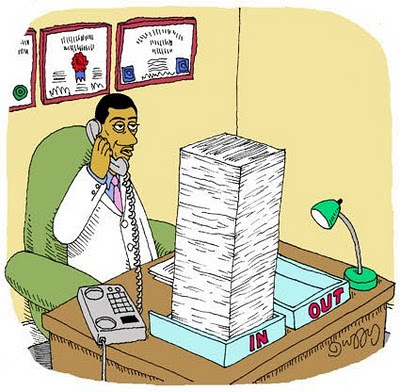 The American Medical Association (AMA) had a press release [recently] announcing findings from their survey on the impact of insurance company preauthorization policies.
Surprisingly, they discovered that these policies use physician time and delay treatment. It’s funny, because preauthorization policies were designed to save money. And I imagine they do, for the insurer, but they cost money for everyone else. Read more »
*This blog post was originally published at Shrink Rap*