July 18th, 2010 by David Kroll, Ph.D. in Better Health Network, Health Policy, News, Opinion, Quackery Exposed, Research
No Comments »

Today I refer you to an excellent post by Peter A. Lipson, M.D., at the blog Science Based Medicine entitled “HuffPo blogger claims skin cancer is conspiracy.”
The post focuses on an article by someone who contends that the link between sunlight and skin cancer is a conspiracy by dermatologists and the cosmetic dermatology industry. Dr. Lipson’s highly insightful analysis about the “interview” process and how doctors must act these days on behalf of their patients concludes:
This article shows a misunderstanding of journalistic ethics, medical ethics, and medical science. It’s a disaster. And it’s no surprise that it’s in the Huffington Post.
While this is a medicine story, my question relates to why an organization with a lot of great front-page news so frequently posts medical articles that are wrong and, sometimes, downright dangerous.
Read the article first, then read Dr. Lipson’s analysis.
Disclosure: I am an occasional contributor to Science Based Medicine but, like all contributors there, receive no compensation.
*This blog post was originally published at Terra Sigillata*
July 18th, 2010 by John Mandrola, M.D. in Better Health Network, Humor, Opinion, True Stories
No Comments »

What would you be if life gave you a do-over, and stipulated you couldn’t be what you are now?
It’s true, I’m a dreamer. I cried during “Stand and Deliver.” A believer in the power of passionate leadership am I.
Finally, this Saturday morning, I was able to drink coffee, eat bagels and read the paper. Ah, it felt so good. And in doing so I was moved by the WSJ piece on Teachers for America, an organization that allows recent Ivy league graduates to try their hand at being “Kimo-sabes.”
As a dreamer, I often find myself thinking of what I would be after finishing a stint as a doctor, or even more dreamer-esque, what would I be if I wasn’t a doctor. For me, an equally-attractive job to doctoring would have to entail contributing something positive to humanity.
One of the coolest things about being a doctor is asking patients what they do. Not just to find out how much one’s occupation contributes to the inflammatory soup of life, but also to feed a dreamer’s visions. Few patient occupations pique my interest more than teaching. Read more »
*This blog post was originally published at Dr John M*
July 18th, 2010 by Medgadget in Better Health Network, News, Research
No Comments »

 A British research project called BioCouture is working on clothing made out of bacterial cellulose that was grown in a hacked-together bioreactor.
As Gizmodo notes, it’s not clear what the point of the project is, seeing how we already grow cotton in a pretty efficient manner, but we kind of like the concept nevertheless. It’s sure to be a hit in biology labs everywhere.
See more pictures here: BioCouture…

*This blog post was originally published at Medgadget*
July 18th, 2010 by Toni Brayer, M.D. in Better Health Network, Humor, Medical Art, Opinion, Quackery Exposed
No Comments »

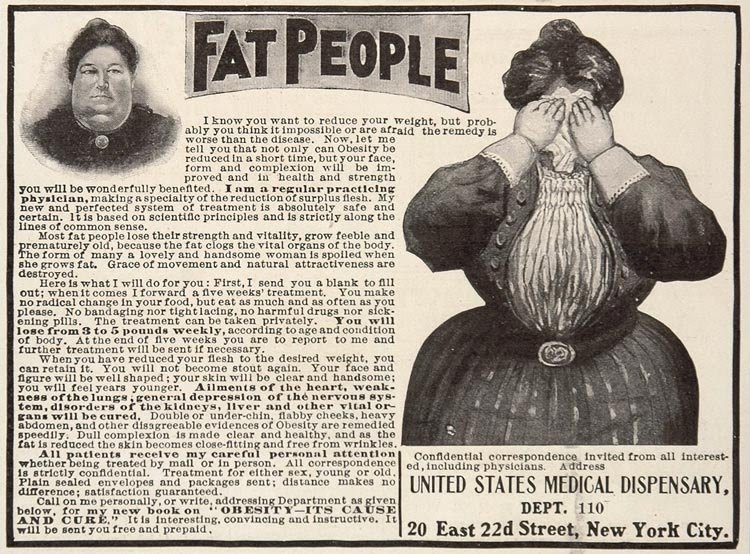
I really want to know what the treatment is that this “regular practicing physician” sent to the patient to reduce the surplus flesh. “Eat as much and as often as you please” and “no bandaging nor tightlacing.” Bring it on!
*This blog post was originally published at EverythingHealth*
July 17th, 2010 by GarySchwitzer in Better Health Network, Health Tips, News, Opinion, Quackery Exposed, Research, True Stories
No Comments »

 Freelance journalist and author Suzanne Schlosberg wrote because she was so upset over a New York Times story, “The Chip That Stacks Adds a Multigrain Twist,” that she wanted us to review it. I thought anyone who feels so strongly about something should review it herself. So she did. Here is Suzanne’s guest post:
**************************
I was flabbergasted when I read this New York Times piece on Procter & Gamble’s new entry into the potato-chip market: multigrain Pringles. The story accepts at face value P&G’s misleading marketing pitch — that “multigrain” is equivalent to “healthy.” When I sent a link to my nutritionist friend Cynthia Sass., M.S., R.D., she replied: “Did you notice it says ‘advertising’ in the top left corner? It must be a paid ad that resembles an article.”
Actually, it’s not. It’s a business story that ran in the “Media & Advertising” section. Though the story didn’t appear on the health pages, it should have made clear that “multigrain” simply means that more than one grain is included in the product — not that the product is necessarily nutritious. Read more »
*This blog post was originally published at Gary Schwitzer's HealthNewsReview Blog*












