July 6th, 2010 by Joseph Scherger, M.D. in Better Health Network, Health Tips, News, Research
1 Comment »

Most of us know that salt raises blood pressure in many people. When I learned that in medical school almost 40 years ago, I have not touched a salt shaker since. I enjoy having a low normal blood pressure. A new study published in the Journal of the American Society of Nephrology (July 2010) suggests that sugar, especially the fructose that comes from corn syrup, may also raise blood pressure.
A study team from the University of Colorado in Denver looked at sugar intake among thousands of Americans in a major national nutrition survey between 2003 and 2006. Those who consumed more added sugars, such as the fructose in soft drinks, had significantly higher blood pressures than those who did not and ate more natural foods such as fresh fruit. Fructose from corn syrup is a major cause of the obesity epidemic and may also be contributing to high blood presure, the most common chronic disease in adults. Read more »
*This blog post was originally published at eDocAmerica*
July 6th, 2010 by DavedeBronkart in Better Health Network, Health Tips, Opinion, True Stories
No Comments »

I love this — a website that could’ve ONLY been created by cancer patients. From ThinkAboutYourLife.org:
Find empowerment: Anything you can do to feel like you are taking control of your illness and treatment will help you. Think About Your Life was developed by cancer survivors. We have used the tools on this website in our own experiences, and we hope to inspire you do the same.
This website provides easy-to-use tools for each stage of the cancer journey to help you:
- Process your thoughts and feelings: Elizabeth shared the “Good Day, Bad Day” tool with her family to tell them how they could help her throughout treatment.
- Take control and make decisions: Amanda used her “One Page Profile” with her doctor to discuss the impact of treatment on her life.
- Think about the “what now” and the “what next”: The “Hopes & Fears” tool helped Susan think about the next few months of her life after treatment.
I learned about the site from its creator, Amanda George, who commented on a recent post about person-centered health. Hot diggety. Don’t you just love how the Internet lets us connect with each other and share ideas?
*This blog post was originally published at The New Life of e-Patient Dave*
July 5th, 2010 by Shadowfax in Better Health Network, Health Policy, Opinion, True Stories
No Comments »

I don’t know what’s going on with American College of Emergency Physicians (ACEP) lately, but it’s disheartening. Their abdication of responsibility and engagement during the healthcare reform debate was depressing. Then there was a rigged poll designed to elicit a predetermined result. Now I see a bizarre op-ed piece in USA Today entitled “Opposing view on drug addiction: Don’t make us ‘pain police'” and authored by ACEP President Angela Gardener. An excerpt:
The patient-physician relationship is sacrosanct, demanding candor and trust. In the emergency department, trust is built in nanoseconds because patients and doctors do not have prior relationships. Knowing that any pain prescription will be entered into a large, public database might prevent patients from being truthful, or in the worst case, from seeking needed care. … As an emergency physician, I can assure you that the drug abusers who use the emergency room simply to get a prescription drug fix represent a micropopulation of the 120 million patients who seek emergency care every year in the USA. … Put bluntly, if legislators have money to spend, they should spend it where it will do the most good for our patients, and that is not on drug databases.
I really don’t know what to say, other than to wonder whether Dr. Gardner and I practice in the same United States in which abuse of prescription drugs is growing exponentially and in which “drug-seeking” patients are a part of each and every shift worked in the ER, where deaths due to overdoses of prescription medications are on the rise, and where diversion of narcotics is a serious and growing problem. Read more »
*This blog post was originally published at Movin' Meat*
July 5th, 2010 by KevinMD in Better Health Network, Health Policy, News, Opinion, Research
No Comments »

Emergency physicians are in a dilemma. Risk missing a diagnosis and be sued, or be criticized for overtesting.
Regular readers of this blog, along with many other physicians’ blogs, are familiar with the difficult choices facing doctors in the emergency department.
The Associated Press, continuing its excellent series on overtesting, discusses how lawsuit fears is a leading driver of unnecessary tests. Consider chest pain, one of the most common presenting symptoms in the ER:
Patients with suspected heart attacks often get the range of what the ER offers, from multiple blood tests that can quickly add up in cost, to X-rays and EKGs, to costly CT scans, which are becoming routine in some hospital ERs for diagnosing heart attacks …
… and the battery of testing may be paying off: A few decades ago insurance statistics showed that about 5 percent of heart attacks were missed in the emergency room. Now it’s well under 1 percent, said Dr. Robert Bitterman, head of the American College of Emergency Physicians’ medical-legal committee.
“But you still get sued if you miss them,” Bitterman added.
The American Medical Association’s idea of providing malpractice protection if doctors follow standardized, evidence-based guidelines makes sense in these cases. Furthermore, it can also help reduce the significant practice variation that health reformers continually focus on. Read more »
*This blog post was originally published at KevinMD.com*
July 5th, 2010 by Berci in Better Health Network, Health Policy, News, Opinion, Research
No Comments »

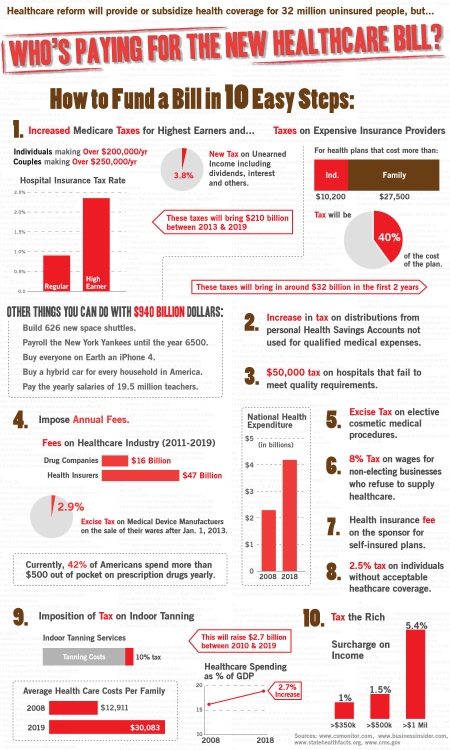
Ever wondered who’s paying for the U.S. healthcare bill? My new favorite blog just published an infographic describing this issue in detail (click on the image for the original larger version):
*This blog post was originally published at ScienceRoll*