February 18th, 2010 by Jonathan Foulds, Ph.D. in Better Health Network, Health Tips, Research
3 Comments »

E-cigarettes continue to create a lot of media buzz and chatter among smokers and smoking cessation experts alike. Today, Professor Thomas Eissenberg of Virginia Commonwealth University published an important study demonstrating that E-cigarettes, despite claims on the packaging and advertising, deliver almost no nicotine to the user.
The study is published in the latest edition of the journal, Tobacco Control. Professor Eissenberg had 16 smokers abstain overnight, then come to the lab. on different days and (a) smoke two of their usual cigarettes (b) puff on two unlit cigarettes or (c) “smoke” 2 leading brands of E-cigarette using their “high nicotine” cartridge (16mg), each brand on a separate occasion. On each occasion he measured the blood nicotine levels before, during and up to 45 minutes after using the products. Read more »
This post, Are E-Cigarettes Anything More Than A Theater Prop?, was originally published on
Healthine.com by Jonathan Foulds, Ph.D..
February 18th, 2010 by Dr. Val Jones in Announcements, Expert Interviews, Video
No Comments »
This year, the Better Health team will be offering live coverage of healthcare’s largest tech conference: HIMSS in Atlanta, March 1-4. Three medical bloggers, Dr. Val Jones, Dr. Mike Sevilla, and Dr. Nick Genes will interview over 40 different exhibitors and stream their interviews live via UStream. You can ask questions of the interviewees by submitting questions to @drval during the event. Dr. Val Jones will report to ABC News, DC via Skype from the convention floor on Wednesday, March 3rd at 10:50am. Here’s a sneak preview of HIMSS:
httpv://www.youtube.com/watch?v=v96kje6mCRU
Stay tuned to the Better Health blog for more information about HIMSS coverage… Or meet Dr. Val at HIMSS during her “Meet The Bloggers” panel discussion. Read more »
February 18th, 2010 by RamonaBatesMD in Better Health Network, Book Reviews
No Comments »

 I received a free copy of the book, Genius on the Edge: The Bizarre Double Life of Dr. William Stewart Halsted by Gerald Imber, MD, a week ago. I have enjoyed reading it. The book is the biography of Dr Halsted, but also gives you a glimpse into the life of many other great medical figures: William Osler, William Henry Welch, Harvey Cushing, etc. (photo credit)
In many ways it is a history of medicine/surgery in America. Halsted was very influential in bringing aseptic techniques to surgery and introduced the residency training system. He used his knowledge of anatomy to improve surgical technique. He performed the first successful hernia repair and radical mastectomy for breast cancer.
Early in his career Halsted became addicted to cocaine while experimenting with the drug for use as a local anesthetic. Treatment at the time, involved substituting morphine for cocaine. Halsted spent 40 years of his life struggling with his addiction to both cocaine and morphine. Read more »
*This blog post was originally published at Suture for a Living*
February 18th, 2010 by Harriet Hall, M.D. in Better Health Network, Book Reviews
No Comments »

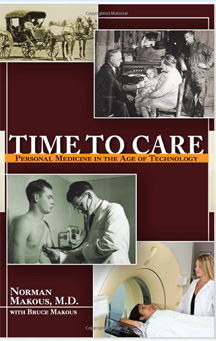 In 1925, Francis Peabody famously said “The secret of the care of the patient is in caring for the patient.” A new book by Norman Makous, MD, a cardiologist who has practiced for 60 years, is a cogent reminder of that principle.
In Time to Care: Personal Medicine in the Age of Technology, Dr. Makous tackles a big subject. He attempts to show how modern medicine got to where it is today, what’s wrong with it, and how to fix it. For me, the best part of the book is the abundance of anecdotes showing how medicine has changed since Dr. Makous graduated from medical school in 1947. He gives many examples of what it was like to treat patients before technology and effective medications were introduced. He describes a patient who died of ventricular fibrillation before defibrillators were invented, the first patient ever to survive endocarditis at his hospital (a survival made possible by penicillin), a polio epidemic before polio had been identified as an infectious disease, the rows of beds in the tuberculosis sanitariums that no longer exist because we have effective treatments for TB. Read more »
*This blog post was originally published at Science-Based Medicine*
February 17th, 2010 by DrRob in Better Health Network, Health Policy, Opinion
6 Comments »

I am going to state something that is completely obvious to most primary care physicians: I do not accept Medicare and Medicaid patients because it is good business, I accept them despite the fact that it is bad business.
In truth, I could make that statement about insurance as a whole; my life would be easier and my income would be less precarious if I did not accept any insurance. If I did, I would charge a standard amount per visit based on time spent and require payment at the time of that visit. This is totally obvious to me, and I suspect to most primary care physicians. A huge part of our overhead comes from the fact that we are dealing with insurance. A huge part of our headache and hassle comes from the fact that we are dealing with insurance. Read more »
*This blog post was originally published at Musings of a Distractible Mind*