January 11th, 2010 by DrWes in Better Health Network, Health Policy, Opinion
1 Comment »

With the turn of the calendar to the new decade, the reality of health care reform has set in for doctors and patients. Already cuts to physician salaries and patient access to care are becoming starkly apparent to those of us on the front lines of health care.
I wonder why doctors have been so ineffectual relative to the other special interests “at the table,” in the health care debate? One would think that those with the knowledge base and skill to manage their patients would be the ultimate power brokers in the efforts of health care reform. Yet here we are, watching the commoditization of our profession at the hands of lawyers and politicians in Washington, eager to avoid being perceived as the spoiler. Read more »
*This blog post was originally published at Dr. Wes*
January 10th, 2010 by Nancy Brown, Ph.D. in Better Health Network, Research
No Comments »


According to a study by researchers at Columbia University, teens whose parents let them go to bed past midnight were 24 percent more likely to be depressed and 20 percent more likely to have contemplated suicide than peers whose parents set bedtimes at or before 10 p.m.
The results were reported in the journal Sleep, and suggest earlier bedtimes may be protective because they increase the likelihood of getting enough sleep. According to the Centers for Disease Control & Prevention (CDC), about 4,400 Americans between the ages of 10 and 24 commit suicide each year, making it the third-most common cause of death in the age group. This is also to be the group getting the least amount of sleep, which suggests a pretty logical correlation between suicide and lack of sleep.
Data from this study comes from 15,659 U.S. students, who were in grades seven to 12 between 1994 and 1996, and their parents. Seven percent of the teens were found to have depression and 13 percent said they seriously contemplated suicide during the preceding 12 months. The association was stronger for girls and older children. Read more »
This post, Teens, Sleep, Depression And Suicide, was originally published on
Healthine.com by Nancy Brown, Ph.D..
January 10th, 2010 by Stanley Feld, M.D. in Better Health Network, News, Opinion
1 Comment »

Cecelia and I just finished watching the movie Food Inc. It is a movie worth watching.

I was upset seeing the abuse of our food chain by big food corporations. There is little respect for America’s food safety.
America’s obesity epidemic is caused, in part, by the food industry’s ability to produce cheap food. Fifty years ago, when I was at Columbia College, the solution to America’s impending food shortage was debated. The predication was the nation was going to face a food shortage in the next 50 years. Read more »
*This blog post was originally published at Repairing the Healthcare System*
January 10th, 2010 by GruntDoc in Better Health Network, True Stories
No Comments »

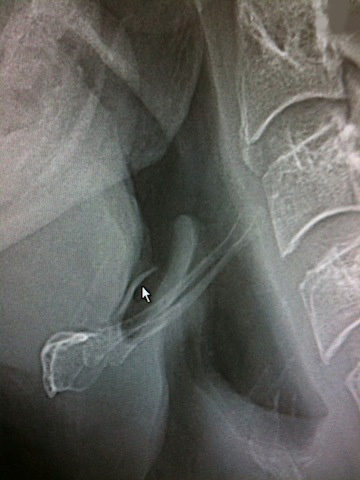
A patient comes in with the entirely understandable complaint of “I have a fishbone lodged in my throat”. Came straight from dinner to the ED. When I ask a stupid question I’m given a stupid answer: “It feels like…a fishbone…”. Duh on me.
Now, I went to a pretty good EM residency, and while there I learned two things: the books say fishbones don’t show up on x-rays of the neck, and, fishbones sometimes show up on x-rays. I’m about 70% positive in my career…
So, I got an xray. See if you can spot the fishbone (hint: there’s an arrow pointing at it…)
So, it’s there… Now what… There are very few wrong answers. Call ENT, etc. My answer: go get it. Read more »
*This blog post was originally published at GruntDoc*
January 9th, 2010 by Peggy Polaneczky, M.D. in Better Health Network, Opinion
1 Comment »

This post is in response to Jane Brody’s recent NY Times article on the FRAX fracture risk calculator. FRAX is a clinical decision tool devised by the World Health Organization that allows physicians to account for the myriad of risk factors, including bone density, to determine a patient’s risk for osteoporotic fracture.
Now about 20 years into the practice of medicine, I have evolved from what they call an “early adopter” of new drugs, through a time of cautious use of new drugs, to what I am now – highly skeptical of most new medications and suspicious of Big Pharma, medical thought leaders and anyone else trying to “educate” me about a disease. I am also disappointed in my medical societies for failing to cut the ties between themselves and industry, but hopeful that we are slowly but finally starting to emerge from of an era of industry-dominated health care and into a time of patient-centered medicine. Read more »
*This blog post was originally published at The Blog that Ate Manhattan*













