December 9th, 2009 by Edwin Leap, M.D. in Opinion, True Stories
1 Comment »


Three of my children love to play the game ‘Life,’ where players choose college or career and are paid, take out loans, pay taxes, have families and all the rest as they navigate towards retirement. I especially love playing with them when they each become frantic, not for the highest income, but to finish the game with the most children. Along the way, my daughter is even naming her kids as the tiny blue and pink pegs fill up her little plastic car. (Talk about your parental validation!)
But after playing, then thinking back on my week at work, I fear that we could easily make a new game that was more familiar to many modern kids. I suppose we’d have to call it ‘The Game of Death,’ or maybe just ‘The Game of Pain.’ Read more »
*This blog post was originally published at edwinleap.com*
September 16th, 2009 by DrWes in Better Health Network, Opinion
No Comments »

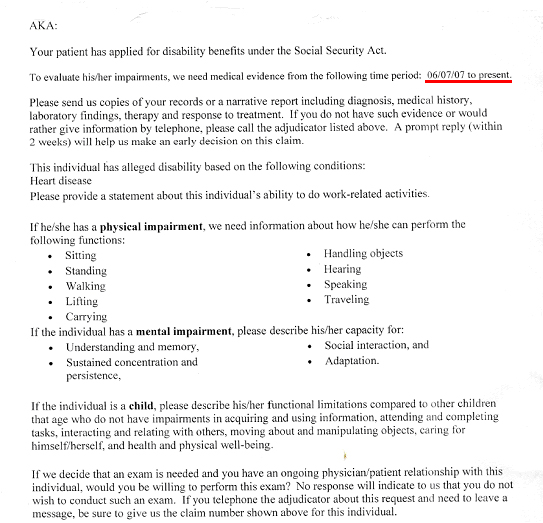
This week, like many doctors in primary care, I was sent a request by the Social Security to provide “medical evidence” that one of my patients was disabled so they could collect Social Security benefits. As part of that request, I was asked to provide evidence since June 6th, 2007, that my patient qualified for disability on the basis of “alleged” diagnosis of “Heart Disease.”
I was asked to send “copies of records or a narrative report including diagnosis, medical history, laboratory findings, treatment and response to treatment.” Beyond this, I also had to include physical and emotional impairment assessments and a functional assessment of their ability to sit, stand, walk, lift carry, handle objects, hear, speak, travel, and wash their car, view films, and eat bon bons (well, kind of).
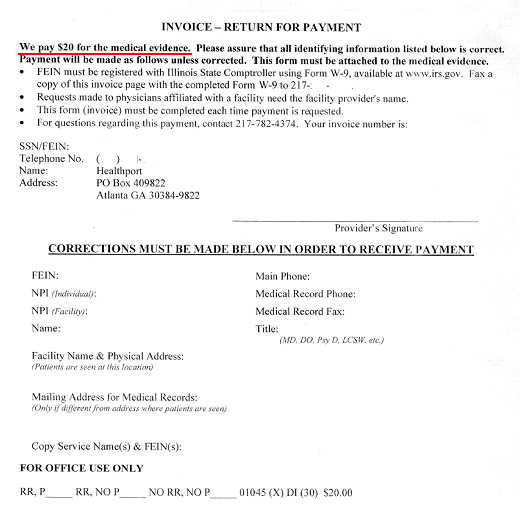
And for this copying, writing, mailing, collating what might I see from the government to compensate my time? Well, if I attach this invoice that requires a Federal Employee Identification Number filed through form W-9 available at www.irs.gov (yes, Virginia, this compensation is taxed), I might receive…
…drum roll, please…
… twenty dollars.
Now looking up the lowest paygrade of Social Security worker’s annual compensation of $29,726 and accounting for the 13 vacation days, 13 paid sick leave days, and 10 federal holidays they get paid, I estimate the least expensive Social Security employee makes a bit more than $16.50 an hour.
If we assume that the paperwork they just asked for takes about 2 hours collectively of office staff and doctor time, I think it’s clear that doctors’ payment for this service provided on behalf of our patients is substantially less than what the Social Security administration pays their own staff.
I wonder what else the government has in store for us.
-Wes
*This blog post was originally published at Dr. Wes*
April 8th, 2009 by Dr. Val Jones in Expert Interviews
No Comments »
Marty Prahl is the lead contracted health IT architect at the Social Security Administration (SSA). His personal experiences have led him to become a passionate advocate for digital data sharing. Several years ago one of his uninsured relatives was diagnosed with a devastating disease. She applied for disability benefits through the SSA but the process took over a year for her approval. During that year her medical condition caused her to lose her job, and she had no means by which to pay her soaring medical bills. The bank repossessed her home, her husband left her, and she had to move in with Marty’s family. As they waited for her disability benefits to be approved, Marty tried to make payment on her bills, which put enormous financial stress on his family.
Living through this nightmare galvanized Marty into action – he decided to devote his IT career to speeding up and streamlining the disability determination process. Thanks to Marty’s work, and the many people who created the Nationwide Health Information Network (NHIN), the SSA is now participating in an electronic medical record and data sharing network. This means that transfer of the records required to make an individual disability determination (if everyone sending data to the SSA is part of NHIN) can occur in under a minute. If the information supports the disability claim, an approval could be made within 1-2 days.
Prior to becoming part of the NHIN network, the SSA had no choice but to receive information by fax and paper. In order to make a disability determination, all medical records (from all healthcare professionals involved in the patient’s are) had to be gathered and analyzed by hand. If a doctor’s office didn’t send in the patient’s medical record in a timely manner, then the process would halt. Of course, compensation for sending records to the SSA didn’t generally cover the cost of doing so for the doctor, so the financial incentive to get the documents in was low. It’s no surprise that this resulted in wait times of 3 months to 2 years.
But some people simply can’t afford to wait – disability determinations are the gateway to Medicare and Medicaid funding, and there are other programs available for those who don’t qualify for Medicare and Medicaid. But those programs cannot be accessed until an official disability determination is made by the SSA. There are approximately 3 million new disability claimants annually in the United States – and without electronic data sharing, those people will have to wait for the paper process to run its course.
However, early adopters like MedVirginia, in Richmond, VA are already members of NHIN and can easily share medical records with the SSA. If more hospital systems and providers joined the network, disabled patients would gain rapid access to much needed government insurance benefits, and hospitals would no longer be offering them potentially bankruptcy-inducing “charity care” while they wait for a determination from SSA.
So what should Americans do about this? Spread the word about NHIN, and ask your hospitals to join the network. The software is free and available online (the CONNECT “open-source” code is here). As for me, I guess I hope that if I’m ever in a terrible car accident I’ll be taken to a NHIN participating hospital. A couple of days seems like a much better wait time than 2 years for disability benefits. I think Marty would agree.