September 1st, 2015 by Dr. Val Jones in Book Reviews
Tags: Acting, Empathy, How To Be A Rock Star Doctor, On Stage, Outpatient Medicine, Primary Care, Tips, Tips For Success
1 Comment »
 I’m often asked to do book reviews on my blog, and I rarely agree to them. This is because it takes me a long time to read a book – and then if I don’t enjoy it, I figure the author would rather me remain silent than publish my true thoughts. Most of the reviews that I end up writing are unsolicited, but today is an unusual exception. A colleague asked me to read her book, “How To Be A Rock Star Doctor.” I got half way through when she checked in to see how things were going. I had to tell her that I didn’t agree with some of her advice to young doctors, and I worried that she would be discouraged by my honesty.
I was very pleasantly surprised to find that she welcomed the criticism and actually asked me to write my review – favorable or unfavorable as I saw fit. She is the very first author to take that position (others have thanked me for not writing a review) and I am proud of her for it.
In essence, How To Be A Rock Star Doctor, is an easy-to-read primer for young primary care physicians looking to setup their first outpatient practice. The troubling part of the book (for me) was Dr. Bernard’s approach to the empathy fatigue that can set in for overworked physicians. In her view, we must “fake it” if we’ve lost it or don’t have it.
The book contains specific advice for how to appear empathic. Smiling broadly (no matter how one is feeling internally), dressing in a white coat, and exuding confidence, are recommended because we should see our patient interactions as an acting role – we are on stage, and they are depending on us to look/act the part.
Although Dr. Bernard rightly points out that there is research to support smiling as a means to achieving a happier mood, I was left with a certain uneasiness about the idea of putting on an act for patients. Something about the potential for dishonesty didn’t feel right to me. But then again, maybe the alternative – just being oneself – can create a poor therapeutic relationship if we’re in a bad mood for some reason.
I have heard many times that doctors can be uncaring to patients. Heck, I’ve even blogged about terrible interactions that I’ve had with my peers when I was in the patient role. But what is the solution? Should doctors learn how to imitate the qualities of a compassionate physician to achieve career success, or should we go a little deeper and actually try to be caring and let the behavior flow from a place of sincerity?
On the one hand, any tips to make the doctor-patient relationship go more smoothly should be welcomed… but on the other, if patient care is just an act, then what kind of meaning do our relationships have? If we act empathic do we eventually become empathic? Maybe yes, maybe no.
One thing I’m sure of, Dr. Bernard has opened an interesting discussion about how to handle stress, burnout, and create an excellent therapeutic experience in the midst of a broken healthcare system. She is willing to take criticism, and has endeared herself to me through our email exchanges. While I may not agree with all of her strategies to optimize patient satisfaction, one thing seems clear: she is as advertised — a rock star doctor.
Check out her book and find your own path forward. 🙂
February 6th, 2013 by Dr. Val Jones in Book Reviews
Tags: Bill Starbuck, Book Review, Fiction, Orville Rose, Samuel Shem, Starbusol, The House Of God, The Spirit Of The Place
1 Comment »
 When I was in medical school, I read Samuel Shem’s House Of God as a right of passage. At the time I found it to be a cynical yet eerily accurate portrayal of the underbelly of academic medicine. I gained comfort from its gallows humor – and it made me feel connected to my peers during the most stressful time of my training. So when I was invited to review Shem’s “bookend” to House Of God, it was with a sense of eagerness and nostalgia that I accepted the challenge. How had the author’s thinking developed since the launch of his first blockbuster in 1978? I hoped to find a kinder, gentler Shem, perhaps looking back on his career in medicine with a sense of grace and dignity. I wanted the pomp and cruelty of his training to fade away into a kind of “it was all worth it in the end” conclusion. Alas, I was jarred into a very different reality.
The Spirit Of The Place is a gruesome portrayal of American suburban decay, mixed with some unexplained hostility towards non-Jewish Americans and those with conservative values. The hero of the book, Orville Rose, escapes his mundane American life for a two year adventure with Doctors Without Borders in Europe. He soon is ensconced in a carnal relationship with a gold-digging, alternative-medicine practicing, Buddhist, Italian yoga master who later dumps him for a Swiss banker. Orville returns from Italy to his home town of Columbia, New York, to sort out his family affairs after his mother’s death. She has arranged to transfer all of her wealth to him if he agrees to live in his childhood home for a full year and thirteen days – a fate almost worth than death.
Columbia is a horrific place, filled with poverty, violent crime, summer mosquitoes, and winter ice storms. The central medical figure is an aging general practitioner (Bill Starbuck) who regularly prescribes a kind of snake oil for various life-threatening ailments (Starbusol). Orville sees this physician as a kind of avuncular mentor, excusing his gross medical malpractice as simply “old fashioned.” Bill soon asks that Orville take over his practice while he goes on a much needed vacation, which turns out to last over a year. Orville is stuck being the only GP for a town of about seven thousand. He soon becomes overworked and overwhelmed. But that doesn’t stop him from falling in love with a single mom and polio survivor who was secretly asked by his dying mother to mail Orville letters (written in advance) after her demise. These letters are filled with venom and manipulative accusations (paging Dr. Freud).
The plot makes the reader predisposed to feel empathy for the protagonist, but Shem so exposes Orville’s character flaws that he is nearly entirely unlikable. Every tender moment in the book is derailed by some sort of unpleasant comment or thought. Take for example, the death of Dr. Starbuck. Orville is at his bedside in the ICU, explaining how important it is to treat patients with dignity, even when they are unconscious. He gently whispers that it’s ok for Dr. Starbuck “to let go” and provides one last facial shave as the man drifts off into his final breaths. And in the middle of this, what does Orville also think to himself?
“…Bill’s groin, the purple crowned penis that had had its share of adventures in repayment for his tending the whores on Diamond street. ‘Two dollars a housecall, Bill, and you never came away empty-handed.’ He took out his comb and combed Bill’s thin hair, gray lines on a shiny dome.”
And then there’s the awkward sex scene where Orville describes kissing his lover’s limb shriveled from the polio virus. I’ll save that one for your imagination.
The point, we are left to assume, of this depressing exploration of human defects (from the physical to the emotional, and at every level of organization – from the family unit to the city government and even national and international politics) is to promote tolerance and understanding of the human condition. Unfortunately the book is more likely to suck the last breath of optimism and hope out of you. The darkness has consumed the light, and with little to admire in any character portrayed in The Spirit Of The Place, it is difficult to read. In fact, it took me over two months to complete it.
That being said, Shem is an excellent writer. And for those who enjoy wrist-slitting fiction, this may be just the book for you. I was personally quite astonished by Abraham Verghese’s exuberant cover jacket blurb:
“An incredible and heartfelt story… The Spirit Of The Place entertains, satisfies, and affirms; it is beautifully conceived and brilliantly executed.”
Clearly not everyone agrees with my analysis. I’d be curious to know which one of us is crazy – me, Verghese, or Shem?
I suppose Shem would say we all are, and that’s the point…
December 24th, 2012 by Dr. Val Jones in Book Reviews, Quackery Exposed
Tags: Diet, Diet Book, Eat To Save Your Life, Exercise, Gloria Askew, Jerre Paquette, Misinformation, Not Recommended, Obesity, Pseudoscience, Weight Loss
No Comments »
 I am hesitant to review diet books because they are so often a tangled mess of fact and fiction. Teasing out their truth from falsehood is about as exhausting as delousing a long-haired elementary school student. However, after being approached by the authors’ PR agency with the promise of a book that contains science-based nutrition information I decided to agree to the review. This is how the book was described to me in an email:
In their provocative new book, Eat to Save Your Life, best-selling authors Dr. Jerre Paquette and Gloria Askew, RRN, sort through the piles of information and misinformation about nutrition to reveal the true connection between food and health. Fed up with the advertising hype and conflicting nutritional advice, the duo provides common sense explanations for consumers everywhere who are looking to make smart nutritional choices.
Unfortunately, I was sold (quite predictably) a bill of goods. And rather than ignore the book and simply not do a review, I figured that maybe a negative review would reduce the number of incoming PR requests for future tomes of pseudoscience. In the end, I’ll probably just become the focus of personal attacks by dedicated proponents of various snake oils.
That being said, I thought it might be somewhat instructive to remind Better Health readers of certain basic “warning signs of pseudoscience” that I accidentally overlooked in agreeing to review the book. For a more complete review of similar “signs” I highly recommend Dr. David Gorski’s 2007 classic, humorous take on predictable arguments and behaviors of alternative medicine proponents (written in the style of comedian Jeff Foxworthy). As for me, I tend to think of much of the world of integrative medicine as a militant group of bakers eager to add odd, inert and occasionally toxic substances to cake recipes.
And so, without further ado, here is a small sample of what authors Askew and Paquette have added to their half-true diet book recipe:
- The “one true cause” fallacy: The book opens with an interesting review of vitamin C deficiency, noting that it (apparently) took the British Royal Navy 40 years before they accepted that the treatment for scurvy was citrus extract (rather than flogging). Citing this incident as an example of nutritional deficiency leading to life-threatening illness, it’s a short ride to the “one true cause” fallacy whereby the authors postulate that there are untold numbers of modern diseases caused by unrecognized nutritional deficiency syndromes. Nutritional deficiency may be the one true cause of most diseases, you see.
- The appeal to research without references. Countless appeals are made to “mounting evidence” of this and that (arthritis being caused primarily by food-related inflammation for example), either without reference footnotes, or with mentions of sources of dubious credibility (such as the Canadian Association of Naturopathic Doctors).
- The appeal to supplements in lieu of vaccines. No diet advice would be complete without a gratuitous attack on vaccines, right? The authors suggest that flu vaccines (for example) only provide immunity for 2 months “and only for certain individuals.” Meanwhile, they assert that a combination of Echinacea, garlic, and vitamin C support the immune system to successfully fight of viruses. These claims are simply unproven and multiple studies have already found no benefit (over placebo) of these supplements at preventing and treating the common cold.
- Over-diagnosis. If you think that the world of medicine is predisposed to seeing disease where there is none, try the alternative medicine world. The authors assert that everything from zits, to rashes, to “brain fog” are potential signs of grave underlying immune compromise – caused by, you guessed it, dietary deficiencies.
- Over-supplementation. The authors argue that “supplementation is a necessity in our nutrient-robbed world.” However, new evidence doesn’t support supplementation for the general population, though it had beentraditionally felt that multi-vitamins might be valuable. In addition, new studies are finding that food sources are preferable to supplements for daily nutritional requirements (such as calcium) and that anti-oxidants such as vitamin E may do more harm than good.
- The “organic is more nutritious” argument. Although a recent systematic review of the scientific literature found no support for the notion that organic foods contain more nutrients than those grown with traditional methods, the authors attribute Americans’ supposed vitamin deficiencies to poor soil quality caused by non-organic farming methods.
- Nutrigenomics and DNA hype. The authors do not take a sufficiently skeptical view of the emerging field of nutrigenomics (whereby certain foods and supplements are recommended to individuals based on their genetic profiles). They even suggest that nutrigenomic testing is so much fun, it’s “almost like being part of a CSI television show.” Who cares if it’s no more accurate than fortune telling?
So what’s the half true part? Well, obesity is certainly a driver of many modern illnesses, and obesity is caused by (in no small part) nutritional choices. The authors cite statistics on the ravages of heart disease, high blood pressure, and diabetes on the U.S. population which are all quite true. (How this supports the “deficiency” argument is somewhat lost on me – because it would seem more logical that a possible excess of nutrients could be the “one true cause” of a lot of these diseases, but I digress).
There are real nutritional deficiencies that cause medical problems, such as iron-deficiency anemia, neural tube defects related to folic acid deficiency, vitamin D deficiency and rickets, and osteoporosis contributed to by low calcium levels. These conditions underscore the importance of healthy eating habits, but do not support the idea that the entire population is deficient in these nutrients. In fact, a large population study analyzed by the CDC, suggests that most Americans are not deficient in any major nutrient even with their current sub-optimal and obesogenic eating habits.
In general, fair-minded individuals will find Eat To Save Your Life to be yet another example of a half-true, hysteria-peddling, micro-nutrient-obsessed diet advice book. Ironically, the book’s title itself states the opposite of what we really need to be doing to reduce obesity-related diseases: stop eating (so much) to save our lives.
This book may be purchased (against my medical advice) at Amazon.com.
***
This post originally appeared at the Science Based Medicine blog.
November 30th, 2012 by Dr. Val Jones in Book Reviews
Tags: Complication Rates, General Surgery, Hospital Safety, Marty Makary, Patient Safety, Readmission Rates, Transparency, Unaccountable, WSJ
No Comments »
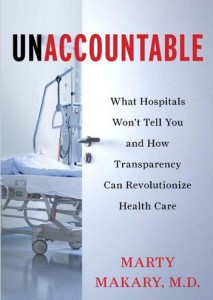 I met Dr. Marty Makary over lunch at Founding Farmers restaurant in DC about three years ago. We had an animated conversation about hospital safety, the potential contribution of checklists to reducing medical errors, and his upcoming book about the need for more transparency in the healthcare system. Marty was well dressed and soft spoken – sincere, and human. We exchanged business cards and wished each other luck in changing the healthcare system for the better. We were two doctors tilting at windmills.
Just two months ago my fiancé sent me a “must read” article from the Wall Street Journal. It was Marty’s provocative piece, “How To Stop Hospitals From Killing Us.” The article was an excellent primer for his book, “Unaccountable: What Hospitals Won’t Tell You And How Transparency Can Revolutionize Health Care” which I highly recommend (holiday gifts, anyone?)
Unaccountable is both horrifying and oddly optimistic. Marty describes case after case of medical errors, lapses in judgment, and near misses in the surgical suite. He exposes the cultural foibles of the medical and hospital hierarchy, leaving no dirty stone unturned. Surgical delinquents such as Dr. Hodad (“hands-of-death-and-destruction”) are presented with detached accuracy, along with a clear list of reasons why the system fails to prevent the Hodads of the world from operating.
From the micro (individual physician mistakes) to the macro (trends in hospital safety breakdowns), Marty turns to survey data to make sense of the shortcomings. Interestingly, hospital “culture” (rated by its own employees) is the most predictive of overall hospital safety performance. Detailed record keeping of surgical complication rates correlates strongly with how employees rate their hospital on three simple questions:
1. Would you have your operation at the hospital in which you work?
2. Do you feel comfortable speaking up when you have a safety concern?
3. Does the teamwork here promote doing what’s right for the patient?
Marty’s conclusion that culture is the defining factor in patient safety and satisfaction ratings is both accurate and squishy. It’s difficult to create a reproducible template for a healthy work culture, and yet good culture is the basis for the success of hospitals such as the Mayo Clinic. Individual hospitals, like individual surgeons, have different personalities and temperaments. Raising them to be upstanding citizens involves a combination of good parenting and good luck.
Because I think Marty is absolutely right about culture as the foundation for safe and effective care, I think he’s also overly optimistic about the potential success of strategies to reproduce caring hospital cultures. By his own admission, not even the Mayo Clinic “mother ship” in Rochester, MN, has been able to create the exact level of quality care in its sister hospitals in Scottsdale, AZ, and Jacksonville, FL. So how can we dramatically improve patient care on a national level? Marty suggests that we need to find ways to force hospitals to become more transparent in order to revolutionize healthcare. His ideas include:
1. Mandatory hospital public reporting of patient re-admissions, complication rates, and never events.
2. Adoption of check lists by surgical teams to reduce errors.
3. Installation of video cameras throughout hospital floors and surgical suites so that staff behaviors can be monitored more effectively (e.g. to enforce hand washing or identify surgeons who have high error rates).
4. Accessible and transferable medical records that put patients at the center of their documentation.
While these ideas have merit, I believe they will fall short of achieving our ultimate goals. In my view, a culture of accountability is not the same as a culture of caring. Adopting certain “Big Brother” (cf. #3 above) strategies to pressure staff to behave/perform appropriately is only going to force the Hodads underground. We need staff to genuinely care enough about their patients to gang up on the Hodads and kick them out of the hospital for good. Caring doesn’t happen at a national level, it is personal and local. That’s why individual hospitals must develop their unique cultures for themselves, with progress measured by responses to those staff questions about whether or not they’d want to be cared for at their own institution.
I agree with Marty that hospital data transparency might be the best antiseptic we have to scrub the underbelly of medicine, though the ultimate success of our procedures will always be culture and surgeon-dependent. And that’s something you can’t regulate from Washington.
***
Marty’s book is available for purchase at Amazon.com.
Check out your local hospital safety scores from LeapFrogGroup.
October 11th, 2012 by Dr. Val Jones in Book Reviews
Tags: California, Davis Liu, Dr. Davis Liu, Kaiser, M.D., Permanente Medical Group, Primary Care, The Thrifty Patient, The Thrifty Patient: Vital Insider Tips For Saving Money And Staying Healthy
1 Comment »
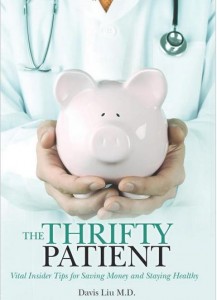 No matter the outcome of the presidential election this year, it’s likely that Americans will be spending more of their money on healthcare going forward. Dr. Davis Liu, a family physician at the Permanente Medical Group in California (and a contributor to this blog), has written a primer on how to get the most bang for your healthcare buck. The Thrifty Patient: Vital Insider Tips For Saving Money And Staying Healthy is a helpful little book for those smart enough to read it.
The first step to becoming a “thrifty patient” is to reduce your need for professional healthcare services. This lesson is perhaps the most important of all: lifestyle choices are the largest controllable determinant of how much healthcare you will consume. Daily exercise, healthy eating, and preventive care services (such as vaccines and screening tests) are the most effective ways to avoid expensive healthcare.
Dr. Liu offers tips for selecting a doctor, questioning the necessity of tests and procedures, choosing less expensive treatments, getting a second opinion, and learning to get the most out of a short doctor visit. He explains why annual check ups may not be necessary, and lists all the preventive health screening tests you’ll need (according to age) to maximize your chance of avoiding many major diseases or their expensive outcomes.
According to Liu, an excellent primary care physician (PCP) can be the best ally in avoiding unnecessary medical costs. Without a PCP’s guidance, 60% of patients select the wrong specialist for their symptoms or concerns. This can trigger a costly cascade of extra testing and referrals. Liu recommends trustworthy websites that can aid in disease management and patient education – suggesting that “Dr. Google” may not be so bad after all, armed with a correct diagnosis from a healthcare professional and links to credible sources of information.
Being thrifty isn’t necessarily “sexy” – but practical tips for avoiding unnecessary and expensive interactions with the healthcare system could add up to some pretty amazing savings (both financially and emotionally). Anyone who takes Dr. Liu’s advice to heart is likely to live longer and better – I just hope that the people who could benefit most from these tips find their way to this book. Perhaps you know someone who needs an early Christmas gift? 😆
The Thrifty Patient can be purchased here on Amazon.com