May 19th, 2011 by KerriSparling in Health Tips, Humor, True Stories
No Comments »

Yesterday I wrote about my wedding, focusing on the parts that meant the most to me: the man I love, our families and friends, the church service, saying “I do,” and dancing ourselves silly at the reception.
But diabetes was a part of my wedding day. We did our best to keep it quiet and unnoticed, though, using several tricky methods. I’m like a diabetes wedding magician … sort of.
First things first: the dress. Wearing an insulin pump is the easiest and least intrusive way for me to take my insulin, and I wasn’t about to go off the pump just for the sake of fashion. My solution? Design a pocket to hold my insulin pump, hidden in my wedding dress. I spoke with the seamstress at Ye Olde Bridal Shoppe and she and I designed something that left the pump accessible, yet hidden.

Even if you were looking for it, the pump pocket was almost impossible to find. Hidden along the seam of my wedding gown, it was held shut with a small piece of velcro. Read more »
*This blog post was originally published at Six Until Me.*
May 9th, 2011 by Toni Brayer, M.D. in News
No Comments »

 The top 10 prescribed drugs in the U.S. for 2010 in order of prescriptions written are:
- Hydrocodone (combined with acetaminophen) — 131.2 million prescriptions
- Generic Zocor (simvastatin), a cholesterol-lowering statin drug — 94.1 million prescriptions
- Lisinopril (brand names include Prinivil and Zestril), a blood pressure drug — 87.4 million prescriptions
- Generic Synthroid (levothyroxine sodium), synthetic thyroid hormone — 70.5 million prescriptions
- Generic Norvasc (amlodipine besylate), an angina/blood pressure drug — 57.2 million prescriptions
- Generic Prilosec (omeprazole), an antacid drug — 53.4 million prescriptions (does not include over-the-counter sales)
- Azithromycin (brand names include Z-Pak and Zithromax), an antibiotic — 52.6 million prescriptions
- Amoxicillin (various brand names), an antibiotic — 52.3 million prescriptions
- Generic Glucophage (metformin), a diabetes drug — 48.3 million prescriptions
- Hydrochlorothiazide (various brand names), a water pill used to lower blood pressure — 47.8 million prescriptions.
Notice that most of these are generic so they aren’t the ones that make the most money for Big Pharma. Those drugs are not offered in generic and they brought in n $307 billion in 2010. What was number one? Drumroll……..
Lipitor, a cholesterol lowering statin.
In case you wondered who is paying for these drugs…Commercial insurance helped pay for 63% of all prescriptions. Medicare Part D (Federal government) paid for 22% of prescriptions. The average co-payment for a prescription was $10.73. The average co-payment for a branded drug was $22.73.
If you are paying for prescriptions, make sure you ask your physician if it is available in generic. It can save you a lot of $$.
*This blog post was originally published at EverythingHealth*
May 7th, 2011 by Happy Hospitalist in Opinion
No Comments »

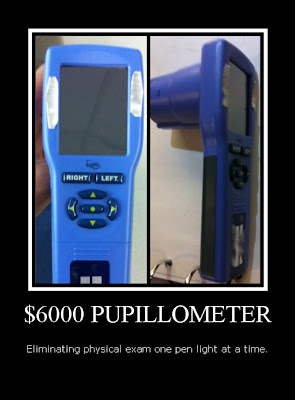 So I’m rounding in the ICU the other day when I came upon this new hospital medical device. It’s called a pupillometer. What does this pupillometer do? It measures subtle changes in the light reflex of the pupil to help take the physical exam to the next level of precision.
Or eliminate it, depending on how you look at it. What used to be a basic physical exam skill is now being replaced by a $6000 piece of medical technology that can distinguish tiny changes in pupil size. Now the real questions remain. Has this pupillometer device gone through the rigors of randomized trials in the ICU to define whether a $6000 flashlight changes outcomes or mortality? And if not, how do we allow medications to require such testing but not the technology that often changes nothing and simply makes health care more expensive.
The way I see things, if I’m trying to decide whether someone’s pupils constrict 1% vs 3% vs 10%, I’m getting a palliative care consult instead and putting the pupillometer back in my holster.
First the vein light. Now the pupillomter. And I thought the super bright LED pen light was all the rage.
*This blog post was originally published at The Happy Hospitalist*
May 4th, 2011 by Lucy Hornstein, M.D. in Humor, True Stories
No Comments »

9:00 pm:
Hello. It’s Mrs. Mumbledimumbler; I need the doctor to call me right away. My hip is driving me crazy. Please call me.
I listen to the message three times so I can sort of make out the name. The problem is that even though I think I can understand it, I don’t recognize it at all. But I call her because she said she needed me to call her right away.
Hello. I need you to call me in some tramadol right away.
“What was your name again?”
She repeats it clearly enough for me to confirm that I really don’t recognize it.
“Have I ever seen you in the office?”
No.
Let me get this straight: it’s 9:00 at night and your hip is hurting, so you call a doctor who’s a complete stranger and insist that they call you in a powerful painkiller without ever having seen you, taken your medical history, or examined you? I don’t think so.
“Um, I’m sorry ma’am, but I really can’t do that unless you’re an established patient in my office.”
Oh, okay; never mind.
I suppose I should count my lucky stars that she didn’t want vicodin.
*This blog post was originally published at Musings of a Dinosaur*
May 2nd, 2011 by RyanDuBosar in Humor, Research
No Comments »

Swearing really can relieve pain, but only if one doesn’t do it daily.
Researchers at Keele University in England have considered this topic before, and most recently, they studied whether people who swear more often in everyday life get as much pain relief from cursing as those who swear less frequently.
 Researchers recruited 71 participants who completed a questionnaire that assessed how often they swore. Pain tolerance was assessed by how long participants could keep their unclenched hand in icy water (5° C, capped at 5 minutes) while repeating a chosen word. The word was either a swear word (self-selected from a list of five words the person might use after hitting their thumb with a hammer) or a control word (one of five they might use to describe a table). Interestingly, one person was excluded from the study because they did not list a swear word among their five choices.
Results appeared in NeuroReport.
Swearing increased pain tolerance and heart rate, and decreased perceived pain compared with not swearing. But, the more often people swear in daily life, the less time they were able to hold their hand in the icy water when swearing compared with when not swearing. Read more »
*This blog post was originally published at ACP Internist*














