December 30th, 2010 by RamonaBatesMD in Better Health Network, Opinion, Research
No Comments »

I am a proud University of Arkansas alumni. The current issue of the alumni magazine has a short segment on Janet Cater and her work with female wounded warriors. Her research on military women amputees earned her a doctoral degree in rehabilitation counseling.
I did a Google search and was happy to find she has a blog: Female Wounded Warriors Posterous. There were only four entries but they allow an understanding of her research project.
The first one, Institutional Review Board Information (November 10, 2009), lays out the goal:
I am seeking to understand the psychosocial adjustment issues experienced by women veterans who have had a traumatic amputation. I am interested in your life experience.
The second one, Volunteer To Help Future Wounded Women Warriors, presented the goal and method again:
My study seeks to understand the adjustment issues faced by American women warriors who experience a traumatic amputation. At the present time there is no published research. As the number of women warriors returning with physical disabilities increases, it is vital that medical and mental health support staff understand the unique challenges these women face. Over 220,000 female soldiers have been deployed to Iraq and Afghanistan for one or more tours of duty. As of August 2009, a total of 121 women warriors have died, and it is estimated over 620 have received serious injuries. This study will use internet interviews using Skype to understand this life experience. Each woman will be invited to tell her story of how she adjusted to life as an amputee with the assurance of confidentiality. Read more »
*This blog post was originally published at Suture for a Living*
May 21st, 2009 by Dr. Val Jones in Health Tips, True Stories
No Comments »
There’s no technological substitute for the human hand. Manual dexterity is incredibly hard to replicate, and so surgeons will go to great lengths to save injured hands. Unfortunately, sometimes the injury is too severe to allow for any meaningful functional recovery.
In these two cases, well-meaning surgeons refused to amputate the unsalvageable hands, thus delaying recovery and adaptation of prostheses.
This is a photo of a trauma victim who underwent extensive reconstruction of the hand, including transplantation of a toe to the thumb’s position. Gangrene set in and tracked up one of the tendon sheaths.
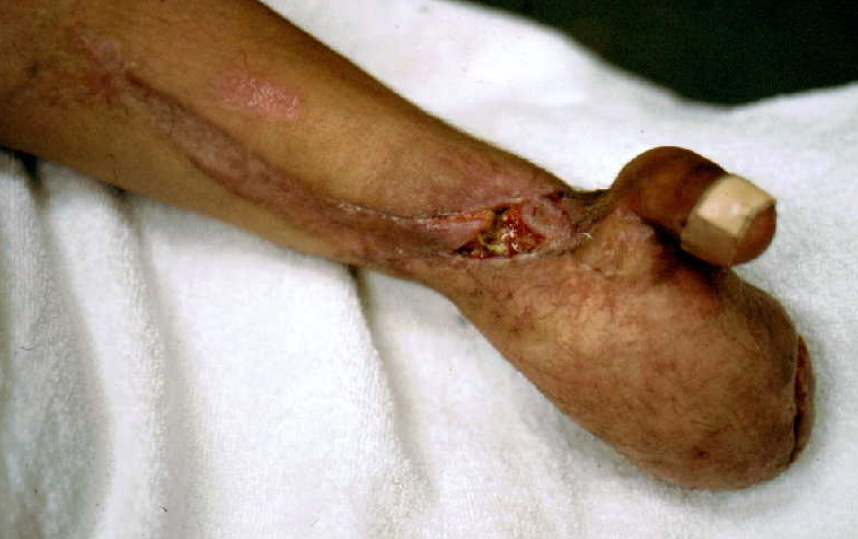
Photo Credit: Dr. Heikki Uustal
In this case, a burn victim was hoping to have some fingers reconstructed from his fist. He declined amputation and fitting with a prosthesis, despite the potential for enhanced function.
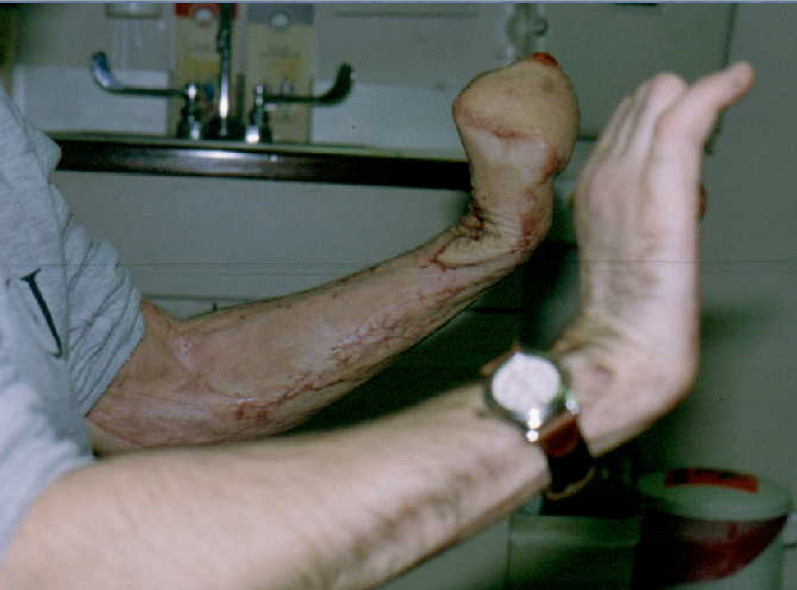
Photo Credit: Dr. Heikki Uustal
In both cases, a wrist disarticulation (amputation at the wrist) and prosthetic fitting (such as this myo-electric device with a self-suspending socket) might have provided a better functional and cosmetic outcome:
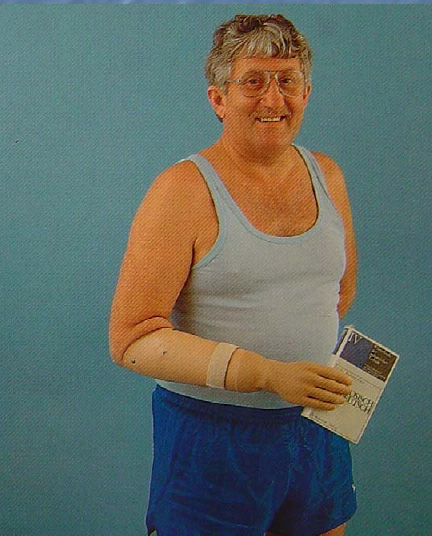
Photo Credit: Dr. Heikki Uustal
Sometimes, it’s better to amputate.
May 17th, 2009 by Dr. Val Jones in True Stories
3 Comments »
Tragically, land mines injure between 15,000 to 20,000 people each year. Some civilians see a metal object sticking out of the ground and attempt to pick it up and inspect it – the result is often loss of both hands and eyes.
The goal of rehabilitation after trauma is to restore as much independence as possible to patients. With loss of vision and no hands, self care, feeding, and donning/doffing arm prostheses can be very challenging. There is a procedure, known as the Krukenberg operation (named after Hermann Von Krukenberg, who first described it in 1917), that allows the forearm bones to be separated, using the muscle rotators that exist between them to create a pincer grasp. This procedure is not uncommonly used in India and Pakistan and does indeed return some degree of functional use to the arms.
At a recent Physical Medicine and Rehabilitation conference, this photograph was used to illustrate arm function after the Krukenberg operation.
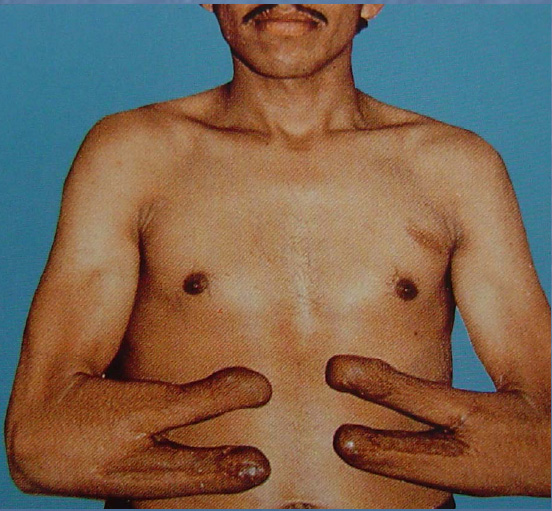
Photo Credit: Dr. Heikki Uustal
It certainly presents a conundrum – should function trump aesthetics in all cases?
I’m not sure that I’d want this procedure, even if I lost my vision and both hands.
Would you?