September 23rd, 2013 by Dr. Val Jones in Health Tips
No Comments »

This actress keeps her dermatologist on speed dial too.
As a light skinned, be-freckled woman with a history of pre-melanoma, I have been sternly instructed to keep my dermatologist on speed dial. Every six months I dutifully return to his office for inspection – nervously eyeing the biopsy tray as I sweat through my paper gown, legs dangling from a vinyl exam table.
In preparation for my most recent trip, I decided to be “an empowered patient” and arrive with a list of general dermatology and skin care questions that could be answered during my skin check. Judging from the near-syncopal episodes that I induced in my dermatologist while describing some of my hygiene practices, I’m not being very good to my skin. In fact, he wanted me to know that at least three products that I currently use are “of the devil.” Just in case you are inadvertently engaging in demonic skin care practices as I was – I thought I’d share what I learned:
1. Dryer sheets. According to my dermatologist, dryer sheets contain “a horrible chemical that no one can pronounce” that becomes “slathered all over your clothing” during the drying process. Although I was fond of the fresh scent and soft texture of my gym clothes, he assured me that heat and moisture was the best way to re-activate the irritating chemicals on delicate skin, virtually guaranteeing a contact dermatitis of the nether regions. So if you’ve been experiencing any unpleasant post-work out skin “issues” – consider dryer sheets as a potential cause.
2. Antibacterial ointments. Personally, I find that over-the-counter antibacterial ointments do a great job of preventing razor bumps. However, my dermatologist says that repeated or excessive use of these products can lead to allergies and colonization with antibiotic-resistant organisms. So… unless you want to be giving MRSA a “come-hither stare,” you might want to opt out of the Neosporin.
3. Battery-operated exfoliating brushes. I’ve seen so many ads for Clarisonic-type products that I figured they would be a reasonable choice for facial exfoliation needs. In fact, this topic may be somewhat controversial since I know other doctors who recommend these products. However, my dermatologist says that they are overkill and might do more harm than good to delicate facial skin, especially if you use any products that have an exfoliating acid included in their ingredient list, or if you use scrub creams. In other words, if you wash your face regularly, you probably don’t need to use additional aggressive cleaning measures.
In addition to the information provided about evil products commonly used by innocent people across America, my dermatologist offered these general tips for healthy skin:
1. You don’t need so much moisturizer. “You don’t need to put on moisturizer every night just because your mother told you to,” he said, bow tie looming large at eye-level. “Women think they need to apply moisturizer multiple times a day, but there is enough moisturizer in sunscreens and anti-oxidant serums to make additional products unnecessary.”
2. Throw away your 10x mirror. “Honestly, no one sees your skin at 10x, so why should you worry about what it looks like so close up? The best way to make your pores look smaller is to quit looking at them under a magnifier.”
3. Use physical block sunscreen every day. Most of the cheaper, spray-on sunscreens use chemicals to scatter light, but zinc-based sunscreens physically block incoming UV radiation. “The most important part of an ‘anti-aging’ regimen is to avoid sun exposure, and the best way to do that is with constant use of physical blocks.”
4. Skin-lightening cream (hydroquinone) can reduce the appearance of sun damage. Hydroquinone is the active ingredient in most skin-lightening creams. It acts to down-regulate melanin production in melanocytes, but can be reversed fairly easily by UV exposure (i.e. sunlight up-regulates melanin production). So even if you’re already pale-skinned, hydroquinone products can even out skin tones and sun spots – but only if you simultaneously commit to aggressive avoidance of UV exposure.
I hope you’ve found these skin tips enlightening (pun intended). I’ll have to think of some other good questions to ask my dermatologist in 6 months from now, during my next cancer screening. Because as an empowered patient, I intend to learn as much as I can in my 15 minutes with the doctor, and then share it with as many people as possible. 🙂
December 8th, 2011 by John Di Saia, M.D. in Research
No Comments »

“According to that study, nearly half of the 500 most popular sunscreens may actually increase the speed at which malignant cells develop and spread skin cancer such as melanoma.
Why? Because they contain Vitamin A, an ingredient that was added to sunscreen formulations because it’s an antioxidant that slows skin aging.
This isn’t necessarily new information….as some studies suggest “that vitamin A might have some phototoxicity.”
Source: health.msn.com/health-topics/skin-and-hair/articlepage.aspx?cp-documentid=100260739
Take it easy folks. One study on the effects of Vitamin A on skin cancers in animals does not invalidate sunscreen use. We don’t really need Vitamin A in sunscreens though. We need good blockers of UVA and UVB at an SPF of at least 30.
*This blog post was originally published at Truth in Cosmetic Surgery*
July 20th, 2011 by HarvardHealth in Health Tips
3 Comments »

 It doesn’t make sense: If sunlight causes cancer, why are human beings so drawn to it, flocking to sunny beaches for vacation time and hoping for sunshine after a rainy spell?
One answer, says David Fisher, chief of dermatology at Harvard-affiliated Massachusetts General Hospital in Boston, may be that humans are literally addicted to sunshine so our skin can make vitamin D. New evidence suggests that we get the same kick out of being in the sun that we get from any addictive substance or behavior. It stimulates the so-called “pleasure center” in the brain and releases a rush of feel-good chemicals like endorphins.
So there may be more than a desire to look good in a tan behind the urge to soak up the sun’s rays. This craving may be a survival mechanism that evolved over thousands of years because humans need vitamin D to survive. Skin makes this crucial vitamin when it is exposed to sunlight. There isn’t much vitamin D in food (except in some of today’s fortified foods) so the human brain rewards us with a rush of pleasure when we seek out the sun and get vitamin D.
Seeking sunshine can be downright dangerous. As Fisher points out, Read more »
*This blog post was originally published at Harvard Health Blog*
July 3rd, 2011 by Jeffrey Benabio, M.D. in Health Tips
No Comments »


Life is really simple, but we insist on making it complicated. -Confucius
This is certainly true of sunscreens. “Broad spectrum, UVA, UVB, avobenzone, oxybenzone, parsol, sensitive skin, titanium dioxide, SPF 15, 30, 45, 50, 55, 60, 70, 75, 100, 100+, waterproof, sweatproof, spray, cream, lotion, antioxidant…”
We spend about $700 million in sunscreens every year, and many people don’t have a clue as to what’s good or bad, or a waste of money. The Food and Drug Administration has been meaning to help you out with this problem for a while now. Actually for over 30 years (who says nothing gets done in government?). The F.D.A. has made a final decision on sunscreen labels. They’ve sought to make labels simple and accurate to help you choose the right one:
1. The sunscreen must protect against both UVA and UVB rays; that is, it must be broad spectrum.
2. To be labelled as “protecting against skin cancer,” the sunscreen must be an SPF of at least 15. The labels will likely be capped at SPF 50 because SPFs greater than 50 seem to be of little additional benefit.
3. Sunscreens can no longer be labelled as “waterproof” or “sweat proof,” as neither is physically possible, therefore, rendering the claim “misleading.” Sunscreens will be labelled as effective in water for 40 minutes or 80 minutes which is accurate and much more useful.
This simple system should help consumers make better choices, but some say the F.D.A. didn’t go far enough. They did not comment on the safety of various sunscreen ingredients. They have also not loosened up enough to allow for other sunscreens that are widely used in Europe to be sold here in the U.S.
Do you think the F.D.A was too strict or didn’t go far enough?
Photo: Wandering Magpie, Flickr
*This blog post was originally published at The Dermatology Blog*
July 1st, 2011 by Dr. Val Jones in Audio, Health Tips
No Comments »
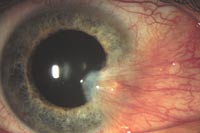
A Pterygium
Dermatologists have done a great job promoting sun safety. We all know that we should use sunscreen or sunblock to avoid burns, and to reapply it religiously when we plan to be outdoors for long periods of time. But how often do we think about protecting our eyes from the same UV rays?
A dear friend of mine has been on a long-term medicine that makes her skin especially sun-sensitive. She did not take sufficient precautions to protect her eyes from UV radiation (though she always wore sunscreen on her skin), and she developed a pterygium that looks just like the photograph above. Her condition reminded me of the importance of eye protection, and I thought I’d offer you 5 excellent reasons to start shielding your eyes from the sun. UV protection is critical for avoiding:
1. Photokeratitis. Photokeratitis is essentially a sunburn of the front layer (cornea) of your eyeball. If you’ve ever had a burning sensation in your eyes after a long day at the beach, or in the snow, you may have burned your eyes. Just as skin sunburns are painful and take a few days to calm down, eye pain can be very uncomfortable. But worse than the temporary discomfort is the increased long-term risks of pterygia, cataracts, and other eye conditions (see below).
2. Pterygia. Pterygia are overgrowths of corneal tissue that can grow across the iris and pupil. They can be cosmetically unsightly, and can block vision if they grow large. They are caused almost exclusively by UV damage, and are most common in people who live near the equator (because their exposure to UV radiation is highest). Surgery is the only known treatment for pterygia, though as many as 50% grow back, and surgical divets in the cornea can cause visual problems.
3. Cataracts. Cataracts are opacities of the eye lenses that lead to partial or total blindness. The exact mechanism by which they occur is unclear, though we know that sun exposure contributes to their development. Cataracts are the number one cause of blindness in the world.
4. Skin Cancers. Basal cell carcinoma (BCC) is a type of skin cancer that primarily develops on skin that has been sunburned, especially in childhood. Melanoma is a deadly form of skin cancer that is much rarer than BCC, but also most commonly develops on skin that has been burned. Squamous cell carcinoma (SCC) is the least invasive type of skin cancer, and usually develops on skin that has had the largest total amount of sun exposure over a lifetime. People who don’t protect the thin eye skin and lids from UV radiation (beginning in childhood) are more likely to develop cancer around the eyes
5. Macular Degeneration. Exposure to the sun’s UV rays can cause damage to the deep structures of the eye, including the retina. Light focused on the macula (the most important part of the retina for vision) can cause damage in the area over time. Macular degeneration results in visual damage and even blindness.
Ok, so I hope I’ve convinced you that UV protection is critically important for your eyes… How can you protect yourself? There are 4 primary strategies:
1. Wear UV protective sunglasses. When buying sunglasses, check out their product labels and avoid glasses that are purely cosmetic – opt for those that block 99-100% of UV A and B rays. Larger glasses and wrap-arounds offer the most coverage. Remember that kids need sunglasses too!
2. Wear a wide-brimmed hat. Although a hat doesn’t always protect you from glare and light reflection from other surfaces, it can reduce the total amount of radiation that reaches your eyes and skin.
3. Wear UV-protective contact lenses. Most people don’t realize that some contact lenses are manufactured with a UV protective layer already built in. Although they are not large enough to protect the entire eye surface (or the skin around the eye) they offer an added layer of protection against harmful UV rays. However, not all contact lenses offer UV protection, and of those that do, not all provide similar absorption levels. An eye care professional can prescribe Class 1 UV-blocking contact lenses, which provide the greatest level of UV protection and which have a Seal of Acceptance for UV Absorbing Contact Lenses from both the American Optometric Association and the World Council of Optometry’s Commissions on Ophthalmic Standards. These lenses block more than 90 percent of UVA rays and 99 percent of UVB rays.
4. Protect your eyes all day. UV radiation for the eyes is actually worse when the sun is lower in the sky. Researchers at the Kanazawa Medical University in Japan found that during early morning and late afternoon, UV exposure to the eyes was about double that of the hours around noon during Spring, Summer and Fall.
For more information about protecting your eyes from the sun, you may enjoy listening to my recent interview with Dr. Stephen Cohen.* He is an optometrist who lives in Arizona – and is therefore well acquainted with UV radiation! Scroll down to the bottom of the page after clicking on the link and you’ll see the podcast.
***
Note that I was paid by Johnson & Johnson Vision Care, Inc. to host the radio show with Dr. Cohen.













