September 16th, 2009 by DrWes in Better Health Network, Opinion
Tags: Costs, Disability, Disability Determination, Government, Government-run Healthcare, Paperwork, social security, SSA, Wages
No Comments »

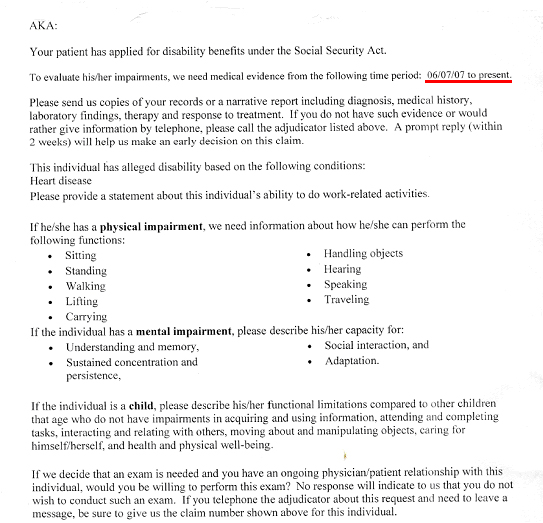
This week, like many doctors in primary care, I was sent a request by the Social Security to provide “medical evidence” that one of my patients was disabled so they could collect Social Security benefits. As part of that request, I was asked to provide evidence since June 6th, 2007, that my patient qualified for disability on the basis of “alleged” diagnosis of “Heart Disease.”
I was asked to send “copies of records or a narrative report including diagnosis, medical history, laboratory findings, treatment and response to treatment.” Beyond this, I also had to include physical and emotional impairment assessments and a functional assessment of their ability to sit, stand, walk, lift carry, handle objects, hear, speak, travel, and wash their car, view films, and eat bon bons (well, kind of).
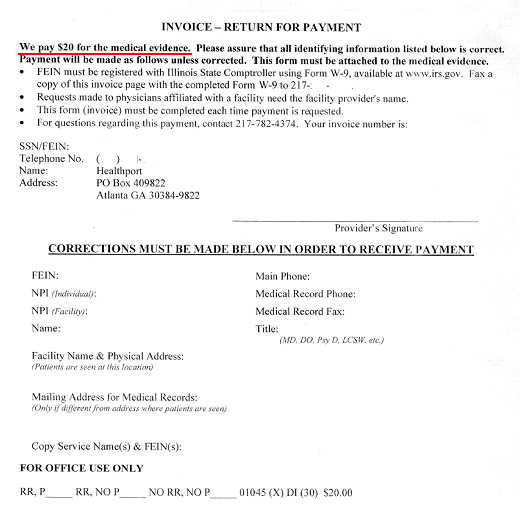
And for this copying, writing, mailing, collating what might I see from the government to compensate my time? Well, if I attach this invoice that requires a Federal Employee Identification Number filed through form W-9 available at www.irs.gov (yes, Virginia, this compensation is taxed), I might receive…
…drum roll, please…
… twenty dollars.
Now looking up the lowest paygrade of Social Security worker’s annual compensation of $29,726 and accounting for the 13 vacation days, 13 paid sick leave days, and 10 federal holidays they get paid, I estimate the least expensive Social Security employee makes a bit more than $16.50 an hour.
If we assume that the paperwork they just asked for takes about 2 hours collectively of office staff and doctor time, I think it’s clear that doctors’ payment for this service provided on behalf of our patients is substantially less than what the Social Security administration pays their own staff.
I wonder what else the government has in store for us.
-Wes
*This blog post was originally published at Dr. Wes*
September 16th, 2009 by KevinMD in Better Health Network, Health Policy, Opinion
Tags: Finance, Health Savings Accounts, Healthcare reform, HSA, Personal Responsibility
No Comments »

by Charles W. Patterson, MD
Health care reform has long been one of my main interests and currently, it seems to be everyone else’s. The President said he thought a single-payer system would be best, but submitted a proposal he thought could be passed. The outcome is in doubt.
Actually, the single-payer system is the second best possible solution. The government would hold the money but would remain vulnerable to political manipulation, bureaucratic inefficiency.
The best system would be a well regulated “Everybody Hold Your Own Money and Pay Your Own Way System.” It would empower patients to deal directly with their caregivers without third-party interference or regulation and lead them to become sensitive to the potential benefit and the cost of their care.
This could be accomplished without taxes and without insurance premiums by a properly designed system of health care savings accounts (HCSAs). These should be funded with pre-tax money from regular automatic savings, like payroll deductions, and everyone should have one from birth. Children’s accounts should be funded by their parents. In only a couple of years, normally healthy people would save enough to stay ahead of their health care expenses. They would save the same money they now pay in insurance premiums, so once in place, the new system would cost less because no money would go to insurance company administration and profit, and unnecessary procedures and tests would decrease because people would keep the money they didn’t spend.
When any account becomes large enough to cover anticipated needs (with, say, 90 percent probability) the extra money could be rolled over into a retirement account, or children’s HCSAs. At death, a person’s HCSA could be rolled over to heir’s HCSAs, after an inheritance tax which would be used to fund HCSAs for the poor and unhealthy. Everyone would keep the money they didn’t spend, so they would not spend it unnecessarily.
Government’s role would become only regulatory. A commission might be needed to determine a fair market value for services and patented drugs, but it is likely that market forces would control these and make the mix of available services more appropriate to people’s needs.
To insure that account money was spent on effective care, and not wasted or stolen by fraud, standards of medical practice should be established with a Wikipedia-style online system to allow each licensed practitioner and researcher to propose, amend and vote on standards of practice in his or her’s field. A true consensus statement would then be available on every relevant standard of practice, which would be more up to date and represent truly effective practice, better than the opinions of a panel of “experts.”
The quality of evidence on any issue varies from one study to the next, and leaves room for differences in opinion about what is good treatment. HCSAs should be allowed to pay for all procedures which received an overwhelming vote of approval, and not for those with overwhelming disapproval. The more money in an account, the lower a procedure’s vote would need to be to have it included. The list of approved procedures would change, and its quality would improve as fast as new evidence and experience accumulated.
Regulations should also end patents for new drug which do the same thing as established drugs, as well as new preparations of established drugs. Advertising of prescription drugs should end, because it leads to unrealistic expectations and misdiagnosis. And these regulations should require saved money to be invested conservatively.
Charles W. Patterson is a psychiatrist.
*This blog post was originally published at KevinMD.com*
September 15th, 2009 by Kenneth Trofatter, M.D., Ph.D. in Better Health Network, Health Tips
Tags: Amniocentesis, Down Syndrome, Nasal Bone, Obstetrics And Gynecology, Radiology, Risk, Ultrasound
No Comments »

Patient question about “Amniocentesis is Not Without Risk”:
I am 29 years old and am 21 weeks along. I just had an ultrasound a couple of days ago and was told that the nasal bone is not showing up which puts me at higher risk for a baby with Down Syndrome. I have yet to have someone tell me how much of an increased risk. I did not have the 1st trimester screenings as I’ve always said that it wouldn’t make any difference but now that it’s staring me in the face I am seriously considering an amniocentesis. I just wonder if I can go through the next 19 weeks wondering. Can you tell me what my risk is for a Down Syndrome baby? Thank you.
Previously we published a post that discussed the role of assessment of the fetal nasal bone in first trimester screening for fetal chromosomal abnormalities and, in particular, screening for Down syndrome (trisomy 21). Confirmed absence of the fetal nasal bone in first trimester has been correlated with a detection rate for Down syndrome in the range of 70% (with false positive rates dependent on maternal ethnicity – 2.2% in causcasians; 5% in Asians; and 9% in Afro-Carribeans) (Cicero, et al. Ultrasound Obstet Gynecol. 2003;21:15–18; Prefumo, et al., BJOG 2004; 111:109–112). Although determining the presence or absence of the nasal bone can clearly contribute to the risk assessment in first trimester, unfortunately, the technical difficulty of reliably obtaining an image and accurately interpreting the findings have led to more restricted use here in the U.S., even at many major academic centers.
In contrast, in midtrimester genetic screening, often done at 18-20 weeks, the finding of an absent nasal bone and to a lesser degree a hypoplastic nasal bone, is becoming more widely recognized as a major ‘marker’ for trisomy 21. In midtrimester, complete absence of the fetal nasal bone occurs in about one-third of Down syndrome babies. If a ‘short’ nasal bone (nasal bone hypoplasia), is included in the evaluation, 60% or more fetuses with Down syndrome may be detected, again with false-positive rates depending on ethnicity and the variable cut-off values for defining a “short nasal bone” in different studies (Bromley; et al., J Ultrasound Med 2002; 21:1387–1394; Bunduki; et al., Ultrasound Obstet Gynecol 2003; 21:156–160; Lee, et al., J Ultrasound Med 2003; 22:55–60; Gamez, et al., Ultrasound Obstet Gynecol 2004; 23:152–153).
One small study using 3D ultrasound found an absent nasal bone in 9 of 26 babies with Down syndrome (34.6%) and only 1 of 27 (3.4%) chromosomally normal babies, but this also meant that 9 of the 10 (90%) babies in whom complete absence of the nasal bone was found had Down syndrome (Goncalves, et al., J Ultrasound Med 2004;23:1619-27). In a recent study of 4373 babies evaluated in midtrimester, complete absence of the nasal bone was found in about 30% of Down syndrome and only 1% of chromosomally normal fetuses . (Odibo; et al., Am J Obstet Gynecol 2008;199:281.e1-281.e5). Nasal bone hypoplasia, defined in this study as <0.75 MoM, identified 47% of Down syndrome pregnancies and occurred in 6% of normal pregnancies.
So, to our reader, I cannot give a precise estimate of increased risk based on the ultrasound findings you report. However, if the ultrasound was performed by an experienced examiner and adequate images were obtained for evaluation, the complete absence of a fetal nasal bone at 21 weeks, even as an isolated finding, is disconcerting. The risk for Down syndrome could be as high as 90% and the false positive rate 5% or less. And, if you really need to know whether or not your baby is affected, an amniocentesis would be the best way to get that information. Best wishes and please let us know what you find out.
Dr T
This post, Absence Of Fetal Nasal Bone Is A Marker For Down Syndrome, was originally published on
Healthine.com by Kenneth Trofatter, M.D., Ph.D..
September 15th, 2009 by Medgadget in Better Health Network, News
Tags: CAST, Custom, Laryngectomy, Oncology, Otolaryngoloy, Personalized, Speech Technology, Voice
No Comments »

 Researchers from the University of Sheffield, with collaboration of a team from the University of Edinburgh, are experimenting with a voice replacement technique for people who are about to lose their vocal cords. The group partnered with a woman that was going to have her vocal cords removed in a scheduled cancer surgery. Prior to the procedure, her voice was recorded on a computer and then used as a template to create a digitized voice that sounds very much like her. We are 100% for this new technology, as we can’t stand that terrible, scary, artificial voice converter that’s being used nowadays.
The voice was built using around seven minutes of speech from the client, which amounted to 100 sentences. This method is therefore much more practical than established `Voice Banking´ technologies which require two or three hours of recording to build a voice.
The client´s regenerated voice was developed by University of Sheffield Master´s student Zahoor Khan as part of his dissertation, with guidance from research student Sarah Creer, whose doctoral work uses the same technique to improve the voices of people with speech disorders. Their work forms part of the research done within the CAST (Clinical Application of Speech Technology) group, which is a multidisciplinary research group interested in applying speech technology in clinical areas such as assistive technology, speech and language therapy and electronic control systems.
Researchers have since assessed the quality of the recordings by getting listeners to judge the similarity of the simulated voice with the original and by asking Mrs Chapman and her family what they think of the voice. All listeners have thought the regenerated voice sounded very similar to the original.
Researchers in CAST hope to use these personalised synthetic voices in communication aids for people whose speech has become intelligible, speaking for them like a human interpreter.
Bernadette Chapman [the study subject] said: “For many years the Servox machine, or artificial larynx, has been the main means of communication for patients following laryngectomy or for those who have had severe speech impairment. The machine tends to sound very like a dalek and can be very embarrassing to use, especially in public places.”
Press release: Researchers rebuild a voice
Image: soundman1024
(hat tip: The Engineer Online)
*This blog post was originally published at Medgadget*
September 15th, 2009 by Bongi in Better Health Network, True Stories
Tags: Acute Abdomen, AIDS, HIV/AIDS, Infectious Disease, M&M, Peptic Ulcer, South Africa, Surgery, Thrush
No Comments »

 M and M was never fun. Sometimes I would walk out feeling I’d just escaped by the skin of my teeth. Sometimes I would feel like my teeth had had too close a shave. But once…just once, it could have been worse.
It was a pretty standard call. It was very busy. In the early evening I was called to casualties for a patient with severe abdominal pain. When I examined him it was clear there was something seriously wrong inside. He had a classical acute abdomen with board like rigidity. He clearly had a perforated peptic ulcer and needed surgery. I set my house doctor to work to get him admitted and on the list. Meanwhile I went back to theater to work through the number of equally critical patients already on the list.
Things then settled down into a rhythm. I was in theater with a student operating the cases one after the other while the house doctor separated the corn from the chaff in casualties. Finally it was time to do the laparotomy for the guy with the acute abdomen. I needed to shoot through casualties before we started so I decided to swing past the ward and make sure the guy was still ok.
The ward was dark. Pretty much everyone was asleep. Without wanting to wake the other patients I turned on the small bedside light of my patient. Even in that dim light I could see a bit of oral thrush. I was surprised. I was thinking to myself how the hell did I miss that in casualties. I felt his abdomen. It was no longer quite so tender. I turned to the student.
“See why it is important to make your decision before giving opioids?” I said with an air of authority. “Now he is actually not so tender but he definitely had an acute abdomen. We must go ahead with the operation.”
I quickly felt for lymph nodes. He had them everywhere. Once again I was quietly thinking that my clinical skills must be slipping because that I also didn’t pick up in casualties. I kept this new information to myself. Imagine the shock to the student if he realised I was not all knowing. i just didn’t want to be responsible for that level of devastation in his life. But I started considering other causes for his condition. It was clear he had AIDS and TB abdomen started looking like a possibility.
While we were still with the patient, the theater personnel arrived to take him to theater. I told them to get things going so long while I quickly shot down to casualties to evaluate a patient the house doctor was unsure about. And off I went at a brisk walk.
I walked into casualties. The house doctor led me to the patient in question, but as we approached his bed my blood went cold. In the exact bed where my acute abdomen had been lying about four hours previously was my acute abdomen still lying there!! I turned and ran back to theater. Fortunately I was in time.
Later I found out what had happened. Once we had admitted the acute abdomen, the porter had come in to take him to the ward. One of the patients lying in casualties was a guy that had just come in. His HIV had wreaked havoc in his life causing a number of unpleasant things, including AIDS dementia syndrome. The exchange went something like this;
“Timothy Mokoena? Is there a Timothy Mokoena here?” the porter called out.
“Here I am, but it’s not Mokoena. It’s Magagula.”
“Ok, Timothy Magagula, I’m going to take you to the ward.”
“Ok, but it’s not Timothy. It’s Michael.”
“Ok, Michael Magagula. Let’s go.”
And thus Michael Magagula, the AIDS dementia patient (not to be confused with Timothy Mokoena, the acute abdomen patient), thinking he had just jumped the queue to see a doctor was carted off to the ward and prepared for theater. He even signed for a laparotomy without even having seen a doctor.
In the end it all turned out well. Timothy got his operation and the hole in his stomach was patched. Michael was referred appropriately to the physicians. But I couldn’t help wondering how this could have looked in the next M and M meeting.
“Well, prof, the patient died on the table basically because I operated him unnecessarily.”
“And how is the other patient? The one you should have operated?”
“Well, he died too because I didn’t operate him.”
200% mortality for one operation. Not easy to achieve.

*This blog post was originally published at other things amanzi*