July 11th, 2011 by Harriet Hall, M.D. in Quackery Exposed
No Comments »

Remember the Magic Eight Ball toy? You could ask it a question and shake it and a random answer would float up into a window: yes, no, maybe, definitely, etc. There is even a website where you can ask an Eight Ball questions online.
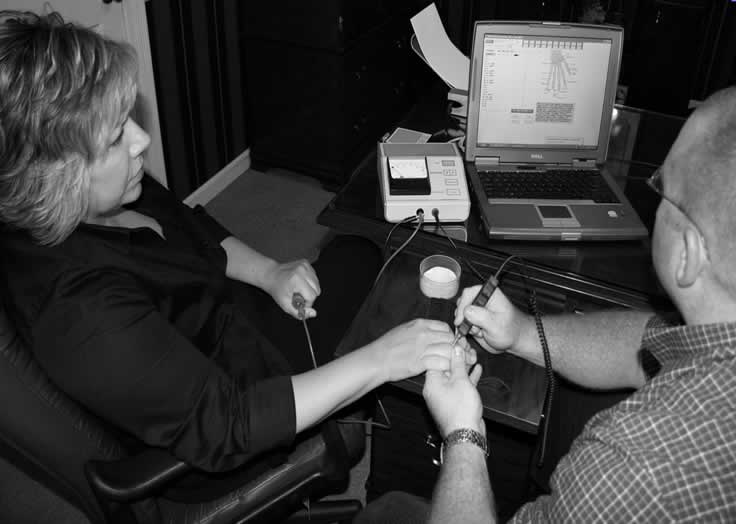
I have been meaning to write about bogus electrodiagnostic machines for a long time. These devices supposedly diagnose diseases and/or energy imbalances, indicate which remedies will correct the problem(s), and sometimes even treat the imbalances by transmitting a balancing frequency to the patient. I knew they were bogus, but I had never really realized the full extent of the deception until I viewed a set of training videos recently sent to me by a correspondent. I had never realized how similar electrodermal testing was to the Magic Eight Ball. I was further amazed at how they managed to combine every kind of alternative medicine into one incoherent package and to bamboozle patients with an appalling display of pseudoscientific babble.
This will be a two-part series. In the first, I will describe what the machines and their operators do. In the second (next week), I will address the legal and regulatory issues.
The History of EAV Devices
The first electrodermal diagnostic device was invented in 1958 by Reinhold Voll, a German medical doctor and acupuncturist. Read more »
*This blog post was originally published at Science-Based Medicine*
July 11th, 2011 by IsisTheScientist in Opinion, Research
No Comments »

Yesterday I went to go see my friend, the recently infrequently-mentioned Dr. Buttercup. When I first came to MRU, Dr. Buttercup was gracious enough to allow me to share lab space with him. That, coupled with our mutual love of beer and cake, meant that we saw each other quite frequently. Now that I have moved into other laboratory digs and find myself full of people, I see less of Dr. Buttercup and am the recipient of far less of his wisdom. It’s a shame. I miss that dude.
Then again, as soon as that guy received a grant score that someone told him was “fundable”, he became insufferable. Show off.
But, I digress. I saw Dr. Buttercup yesterday about a different matter and we got to discussing the idea of collaboration. He shared the notion that, as an Assistant Professor, collaboration is one of the funnest things he does. It’s also potentially one of the most dangerous because it robs your time without real reward. Still, brainstorming new experiments is fun and sometimes that additional effort on someone else’s grant pays the bills.
This made me think that the same is true for postdoc-level scientists and made me think about some collaborations I got myself into once upon a time. You see, when you’re a newly-minted, grown-up scientist, you’re on top of the world. Perhaps you start to feel like an expert in something and, perhaps, you’re enthusiastic to show the folks around you how good you are at what you do.
Don’t do it. Read more »
*This blog post was originally published at On Becoming a Domestic and Laboratory Goddess*
July 11th, 2011 by Michael Kirsch, M.D. in Health Policy, Opinion
2 Comments »

I spent the entire last weekend with an attorney, not a desirable circumstance for most physicians. However, I wasn’t being deposed or interrogated on cross examination. This was a rendezvous that we both sought with enthusiasm.
Lewis is my closest friend, a bond that was forged since we were eight years old. We are separated now only by geography, and we meet periodically because we both treasure the friendship. Earlier this year we rolled the dice in Vegas. Last weekend, we sweated in the sweltering heat of the Mile High City. Next stop? Back to Denver with a few youngins’!
Lewis is the managing partner in a prominent west coast law firm that specializes in tax evasion. (Or is it tax avoidance? Am I confusing my terms here, Lew?) He has been redrafted to this position because he has earned the respect of his colleagues. Clearly, both Lewis and I have ascended to the highest strata of our professions. Lewis is in charge of a large law firm that has global reach; he travels all over the world cultivating business and negotiating deals; and he navigates clients through complex and labyrinthine legal conundrums. I, an esteemed community gastroenterologist, perform daily rectal examinations and counsel patients on flatulence.
I am sure that readers will agree that our future professional prestige is already evident in this photo of us taken several decades ago. Read more »
*This blog post was originally published at MD Whistleblower*
July 11th, 2011 by AliKhanMD in Health Policy, Health Tips, Opinion
No Comments »


Borders, Budgets, and the Rising Risk of Disease
Is there a perfect storm brewing along our nation’s southern border? Let’s take a look at the numbers in El Paso, Texas where I recently visited:
- There are 27 million crossings per year alone at the El Paso Point of Entry (POE)
- Cuts to federal funding including a 50% reduction in the Early Warning Infectious Disease Program as well as 12.5% cuts to critical preparedness and response funding;
- Texas is second in the nation for number of tuberculosis cases, the majority of which are found near the border and many of the cases involve tuberculosis strains that are drug resistant
- The bordering country, Mexico, was the source of the last global influenza pandemic
So is this a bad situation getting worse or a ticking bomb? Read more »
*This blog post was originally published at Public Health Matters Blog*
July 11th, 2011 by admin in News
No Comments »

 Researchers at MIT have developed a cheap and easy to use system, called Catra, that uses a cameraphone clip-on device to map out cataracts.
The technology functions by sweeping the eye with a beam of light and using the phone’s camera to detect fuzzy spots. It can provide both a map of the cataracts and maybe help make an overall assessment of whether surgery might be necessary.
From MIT News:
While the standard test for cataracts in an ophthalmologist’s office assigns a score on a scale of 1 to 4 — from no cataracts to completely blocked vision — the new, inexpensive test actually provides much more information. Media Lab graduate student Vitor Pamplona, a member of the team developing Catra, explains that it “scans the lens of the eye and creates a map showing position, size, shape and density of cataracts.” Read more »
*This blog post was originally published at Medgadget*