July 3rd, 2011 by John Mandrola, M.D. in Health Tips
No Comments »

The Biology of Omega-3 fatty acids: (Just a little science:)
When fish, flax-seeds or Brussels sprouts pass through the intestine, pancreatic enzymes transform the fat to free fatty acids. These acids are quickly taken up by the cells. Once in the cell, these fatty acids enter the mitochondria, endoplasmic reticulum and cytosol–places that you might recall because your mom helped you make a Cell sponge cake in 7th grade Biology.
In the cells, the Omega-3 fatty acids (ALA, DHA and EPA) exert their healthy influence in three major ways:
- in the control of chemical messengers;
- in the flux of ions—cell electricity;
- in the smoothness and health of the cell membrane.
That’s enough about cells.
How do these (good) fats help our bodies?
Omega-3 fatty acids reduce Inflammation:
–Omega-3s get in the cellular (not phone) mix and end up competing with chemicals that cause inflammation—medical people say they antagonize bioactive mediators of inflammation.
–Newly-discovered by-products of Omega-3s are important in the resolution phase of inflammation. Biochem people call these chemicals, resolvins. All you have to remember here is this: to resolve (inflammation) is heart-healthy.
–When omega-3s are incorporated into the membranes of cells they do a lot of good: things like making the membrane more fluid and less sticky. For some reason, they even block genes that induce hardening of the arteries. (Genomic effects.)
Omega-3s benefit the heart: They… Read more »
*This blog post was originally published at Dr John M*
July 3rd, 2011 by Dinah Miller, M.D. in Opinion
No Comments »




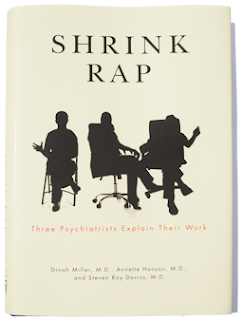 When Jesse read our Shrink Rap book, he said we were too nice to psychiatrists in it– that we didn’t mention that there are some really bad psychiatrists out there and he thinks part of the venom towards psychiatry comes from the whole rushed 15 minute med-check culture.
I thought about this and I thought, really? We have a whole chapter called When Things Go Wrong and we discuss a psychiatrist who is not sensitive enough to a patient (though, granted, the patient is overly demanding and overly sensitive–so I guess not the best portrayal of insensitivity by a shrink), one who is rigid in her formulation to the point of almost destroying a family, one who prescribes medication that makes a patient fat and diabetic, and finally, a psychiatrist who is outright unethical and criminal: who defies all boundaries and gives her patient prescriptions for narcotics to bring back to her! Like how much worse could I make the shrinks? As one Amazon reviewer said,
The authors are careful to include what might be called opposing views. They give some space to the anti-psychiatry movement, and they consider the recent cases of medications that seem to cause suicidal thinking in some patients. But they balance that against the suicidal thinking that is prevented in some other patients by the same medications. They also talk about the influence of drug companies in a fairly open way.
There are no heroes here. The authors aren’t in the business of justifying themselves, and one or two of the fictional therapists we see in the book do spectacularly bad jobs and harm patients.
But Jesse is right, overall the examples portray psychiatrists who are thoughtful and caring, Read more »
*This blog post was originally published at Shrink Rap*
July 3rd, 2011 by RyanDuBosar in Humor, Research
No Comments »

Laughter is the best medicine, and now, here’s the best medicine to treat laughter. Fainting from laughter happens, albeit rarely, and is probably a vasovagal response, reports a case series in the medical literature.
Dubbed “Sitcom Syncope,” the series of three patients and a literature review of other cases evaluated patients who reported loss of consciousness during vigorous laughter. The series was reported by Prashan H. Thiagarajah, MD, an ACP Associate Member at the Allegheny General Hospital in Pittsburgh, Pa., and colleagues in Postgraduate Medicine.
The three patients reported seven fainting spells induced by vigorous laughter that were witnessed friends or family.
All patients were hospitalized and underwent a complete history and physical, 12-lead echocardiogram, chest radiograph, routine blood analysis, transthoracic echocardiography, Holter monitoring, carotid duplex study, stress testing, polysomnography, and head-up tilt table testing. In each cases, structural heart disease and cerebrovascular disease were ruled out. Read more »
*This blog post was originally published at ACP Internist*
July 2nd, 2011 by John Di Saia, M.D. in Health Tips, Quackery Exposed
2 Comments »

I read online a woman telling about how her saline breast implants got mold and she had terrible problems. Does this happen very often?
A few years ago I put up a YouTube video of my experience with silicone gel breast implants. Now every six months to a year somebody posts a comment about how saline implants are just as dangerous. A frequent portion of that response is a statement about a moldy saline implant. My response is and always has been, if saline implants are so often affected by mold, then why have I never seen it?
I have been implanting (and at times removing) breast implants for over 15 years. You would think if something was a dangerous and common phenomenon that I would be seeing it. I haven’t. Not even once.
A saline implant when left on a table outside of your body can develop mold, but this doesn’t seem to happen inside patients. The difference is probably that when implants are properly placed inside a woman’s breasts, her immune system helps protect them from such problems. Read more »
*This blog post was originally published at Truth in Cosmetic Surgery*
July 2nd, 2011 by Glenn Laffel, M.D., Ph.D. in Health Policy
No Comments »

In the 1993 film Groundhog Day, Bill Murray plays a TV weatherman who finds himself trapped in a do-loop, covering the numbingly boring display of Punxutawney Phil, over and over again.
 Forgive those of us who follow news from the Department of Health and Human Services for feeling like Bill Murray in that movie.
Last month, HHS released an action plan to reduce racial disparities in health care. The plan called for new care models, more service delivery sites, a beefed-up health and human services workforce, and targeted efforts to reduce cardiovascular disease, childhood obesity and other scourges of minority populations.
Remarkably however, the plan came with no funding. Apparently, it was supposed to prompt agencies within HHS to assure that their own internal plans were aligned with the effort to reduce racial disparities. Worse yet, the plan involved only HHS itself. In effect, it assumed that a ‘medical model’ can solve racial disparities in health care. However as I argued here, these disparities aren’t about health, at all. They are about socioeconomic status, and HHS can’t fix that by itself.
Solving the problem of racial disparities in health care clearly requires input from many branches of government, including those involved with education, urban planning, transportation and more, in addition to HHS.
When it was all said and done, the HHS plan came off looking like a political stunt by the Obama administration. While the administration probably does want to fund a bona fide effort to reduce racial disparities, today’s incessant (and appropriate) focus on deficit reduction forced the administration to release a plan with no teeth. It isn’t going to make a dent in the problem. Read more »
*This blog post was originally published at Pizaazz*