March 9th, 2011 by LouiseHBatzPatientSafetyFoundation in Health Policy, True Stories
No Comments »

This is a guest post by Dr. Julia Hallisy.
Serious infections are becoming more prevalent and more virulent both in our hospitals and in our communities. The numbers are staggering: 1.7 million people will suffer from a hospital-acquired infections each year and almost 100,000 will die as a result.
When our late daughter, Kate, was diagnosed with an aggressive eye cancer in 1989 at five months of age, our life became consumed by doctor visits, MRI scans, radiation treatments, chemotherapy — and fear. My husband and I assumed that our fight was against the ravages of cancer, but almost eight years later we faced another life-threatening challenge we never counted on — a hospital-acquired infection. In 1997, Kate was infected with methicillin-resistant staphylococcus aureus (MRSA) in the operating room during a “routine” 30-minute biopsy procedure to confirm the reoccurrence of her cancer.
Kate’s hospital-acquired infection led to seven weeks in the pediatric intensive care unit on life support, the amputation of her right leg, kidney damage, and the loss of 70 percent of her lung capacity. While most infections are not this serious, the ones that are often lead to permanent loss of function and lifelong disabilities. In the years since Kate’s infection, resistant strains of the bacteria have emerged and now pose even more of a threat since they can be impossible to treat with our existing arsenal of antibiotics.
Patients afflicted with MRSA will often have to contend with the threat of recurrent infections for the rest of their lives. These patients live in constant fear of re-infection and often struggle with feelings of vulnerability and helplessness. Family members, friends, and co-workers may not fully understand the facts and have nowhere to turn for education about risks and prevention. Loved ones may worry unnecessarily for their own safety, which can cause them to distance themselves from someone who desperately needs their presence and support.
We have the knowledge and the ability to prevent a great number of these frightening infections, but the busy and fragmented system in which healthcare is delivered doesn’t encourage adequate infection control measures, and patients continue to be at risk. A significant part of the problem is that the public doesn’t receive timely and accurate information about the detection and prevention of MRSA and other dangerous organisms, and they aren’t engaged as “safety partners” in the quest to eliminate infections. Read more »
March 9th, 2011 by DrWes in Opinion, True Stories
No Comments »

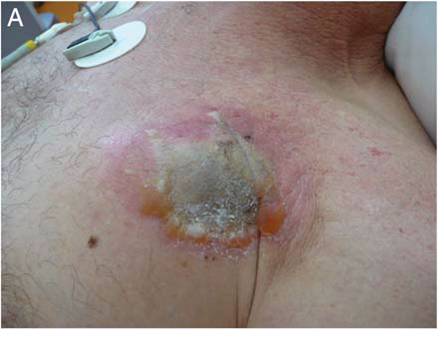
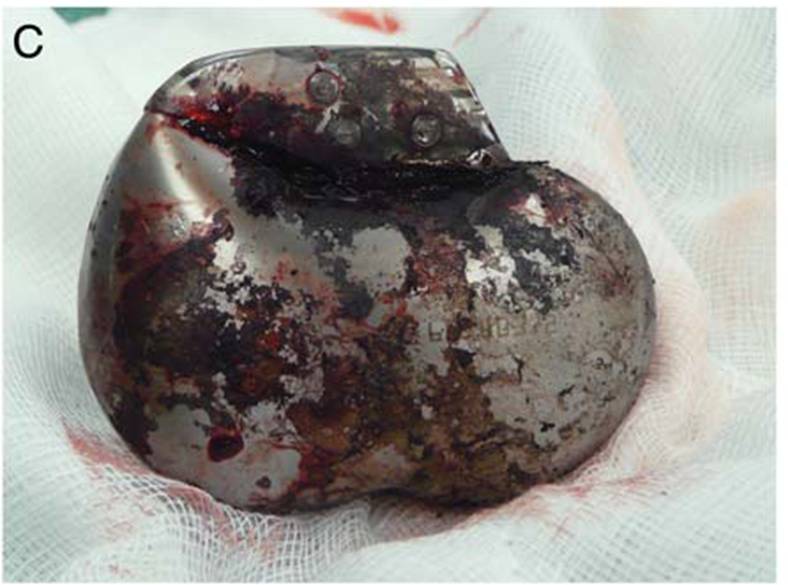
On September 27, 2010, the peer-reviewed scientific journal Europace published online-before-print a case report entitled “Spontaneous explosion of implantable cardioverter-defibrillator” by Martin Hudec and Gabriela Kaliska. In the pdf of that case report a figure containing a color photo of the affected patient’s chest, chest X-ray, and two pictures of the extracted device (one seen here) were included.
The pictures and case presentation were dramatic and the case very rare. Both were perfect reasons to report such an important case to the medical literature. And so these doctors sent the case to Europace on June 29, 2010, and the article was accepted after revision on August 16, 2010, with the article appearing online September 27, 2010.
The authors must have felt very proud to have an article published relatively quickly, and the editors and reviewers of Europace must have thought the case was unique enough and important enough to have the article revised according to their specifications, then published online — until I reported the case on this blog on October 5, 2010, and included images from a portion of the case report’s figure.
Remarkably, later that same day, Europace removed the case report from its website without comment. The article simply vanished. I attempted to e-mail the editor of Europace to inquire about the reason for the retraction but received no reply, so I contacted the lead author, Martin Hudec, M.D. He kindly responded and I included his email response in the comments to my post two days later. Read more »
*This blog post was originally published at Dr. Wes*
March 9th, 2011 by RamonaBatesMD in Opinion, Research
No Comments »

An outcomes article in the January 2011 issue of the Journal of Plastic and Reconstructive Surgery asks the question: “Are patients making high-quality decisions about breast reconstruction after mastectomy?”
The objective of the study was to “measure women’s knowledge about reconstruction and to evaluate the degree to which treatments reflected patients’ goals and preferences.” Their conclusion (bold emphasis is mine):
Women treated with mastectomy in this study were not well-informed about breast reconstruction. Treatments were associated with patients’ goals and concerns, however, and patients were highly involved in their decisions. Knowledge deficits suggest that breast cancer patients would benefit from interventions to support their decision making.
Granted the study was small, but it left me wondering if we the medical community fails to educate these women.
The study involved a cross-sectional survey of early-stage breast cancer survivors from four university medical centers. The survey included measures of knowledge about specific reconstruction facts, personal goals and concerns, and involvement in decision making. Only 84 patients participated (59 percent response rate). Participants answered only 37.9 percent of knowledge questions correctly. Read more »
*This blog post was originally published at Suture for a Living*
March 8th, 2011 by ErikDavis in Opinion, Quackery Exposed
1 Comment »
 This is a guest post from Erik Davis of Skeptic North.
**********
Bankers, Buyouts & Billionaires: Why Big Herba’s Research Deficit Isn’t About The Money
It’s a scene from the blogosphere that’s become all too familiar. A skeptic challenges a natural health product for the lack of an evidentiary base. A proponent of that product responds that the skeptic has made a logical error — an absence of evidence is not evidence of absence, and in such a scenario it’s not unreasonable to rely on patient reporting and traditional uses as a guide. The skeptic chimes back with a dissertation on the limits of anecdotal evidence and arguments from antiquity — especially when the corresponding pharma products have a data trail supporting their safety and efficacy. The proponent responds that it’s unfair to hold natural health products to the same evidentiary standard, because only pharma has the money to fund proper research, and they only do so for products they can patent. You can’t patent nature, so no research into natural health products gets done.
Okay, so maybe this isn’t a scene from an actual blog. The participants are way too civil, the arguments too coherent, and no one has been compared to Hitler. But it’s not a straw man either (look here, here, and here for recent examples), merely a distillation of an argument I’ve seen made repeatedly — that the deck has been stacked by Big Pharma, which has set a research bar that the much poorer natural health industry can’t possibly meet given the costs and lack of financial upside.
In my observation, skeptics don’t often have a good response to this argument beyond their basic scientific disposition toward only making assertions based on positive evidence. Typically, that’s not a disposition shared by the proponent, and thus they simply agree to disagree (read: trade barbs until the thread peters out from fatigue). Yet this need not be a purely philosophical debate. After all, there’s a testable premise embedded in this disagreement — that the natural health industry isn’t rich enough to sustain proper research. Is that true? Read more »
March 8th, 2011 by Medgadget in Better Health Network, Research
No Comments »

Duke University scientists have been successfully testing a new laser system they developed to identify cancerous skin moles. Two lasers in the system are used to identify the presence of eumelanin in biopsy slices and a future version of the device may work directly without having to sample the mole. According to an article in Science Translational Medicine, “the ratio of eumelanin to pheomelanin captured all investigated melanomas but excluded three-quarters of dysplastic nevi and all benign dermal nevi.” From the press release:
The tool probes skin cells using two lasers to pump small amounts of energy, less than that of a laser pointer, into a suspicious mole. Scientists analyze the way the energy redistributes in the skin cells to pinpoint the microscopic locations of different skin pigments.
The Duke team imaged 42 skin slices with the new tool. The images show that melanomas tend to have more eumelanin, a kind of skin pigment, than healthy tissue. Using the amount of eumelanin as a diagnostic criterion, the team used the tool to correctly identify all eleven melanoma samples in the study.
The technique will be further tested using thousands of archived skin slices. Studying old samples will verify whether the new technique can identify changes in moles that eventually did become cancerous.

Malignant melanoma under the new laser light. Clear deposits of eumelanin (red) appear in unhealthy tissue.
Press release: Lasers ID Deadly Skin Cancer Better than Doctors …
Abstract in Science Translational Medicine: Pump-Probe Imaging Differentiates Melanoma from Melanocytic Nevi
Flashback: Diagnosing Skin Cancers with Light, Not Scalpels
*This blog post was originally published at Medgadget*