February 6th, 2011 by DrWes in Better Health Network, Opinion
No Comments »

 Heart disease and February: What relationship could be more cozy? From the scary risks of shoveling snow (yep, you could die, so be sure to lift a little at a time), Mercedes-sponsored red dress parades and government-sponsored National Wear Red Day®, to tips for identifying heart attacks in women (men, you need a different month I guess), February has all the important stories to improve your awareness. Such a polite term “awareness.”
But I wonder, now that the Internet is upon us and people are seeing their insurance rates and co-pays skyrocket, if maybe we’re shooting ourselves in the foot with all this heart-month marketing hype. People are sick and tired of testing “just to be sure.” It’s starting to directly cost them a fortune, and people are frustrated at having to pay a fortune for healthcare, let alone heart care.
I know, I know — I should be at the forefront of working with patients to stomp out heart disease. And goodness, people DO need to be attuned to diet, exercise, and weight loss. But the reality is, if we’re giving you the 10 latest tips on how to detect a heart attack, we’re probably a bit too late.
That’s the problem with all these press releases: While there’s a need to raise “awareness” of heart health, there’s also a very real need for people to take us — heart disease professionals — seriously to help cut costs in healthcare here. The last thing our healthcare system needs is more frivolous testing. Yet this is exactly what all this marketing does for our healthcare system — and it helps those with the largest PR budgets most of all. Read more »
*This blog post was originally published at Dr. Wes*
February 6th, 2011 by Dinah Miller, M.D. in Health Tips, Humor
No Comments »


 So it’s Super Bowl Sunday and the fans are psychiatric patients waiting to happen — the beer and the beer and the beer, and maybe the fights will break out, and they’ll all end up in therapy. Oh, the angst and the panic, and the pre-game anxiety, and the post-game euphoria or depression.
New York Times reporter Benedict Carey talks about treatment options in his article, “A Home Treatment Kit for Super Bowl Suffering.” Mr. Carey suggests:
Breathing exercises are highly recommended and become increasingly important as the football contest nears the fourth quarter, when events on the field are likely to prompt strong physiological reactions, like a pounding heart, hyperventilation, even dizziness. These internal cues, as they’re called, can escalate the feeling of panic, a self-reinforcing cycle resulting in groans and cries that can be frightening to small children, pets and sometimes neighbors.
In the final minutes of the game, be forewarned: Many patients will move beyond the reach of therapy. Their faces may change, their breathing appear to stop. Researchers have not determined whether this state is closer to Buddhist meditation or to the experience of freefall from an airplane. All that is known is that, once in it, patients will fall back on primal coping methods, behaviors learned in childhood within the cultural context of their family.
Like emitting screams. Or leaping in an animated way, as if the floor were on fire. Or falling on their back and moving their arms and legs like an overturned beetle, in celebratory fashion.
This post is dedicated to my husband and son.
*This blog post was originally published at Shrink Rap*
February 6th, 2011 by RyanDuBosar in Better Health Network, Research
No Comments »

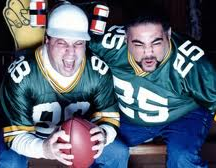 Sports fans may literally live and die on their team’s victories, according to researchers who examined cardiac mortality rates after the home team won and lost the Super Bowl.
Total and cardiac mortality rates in Los Angeles County increased after the football team’s 1980 Super Bowl loss but overall mortality fell after the 1984 the team’s Super Bowl win, researchers concluded from a review of death certificates reported in Clinical Cardiology.
First, authors gave a clinical review. Stress causes a cardiac cascade. The sympathetic nervous system increases and releases catecholamines. This triggers a rise in heart rate and blood pressure, and ventricular contractility increases oxygen demand, causing blood the sheer against and fracture atherosclerotic plaque, the authors explained. Stimulation of alpha receptors in the vasculature further constrict coronary vessels, increasing oxygen demand while limiting oxygen supply to the heart.
Next, they gave a sporting review. Los Angeles has played twice in the Super Bowl, the first time losing to the Pittsburgh Steelers (who play in this Sunday’s Super Bowl, incidentally) in 1980. The Los Angeles Rams, as they were known then, were a long-time hometown team and played the game in nearby Pasadena, Calif. “This game was high intensity,” wrote the authors, “with seven lead changes before Los Angeles lost a fourth-quarter lead and the game.”
Later, a new football franchise arrived in town, the Los Angeles Raiders. In 1984 the Los Angeles Raiders traveled to Tampa, Fla. to beat the Washington Redskins in a more mundane affair.
Now, the review of findings. Researchers combed death certificates based on age, race and sex to compare mortality rates for Super Bowl-related days with non-Super Bowl days and created regression models predicting daily death rates per 100,000. Read more »
*This blog post was originally published at ACP Internist*
February 6th, 2011 by Linda Burke-Galloway, M.D. in Health Policy, Opinion
2 Comments »

 When our country starts closing obstetrical units in hospitals because they “cost too much” money to operate, pregnant women need to pay attention because their babies are in serious trouble. Such was the case of the most recent casualty, South Seminole Hospital, a 200-bed hospital, that’s located within 30 minutes of my neighborhood.
More than 20,000 babies were born in South Seminole Hospital during the past 18 years, and many of the babies were delivered by a local obstetrician who died approximately three years ago. I recall sitting in the emergency room of the hospital with a fractured ankle and listening to a chime that used to ring every time a baby was born. It was a soothing and humbling sound knowing that a new life was making its grand entrance each time that chime rang. Now, it will be replaced with silence.
Unfortunately, this phenomenon is not unique to Florida. In 1997 the closing of a North Philadelphia hospital (Northeastern) affected six additional hospitals in the community and their 23,570 annual births. In my hometown of Brooklyn, New York, Long Island Hospital had an annual delivery rate of 2,800 babies, but still closed its doors to the community and sold the hospital as prime real estate to the highest bidder, citing low reimbursement rates and high premiums for malpractice insurance as the culprit behind the decision. The Bedford Stuyvesant community of Brooklyn lost St. Mary’s Hospital, a delivery center of thousands of babies in 2005. Read more »
*This blog post was originally published at Dr. Linda Burke-Galloway*
February 5th, 2011 by KevinMD in Opinion, Research
No Comments »

Female doctors make less than male physicians. That conclusion gained major media traction recently. A recent post on KevinMD.com by medical student Emily Lu had some great conversation discussing reasons why women make less money in medicine.
To recap, the study from Health Affairs concluded that,
newly-trained physicians who are women are being paid significantly lower salaries than their male counterparts according to a new study. The authors identify an unexplained gender gap in starting salaries for physicians that has been growing steadily since 1999, increasing from a difference of $3,600 in 1999 to $16,819 in 2008. This gap exists even after accounting for gender differences in determinants of salary including medical specialty, hours worked, and practice type, say the authors.
Everyone hypothesized all sorts of reasons. Female doctors prefer more family-friendly hours and less call, which may impact their salary. Women are simply worse negotiators than men. Blatant sexism exists when hiring new physicians. Money isn’t as important to women as it is to men. All of which may, or may not, be true. Read more »
*This blog post was originally published at KevinMD.com*