November 2nd, 2010 by DrRob in Better Health Network, Health Policy, News, Opinion
1 Comment »

The top vote-getting answer on my poll about what people feel about the election: Different lunatics, same asylum. We are getting jaded by our system. Being the “flaming moderate” that I am, I find it hard to hear the substance of the rhetoric on either side, just the shrillness and rancor of the voices.
From the physician’s perspective, it is very hard to know who to favor in this election. The democrats seem to love lawyers and hate tort reform, and they also favor an expansion of government. The republicans love big businesses and “free market,” accepting the bad behavior of insurance and drug companies as “the market working itself out.” They both seem hell-bent on sticking it to the other party at the expense of getting anything done — and this in a time of crisis for our industry.
The results of this playground brawl between the two gangs of bullies is that all of us wimpy kids (the ones without power) end up lying bloody in the dirt. Here are the facts as I see them about healthcare in our country:
1. It costs far too much. The top item on the agenda needs to be cost control. The only way to control cost is to stop paying for things that are unnecessary or for which there is a cheaper alternative. I know that’s not simple as it sounds, but so much of the discussion is about coverage and how things are paid, while the real issue is not who pays, it’s what and how much gets paid. Read more »
*This blog post was originally published at Musings of a Distractible Mind*
November 2nd, 2010 by JenniferKearneyStrouse in Better Health Network, Health Policy, News
No Comments »

All eyes are on today’s mid-term elections and how they’ll play out across the country. The results are likely to affect the recently enacted healthcare reform legislation, Politico reports. Although repealing the legislation would be difficult, Republicans may be able to challenge its implementation if they gain control of the House. Attempts to modify the law could require a delicate balance since, as noted by the Washington Post‘s Ezra Klein, some of its provisions, such as coverage for dependents age 26 and younger, are individually popular.
Reuters has published a Q&A on what the election results could mean for the healthcare reform law. The Wall Street Journal is asking readers to weigh in on whether the legislation is affecting their votes. (Politico, Washington Post, Reuters, Wall Street Journal)
*This blog post was originally published at ACP Internist*
November 2nd, 2010 by Dr. Val Jones in Health Tips, Video
7 Comments »
The Internet has revolutionized how we receive information – and it’s also changing how we learn about and manage our health. A new “ePatient” movement promises to empower patients with online and mobile tools – making it easier than ever to contact a physician, track health variables, and join a support group.
Four minutes isn’t much time to summarize an entire movement, and I think I got a little off topic while suggesting a new use case for David Hale’s NIH PillBox (a pill identifier tool). I said it could be used to identify pills even after your pet licked part of the label off them!
httpv://www.youtube.com/watch?v=pVcm-Xzc0Sc
For more information about ePatients, check out my earlier blog post.
November 2nd, 2010 by admin in Health Policy, Humor, Opinion, True Stories
No Comments »
This is a guest post from Carolyn Thomas:
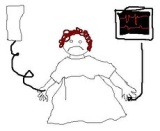 An Open Letter To All Hospital Staff
Dear hospital employees,
After a particularly bizarre experience undergoing a treadmill stress echocardiogram at your hospital recently, I decided to do something that I have never done before: I called the manager of the cardiology department to complain about her staff. (Incidentally, a recent opinion survey of international tourists found that Canadians were #1 in only one category: “Least likely to complain when things go wrong” — so you can appreciate that lodging an official complaint is a fairly big deal here!)
In my best PR fashion, I told the manager how distressing the appointment had been because of the behaviour of the two cardiac technicians in the room. It’s not so much that they were openly rude, but it was their insufferable lack of people skills that had pushed me over the edge. No introductions, no eye contact, no consideration of how awkward this test can be, no explanation of the test procedures or even the flimsiest effort at polite conversation. To them, I was merely the 1:00 o’clock appointment, the obstacle between them and their next coffee break, just a piece of meat on a slab — but worse, an invisible piece of meat. Read more »
November 2nd, 2010 by John Mandrola, M.D. in Better Health Network, Health Policy, Humor, Opinion
No Comments »

Have you ever thought: “What if I won an election and was put in charge of an administration?”
Halloween weekend seemed the perfect time for considering the fantasy (or some would argue the horror) of a DrJohnM administration. (Let it be known, I have some leadership experience: I lead local group rides with some success. A community organizer of sorts.) But for the sake of college-like dreaming, let’s consider government under my realm.
First off, clearly the present-day political costumes would have to change. There would be a ban on suits, ties (MRSA-spreading), and uncomfortable shoes. People think better if they are dressed in comfy clothes. It works for Google.
Of course, since I am a practicing doctor, a focus of my administration would be on healthcare reform. And like our current president, I would also have “expert” panels — only my “fix healthcare” panel would look very different. To illustrate these phenotypical differences, let’s consider some of my panel’s inclusion and exclusion criteria.
Panel exclusions:
Anyone with a 4.0 GPA. You are out. Sorry, there are plenty of other think tanks for you, in pretty cool places too, like Cambridge, Ann Arbor, and Palo Alto. A very wise retired urologist once told me that B students nearly always make better doctors, and surely those who tried other things in life (besides the classroom) will make better real-life decisions. Read more »
*This blog post was originally published at Dr John M*