Better Health: Smart Health Commentary Better Health (TM): smart health commentary

Latest Posts

Doctors And Their Smartphones

An eye-popping statistic shows that 94 percent of doctors have adopted smartphones, in part to keep up with an information glut. A consulting group released results of 100 in-depth interviews with physicians working in acute and ambulatory care environments in numerous specialties nationwide. The physicians used the phones to communicate, manage personal/business workflows, and access information, including medical reference materials. (In case you’re curious about what your peers are using, 44 percent use an iPhone and 25 percent use a BlackBerry.)

This growth in adoption — a 60 percent increase since 2006 — isn’t surprising, since the same survey reported that doctors’ biggest challenges are communicating with colleagues in a timely manner, the volume of communications with patients and the entire care team, and the different platforms (e-mail, voice mail, pager, etc.) needed to keep up with it all.

But one early adopter, Dr. Rob Lamberts, ACP member, cautions that while the new technology can help, it isn’t yet.

*This blog post was originally published at ACP Internist*

Healthcare Reform Will Keep Medicare Afloat

One of the more effective criticisms of the health reform law (Affordable Care Act, or ACA) is that it hurts Medicare. It also is wrong.

Effective, in that it has been widely reported that seniors are more likely to express negative views of the ACA than other age groups. (Although the Kaiser Family Foundation’s Drew Altman, citing the group’s most recent tracking polls, writes that seniors’ opposition to health reform “is at least somewhat over played.”)

Effective, but wrong: The ACA actually helps Medicare in three important ways. Read more »

*This blog post was originally published at The ACP Advocate Blog by Bob Doherty*

What A ‘68 Chevy Impala Can Tell Us About Primary Care

When I was a much younger man I had a 1968 Chevy Impala. I loved its V-8 engine and spaciousness, but I paid a steep price for it. It consumed gas like a drunk on a binge. It was prone to breakdowns, usually in the left lane of a busy highway. Even as it consumed my limited financial resources, I couldn’t count on it to reliably get me to where I wanted to be. Yet I held onto it. One day, though, its transmission gave out, and I finally had to resign myself to buying a new, more reliable, more modern, and efficient vehicle. Yet to this day, I miss my clunker.

I am reminded of this when I think about the state of primary care today. Many of us are attached to a traditional primary care model that may no longer be economically viable — for physicians, for patients, and for purchasers.

We hold onto a model where primary care doctors are paid based on the volume of visits, not the quality and value of care rendered. We hold onto a model where patient records are maintained in paper charts in voluminous file folders, instead of digitalizing and connecting patient records. We hold onto a model that generates enormous overhead costs for struggling physician-owners but generates insufficient revenue. We hold onto a model that most young doctors won’t buy, as they pursue more financially viable specialties and practices. Read more »

*This blog post was originally published at The ACP Advocate Blog by Bob Doherty*

Public Service: Does Having An Opinion Disqualify You?

Many conservatives are up-in-arms about President Obama’s decision to appoint Don Berwick, a pediatrician and renowned expert in quality improvement and patient safety, to lead the Center for Medicare and Medicaid Services (CMS). They object to Dr. Berwick’s views on a range of issues, and to Obama’s decision to use his office’s authority to appoint Dr. Berwick while the Senate was out on a short Independence Day holiday recess. As a “recess appointment,” Dr. Berwick was able to take office without Senate hearings and confirmation, but he can only serve through the end of the 111th Congress — that is, until the end of 2011 — unless ratified by the Senate.

Berwick, though, also has many supporters. Maggie Mahar articulates the “pro” viewpoint on Dr. Berwick’s appointment in a recent Health Beat post. She observes that two former CMS administrators who served in Republican administrations have commented positively about Dr. Berwick’s qualifications. Read more »

*This blog post was originally published at The ACP Advocate Blog by Bob Doherty*

“Meaningful Use”: Does What You Do Qualify?

One doesn’t usually look to the Federal Register to define meaning or purpose (philosophers, yes, but bureaucrats?), but the federal government has officially ruled on what constitutes “meaningful use” — for the purposes of distributing dollars to clinicians for electronic health records.

The Wall Street Journal’s health blog has an excellent synopsis of the rule and the reaction from different interest groups and experts, and the New England Journal of Medicine has a very clear explanation and summary of its key elements by David Blumenthal, M.D., F.A.C.P., the federal government’s coordinator of health information technology. Read more »

*This blog post was originally published at The ACP Advocate Blog by Bob Doherty*

“Social Mission”: A Primary Care Score For Medical Schools

Medical schools are traditionally ranked on criteria like research funding and technological innovation. These rankings are highly significant. A place on the U.S. News‘ annual “Best Medical School” list  is a coveted spot indeed.

So that’s why there was some media attention paid to a recent study from the Annals of Internal Medicine, which ranked medical schools according to their “social mission” — a phrase that defines a school’s commitment to primary care, underserved populations and workforce diversity. Using this new criterion, some of the traditionally high ranking schools fell significantly. Read more »

*This blog post was originally published at KevinMD.com*

“Whoop-De-Do!” To The Medicare Physician Pay Cut Problem

After months of dithering, delaying, denying, and defaulting on a decision, Congress ended up…doing as little as possible to address the Medicare physician pay cut problem.

Thursday night the House of Representatives acceded to the Senate’s bill to provide physicians with a 2.2 percent update retroactive to June 1. This respite, though, lasts only through the end of November, when physicians and patients will again face another double-digit cut. And if the past is prologue, a lame-duck Congress then will wait until the very last minute to enact another short-term patch, or worse yet, allow the cut to go into effect on December 1 and then pass some kind of retroactive adjustment.

You know that the situation has gotten ridiculously bad when the President says this about the bill he just signed into law:

“Kicking these cuts down the road just isn’t an adequate solution.”

And when Speaker Pelosi (D-CA) calls it “inadequate” and a “great disappointment” and the best that any had to say about it was this from SFC ranking member Charles Grassley (R-IA):

“This action was critically needed so there’s no disruption in services for anyone.”

But it’s too late. Read more »

*This blog post was originally published at The ACP Advocate Blog by Bob Doherty*

Medical Schools: Why Do Some Do Primary Care Better?

A new study published in the Annals of Internal Medicine, ACP’s flagship journal, finds that medical schools vary greatly in producing more primary care physicians and getting them into underserved communities.

- “Public schools graduate higher proportions of primary care physicians” than private schools.

- “The 3 historically black colleges and universities with medical schools (Morehouse College, Meharry Medical College, and Howard University) score at the top” in training primary care physicians who then go on to practice in underserved communities. (Click here for an interview with two recent graduates of historically black colleges and with Wayne Riley, MD, FACP, who is the president and CEO of Meharry Medical College in Nashville, Tennessee and a regent of the American College of Physicians.)

- “The level of NIH support that medical schools received was inversely associated with their output of primary care physicians and physicians practicing in underserved areas.” Read more »

*This blog post was originally published at The ACP Advocate Blog by Bob Doherty*

Healthcare Reform: Digging Out Of The SGR Hole

Friday, the Senate — in a rare stroke of bipartisanship — voted by unanimous consent to reverse the 21 percent SGR cut and provide positive updates of 2.2 percent through November 2010. The legislation is fully paid for by offsets in other spending programs.

Unfortunately, though, the cut remains in effect and claims are being processed at reduced rates, because the House of Representatives has recessed for the weekend and won’t be back until Tuesday. At that time, I expect that the House will pass the Senate’s six-month reprieve and Medicare will make doctors “whole” for the period of time that the cut was in effect.

Not that any of this is a cause for celebration. In the meantime, claims still are being paid at reduced rates, creating havoc for physicians and patients. Kicking the can down the road for another six months doesn’t get us any closer to a permanent solution. It doesn’t lower the overall cost, now estimated at over $200 billion, to dig out of the SGR hole. It doesn’t provide the stability and reliability that physicians and patients need to view Medicare as a trusted partner. It does mean that we will be back again, this summer and fall, fighting to forestall another double-digit cut. Read more »

*This blog post was originally published at The ACP Advocate Blog by Bob Doherty*

Doc Fix Blamed On Doctors

The American Medical Association will launch a multi-million-dollar ad campaign tomorrow to heighten pressure on Congress for a doc-fix bill. The American College of Physicians (ACP) reacted by calling for doctors to contact their member of Congress directly to let their voices be heard. Robert Centor, FACP, called for doctors to protest as well. (American Medical Association, American College of Physicians, DB’s Rants)

Meanwhile, a Florida medical society predicts a crisis in that senior-laden state. The society cited but did not name eight primary care doctors who’ve stopped accepting Medicare patients this year, and 12 cardiologists who left private practice for employment elsewhere because of already reduced payments. Unbelievably, business columnist Steven Pearlstein sorted through the issues around the doc fix, and concluded that it’s the docs that need fixing for paying themselves generous salaries. (Naples News, The Washington Post) Read more »

*This blog post was originally published at ACP Internist*

Latest Interviews

Health Tips For Back-To-School

I was lucky enough to be asked by one of the local TV stations to talk about some back-to-school issues when it comes to health. I don t know about where you re at but most of the local schools around here started yesterday August rd Keeping up-to-date on immunizations…

Read more »

“Medical Self-Care” And The Doc Tom Interview

Next in our series of posts about our founder Doc Tom. Previous time capsules and Come ye economics buffs and algebra fans Get out your pencils and solve for x n and XX Whatever else the year XX is remembered for it will without a doubt go down in history…

Read more »

See all interviews »

Latest Cartoon

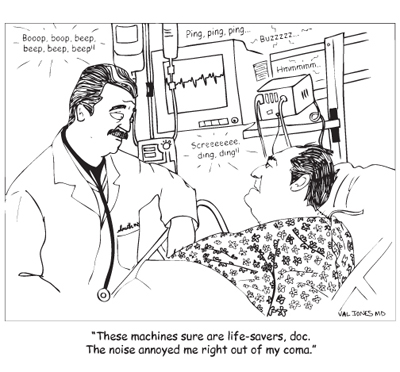
cardiaccath

Here’s a cartoon I created a few years back. Enjoy!

- Dr. Val

*This blog post was originally published at Science-Based Medicine*

See all cartoons »

Latest Book Reviews

A Biomedical Look At Spaceflight

Book review by Dan Buckland Dan Buckland is an editor at Medgadget and an MD PhD student at Harvard Med MIT whose thesis deals with diagnosing back injury in spaceflight using ultrasound. Mary Roach author of previous entertaining books Bonk a history of sex research and Stiff a history of…

Read more »

UTI and “Eat, Pray, Love”

I really didn t expect to like Eat Pray Love. In fact since its publication in I’d been avoiding it like the plague. Typical new-agey Oprah-y girly-book I thought. Nothing in it to speak to me. Then I saw the trailer for the movie and I was hooked probably because…

Read more »

Will Science Succeed With An Anti-Aging Revolution?

Wouldn’t it be great if we could find a way to prolong our lives and to keep us healthy right up to the end Ponce de León never found that Fountain of Youth but science is still looking. What are the chances science will succeed How’s it doing so far…

Read more »

See all book reviews »