June 12th, 2017 by Dr. Val Jones in Health Policy, Uncategorized
No Comments »
 Medical school prepares physicians to prescribe medications for prevention and treatment of disease, but little to no time is spent teaching something just as important: de-prescribing. In our current system of auto-refills, e-prescriptions, and mindless “check box” EMR medication reconciliation, patients may continue taking medications years after their original prescriber intended them to stop. There is no doubt that many Americans are over-medicated, and the problem compounds itself as we age. Although “no-no” lists for Seniors (a tip of the hat to the American Geriatrics Society “Beers List”) have been published and promoted, many elderly Americans are prescribed medicines known to be of likely harm to them.
You may be surprised to learn that one medical specialty has taken advanced steps to address this problem. Physiatry (also known as Physical Medicine and Rehabilitation or PM&R) is a national leader in pain management education, and is the author and promoter of the majority of continued medical education (CME) courses on reducing opioid prescribing in favor of alternative pain management strategies. But did you also know that most patients who are admitted to an inpatient rehabilitation facility (IRF) are tested on their capability to correctly administer their own medications before they are discharged home?
The MedBox test provides a validated cognitive performance assessment of whether or not an individual can correctly distribute multiple prescription medications into weekly pill boxes as directed on the containers. This is a short video of how the test works, demonstrated by some occupational therapists having a good time with it. In one fell swoop, this test checks vision, reading comprehension, pharmaceutical knowledge, manual dexterity, attention, and short term memory.
This test is very helpful in picking up potential misunderstandings in how prescription meds are to be taken, and identifying cognitive deficits that might preclude accurate self-administration of prescription meds at home. One of our main goals in rehab is to make sure that patients have the skills, assistance, and equipment necessary to thrive at home, so that they can remain hospital-free for as long as possible. To that end, we feel strongly that limiting medications to those only truly necessary, as well as making sure that patients can demonstrate safe-use of their medications (or have a caregiver who can do this for them), can reduce hospital readmission rates, falls, unwanted drug side-effects and accidental drug-drug interactions.
In addition to MedBox testing, physiatrists invite hospital pharmacists to join their weekly patient team conferences. While we discuss patient progress in physical, occupational, and speech therapies, we also review nursing assessments of medication self-administration competency, and ask our pharmacist(s) which medications can potentially be stopped or decreased that week. Rehab physicians (familiar with patient health status, goals, and current complaints) and pharmacists together come up with stop dates and taper regimens at these weekly meetings.
Part of the reason why inpatient rehabilitation has been so successful at reducing hospital readmission rates, in my view, is that we are committed to pharmaceutical whack-a-mole. “Test-driving” patient competency at medication self-administration, in the setting of responsible de-prescribing in a monitored clinical environment, is a highly valuable (though sadly under-reported) benefit of rehabilitation medicine. I hope that my medical and surgical peers will join us physiatrists in combating some of the patient harms that are passively occurring in our healthcare system designed to add, but not subtract, diagnoses and treatments.
August 15th, 2013 by Dr. Val Jones in Health Policy, Opinion
No Comments »
 As I travel around the country, working in the trenches of various hospitals, I’ve been struck by the number of errors made by physicians and nurses whose administrative burden distracts them from patient care. The clinicians who make the errors are intelligent and competent – and they feel badly when an error is made. However, the volume of tasks required of them in a day (many of which are designed to fulfill an administrative “patient safety” or “quality enhancement” process) makes it impossible for them to complete any task in a comprehensive and thoughtful manner. In the end, administrators’ responses to increased error frequency is to increase error tracking and demand further documentation that leads to less time with patients and more errors overall. It’s a vicious cycle that people aren’t talking about enough.
As I receive patient admissions from various referral hospitals, I rarely find a comprehensive discharge summary or full history and physical exam document that provides an accurate and complete account of the patient’s health status. Most of the documentation is poorly synthesized, scattered throughout reams of EMR-generated duplicative and irrelevant minutiae. Interpreting and sifting through this electronic data adds hours to my work day. Most physicians don’t bother to sift – which is why important information is missed in the mad dash to treat more patients per day than can be done safely and thoroughly.
I have personally witnessed many critical misdiagnoses caused by sloppy and rushed medical evaluations. I have had to transfer patients back to their originating surgical hospitals (at some of America’s top academic centers) for further work up and treatment, and have uncovered everything from cancer to brain disorders to medication errors for patients who had been evaluated and treated by many other specialists before me. No one seems to have the time to take a long hard look at these patients, and so they end up undergoing knee-jerk treatments for partially thought through diagnoses. The quality of medical care in which I’ve been engaged (over the past 20 years) has taken a dramatic turn for the worse because of volume overload (fueled by diminishing reimbursement) in the setting of excessive administrative and documentation requirements.
To use an analogy – The solution to the healthcare cost crisis is not to increase the speed of the assembly line belt when our physicians and nurses are already dropping items on the floor. First, stop asking them to step away from the belt to do other things. Second, put a cap on belt speed. Third, insure that you have sufficient staff to handle the volume of “product” on the belt, and support them with post-belt packaging and procedures that will prevent back up.
What we require most in healthcare is time to process our thoughts and engage in information synthesis. We must give physicians the time they need to complete a full, comprehensive, evaluation of each patient at regular intervals. We need nurses to be freed from desk clerk and safety documentation activities to actually inspect and manage their patients and alert physicians to new information.
Until hospitals and administrators recognize that more data does not result in better care, and that intelligent information synthesis (which requires clinician time, not computer algorithms) is the foundation of error prevention, I do not foresee a bright future for patients in this manic assembly line of a healthcare system.
November 30th, 2012 by Dr. Val Jones in Book Reviews
No Comments »
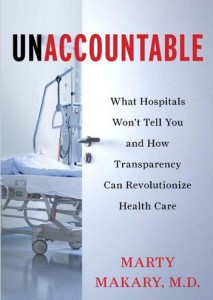 I met Dr. Marty Makary over lunch at Founding Farmers restaurant in DC about three years ago. We had an animated conversation about hospital safety, the potential contribution of checklists to reducing medical errors, and his upcoming book about the need for more transparency in the healthcare system. Marty was well dressed and soft spoken – sincere, and human. We exchanged business cards and wished each other luck in changing the healthcare system for the better. We were two doctors tilting at windmills.
Just two months ago my fiancé sent me a “must read” article from the Wall Street Journal. It was Marty’s provocative piece, “How To Stop Hospitals From Killing Us.” The article was an excellent primer for his book, “Unaccountable: What Hospitals Won’t Tell You And How Transparency Can Revolutionize Health Care” which I highly recommend (holiday gifts, anyone?)
Unaccountable is both horrifying and oddly optimistic. Marty describes case after case of medical errors, lapses in judgment, and near misses in the surgical suite. He exposes the cultural foibles of the medical and hospital hierarchy, leaving no dirty stone unturned. Surgical delinquents such as Dr. Hodad (“hands-of-death-and-destruction”) are presented with detached accuracy, along with a clear list of reasons why the system fails to prevent the Hodads of the world from operating.
From the micro (individual physician mistakes) to the macro (trends in hospital safety breakdowns), Marty turns to survey data to make sense of the shortcomings. Interestingly, hospital “culture” (rated by its own employees) is the most predictive of overall hospital safety performance. Detailed record keeping of surgical complication rates correlates strongly with how employees rate their hospital on three simple questions:
1. Would you have your operation at the hospital in which you work?
2. Do you feel comfortable speaking up when you have a safety concern?
3. Does the teamwork here promote doing what’s right for the patient?
Marty’s conclusion that culture is the defining factor in patient safety and satisfaction ratings is both accurate and squishy. It’s difficult to create a reproducible template for a healthy work culture, and yet good culture is the basis for the success of hospitals such as the Mayo Clinic. Individual hospitals, like individual surgeons, have different personalities and temperaments. Raising them to be upstanding citizens involves a combination of good parenting and good luck.
Because I think Marty is absolutely right about culture as the foundation for safe and effective care, I think he’s also overly optimistic about the potential success of strategies to reproduce caring hospital cultures. By his own admission, not even the Mayo Clinic “mother ship” in Rochester, MN, has been able to create the exact level of quality care in its sister hospitals in Scottsdale, AZ, and Jacksonville, FL. So how can we dramatically improve patient care on a national level? Marty suggests that we need to find ways to force hospitals to become more transparent in order to revolutionize healthcare. His ideas include:
1. Mandatory hospital public reporting of patient re-admissions, complication rates, and never events.
2. Adoption of check lists by surgical teams to reduce errors.
3. Installation of video cameras throughout hospital floors and surgical suites so that staff behaviors can be monitored more effectively (e.g. to enforce hand washing or identify surgeons who have high error rates).
4. Accessible and transferable medical records that put patients at the center of their documentation.
While these ideas have merit, I believe they will fall short of achieving our ultimate goals. In my view, a culture of accountability is not the same as a culture of caring. Adopting certain “Big Brother” (cf. #3 above) strategies to pressure staff to behave/perform appropriately is only going to force the Hodads underground. We need staff to genuinely care enough about their patients to gang up on the Hodads and kick them out of the hospital for good. Caring doesn’t happen at a national level, it is personal and local. That’s why individual hospitals must develop their unique cultures for themselves, with progress measured by responses to those staff questions about whether or not they’d want to be cared for at their own institution.
I agree with Marty that hospital data transparency might be the best antiseptic we have to scrub the underbelly of medicine, though the ultimate success of our procedures will always be culture and surgeon-dependent. And that’s something you can’t regulate from Washington.
***
Marty’s book is available for purchase at Amazon.com.
Check out your local hospital safety scores from LeapFrogGroup.
December 31st, 2011 by Linda Burke-Galloway, M.D. in News
No Comments »

 It’s an obstetrician’s worst nightmare and it continues to happen on a daily basis. The story of Michal Lura Friedman brings tears to my eyes. After 7 years of trying, the 44 year old songwriter finally became pregnant –with twins. Her husband, Jay Snyder, a free-lance voice-over artist, describes the 9 months of Friedman’s pregnancy as pure bliss. However towards the end, her blood pressure became elevated so she was scheduled to have a C. Section the day after Thanksgiving.
Snyder accompanied his wife to the hospital and witnessed the birth of his babies. Then Friedman began to bleed. And bleed. And bleed. At 9:30 p.m., she became yet another U.S. maternal mortality statistic.
At least 2 women die from complications of childbirth in the US daily. Some celebrities such as Christy Turlington Burns have become a Maternal Health Advocate as a result of first-hand experience. She Read more »
*This blog post was originally published at Dr. Linda Burke-Galloway*
December 28th, 2011 by RyanDuBosar in Research
No Comments »

The vast majority of U.S. physicians are moderately to severely stressed or burned out on an average day, with moderate to dramatic increases in the past three years, according to a survey.
Almost 87% of all respondents reported being moderately to severely stressed and/or burned out on an average day using a 10-point Likert scale, and 37.7% specifying severe stress and/or burnout.
Almost 63% of respondents said they were more stressed and/or burned out than three years ago, using a 5-point Likert scale, compared with just 37.1% who reported feeling the same level of stress. The largest number of respondents (34.3%) identified themselves as “much more stressed” than they were three years ago.
The survey of physicians conducted by Physician Wellness Services, a company specializing in employee assistance and intervention services, and Cejka Search, a recruitment firm, was conducted across the U.S., and across all specialties, in September 2011. Respondents Read more »
*This blog post was originally published at ACP Hospitalist*















